
Ukraine is moving directed-energy weapons from theory to the battlefield. Its new Tryzub laser air-defense system, developed during full-scale war and unveiled by the Unmanned Systems Forces under Commander Vadym Sukharevskyi, makes the country one of only a handful worldwide with an operational laser-based system designed to destroy or disable incoming aerial threats.
Cut-Price Defense For A Drone-Saturated Battlefield
Tryzub is built around commercial off-the-shelf industrial welding lasers combined with precision optoelectronic targeting tools. The system is designed to strike or blind small aerial targets such as drones, glide bombs, cruise missiles, and some ballistic threats. Its destructive engagement range is reported at up to 3,000 meters, while its ability to dazzle or blind sensors extends to around 10,000 meters, giving it a wide protective envelope around key sites.
The primary mission is to shield cities, infrastructure, and front-line logistics hubs from a sustained barrage of Iranian-designed Shahed-136/Geran-2 loitering munitions, which have been used against Ukraine in volumes of roughly 1,000–2,000 per month. Against this backdrop, a system that can fire repeatedly without expensive missiles offers clear appeal. Instead of replacing conventional air defense, Tryzub is intended to sit alongside guns, missiles, and electronic warfare, adding an additional layer specifically optimized for cheap, massed drone attacks.
The standout feature is cost. Each laser shot is estimated at about $13, largely reflecting electricity and routine maintenance, compared with roughly $100,000 to $3 million for a single interceptor missile. That represents a claimed 90–95% reduction in engagement cost. In a conflict defined by attrition and saturation attacks, this economics-first approach could allow Ukraine to keep defending critical targets even as stocks of traditional missiles are strained.
Built In Months, Under Fire
Development of the Tryzub program began in 2024, with the project publicly acknowledged on December 18 that year and more technical details emerging in April. In less than a year, Ukraine moved from concept to a working prototype deployed in combat conditions, an unusually rapid timeline in a sector where similar systems elsewhere have taken many years to reach testing or limited operational status.
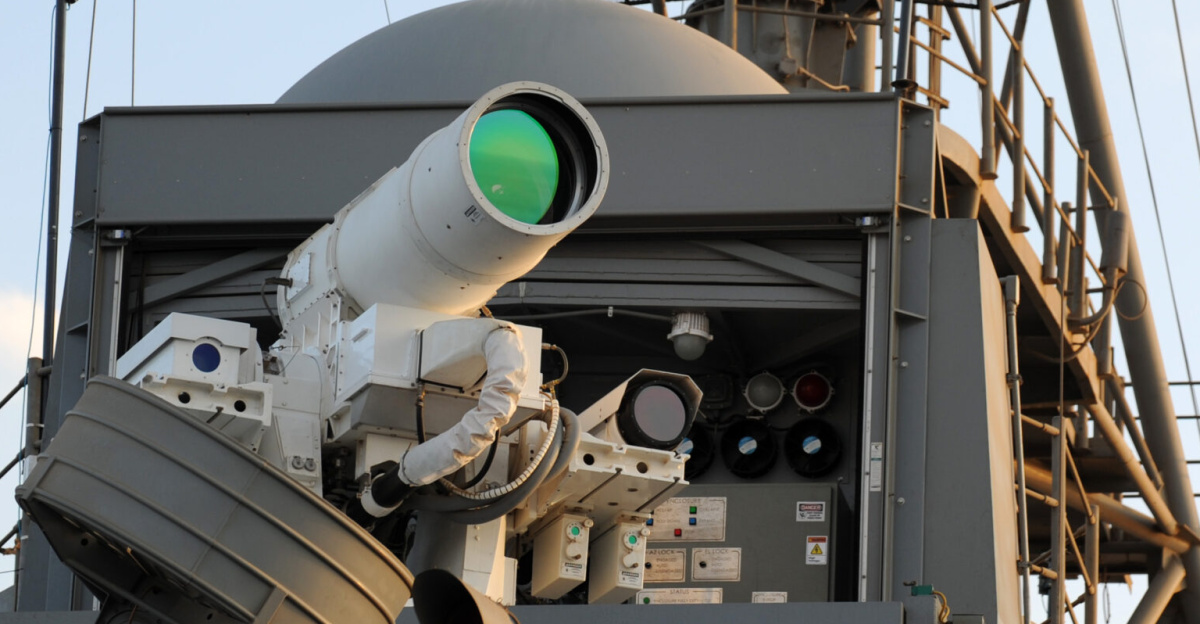
The program has effectively closed an 11-year technology gap with the US Navy’s LaWS (Laser Weapon System), which was first demonstrated in 2013, and is now positioned alongside US and UK high-energy laser initiatives in terms of power class and operational intent. Although mass production has not yet been announced, Ukrainian officials say initial units are already being fielded in high-threat regions, with further refinement taking place in parallel with combat use.
This acceleration was possible because engineers leaned heavily on available commercial components rather than waiting for bespoke, defense-only parts. Instead of moving through the traditional multi-year procurement and certification cycle, the team focused on assembling and testing a practical, good-enough system that could be upgraded iteratively once in use.
Domestic Industry At The Center

From its inception, Tryzub has been framed as a domestically driven innovation. Ukrainian industrial facilities produced mounts, housings, and mechanical subsystems, while local research teams integrated commercial laser generators, optics, and targeting stations. This approach reduced reliance on foreign contractors and allowed engineers to draw directly on Ukraine’s civilian high-tech sector.
Commander Vadym Sukharevskyi has highlighted Ukrainian specialists as central to the system’s creation, and the program has been structured to complement, rather than displace, existing defense-industrial jobs. If production scales up, demand is likely to grow for domestic suppliers of mounts, optics, cooling systems, and control electronics. For now, however, detailed performance data and verified kill counts remain classified, with only limited information released about field trials.
The laser itself is estimated to operate in the 50–100 kW power range, broadly comparable to power levels pursued in US and UK experimental systems. This is sufficient, in theory, to melt or structurally weaken the airframe or warhead of small drones at close ranges, or to blind electro-optical sensors at greater distances. On December 18, 2024, Sukharevskyi stated that Ukrainian forces were already using the system to shoot down aircraft-type targets at altitudes above 2 kilometers and stressed that the system was not merely a prototype but functioning in real conditions.
Promise And Constraints Of A First-Generation System
Despite its potential, Tryzub still reflects the limitations of a first-generation wartime design. The system relies on clear weather and a direct line of sight, since lasers are degraded by rain, fog, smoke, and heavy dust. At present, it is reported as largely manually operated, using a joystick-style control station. That constrains how many threats it can handle simultaneously and may limit effectiveness in large swarm attacks unless paired with radar and automated tracking.
Ukraine has not disclosed verified statistics on the number of drones or missiles destroyed, nor on sustained engagement rates during major strikes. Officials stress that the system is meant to complement surface-to-air missiles and anti-aircraft guns, not to replace them. Integration with existing detection networks, improvements in automation, and enhancements in tracking algorithms are among the areas earmarked for further development.
Strategic Signal And Future Trajectory
Beyond immediate battlefield use, Tryzub carries symbolic weight. It is one of Europe’s first tactical laser systems to be deployed in an active conflict zone, underscoring Ukraine’s determination to match or exceed the capabilities of larger militaries through rapid, cost-focused innovation. The project highlights how urgent wartime demand can compress development cycles and push novel technologies into real combat use far sooner than in peacetime programs.
Financially, widespread deployment of a system that can engage targets at a few dollars per shot could ease pressure on defense budgets and open new opportunities for small and medium-sized manufacturers across Ukraine. Internationally, military planners are watching closely to see whether Tryzub can maintain performance under sustained, large-scale attacks and harsh battlefield conditions.
Planned upgrades include greater automation, improved target acquisition and tracking, and deeper integration with other Ukrainian air-defense and command networks. As these improvements roll out and more units potentially protect additional cities and front-line sectors, other countries are likely to study Ukraine’s experience as they weigh their own investments in directed-energy defenses. The ultimate test will be whether systems like Tryzub can consistently blunt massed drone and missile attacks, reshaping both the cost and conduct of aerial warfare in the years ahead.
Sources:
CNN, “Ukraine says it has a laser that can shoot down aircraft,” 17 December 2024
Defence Blog, “Ukrainian Tryzub Laser System Shown for the First Time,” 12 April 2025
United24 Media, “Ukraine Confirms Use of Secret Laser Weapon on Russian Targets,” 2 February 2025
CSIS Analysis, “Drone Saturation: Russia’s Shahed Campaign,” 12 May 2025
Euromaidan Press, “Frontline report: Ukraine’s sci-fi laser weapon Tryzub blinds Russian pilots and melts drones,” 18 April 2025