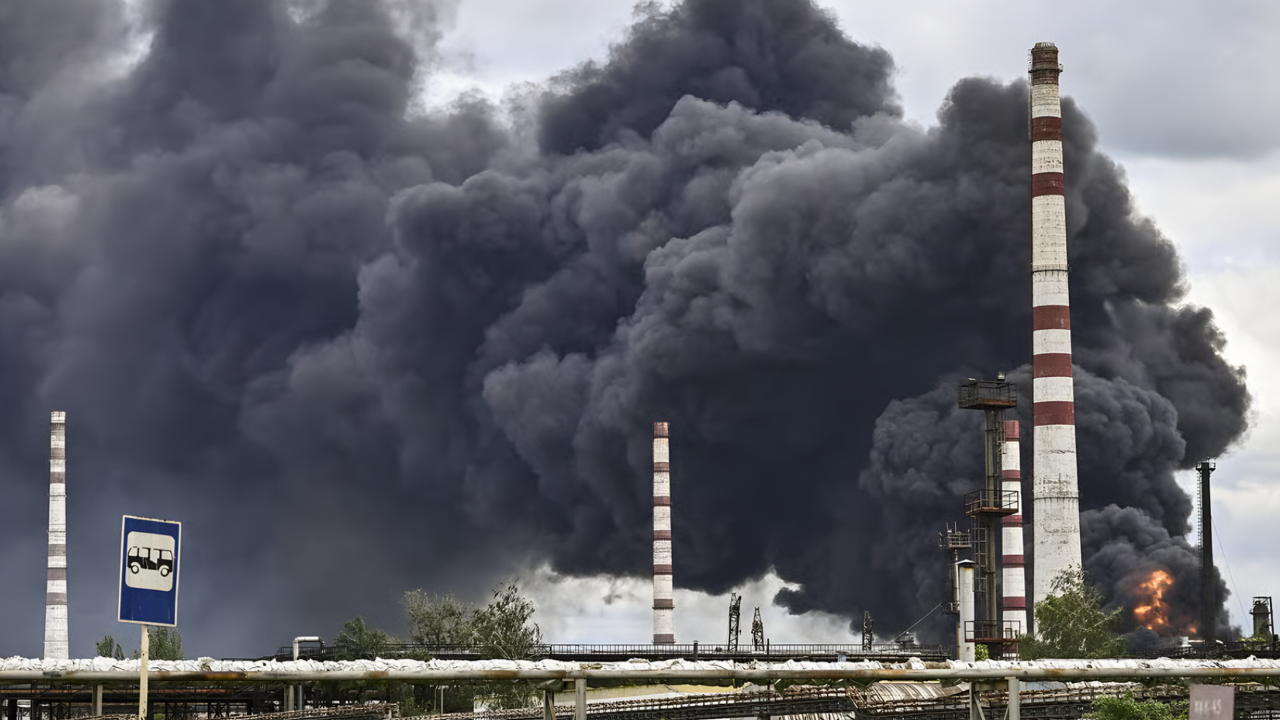
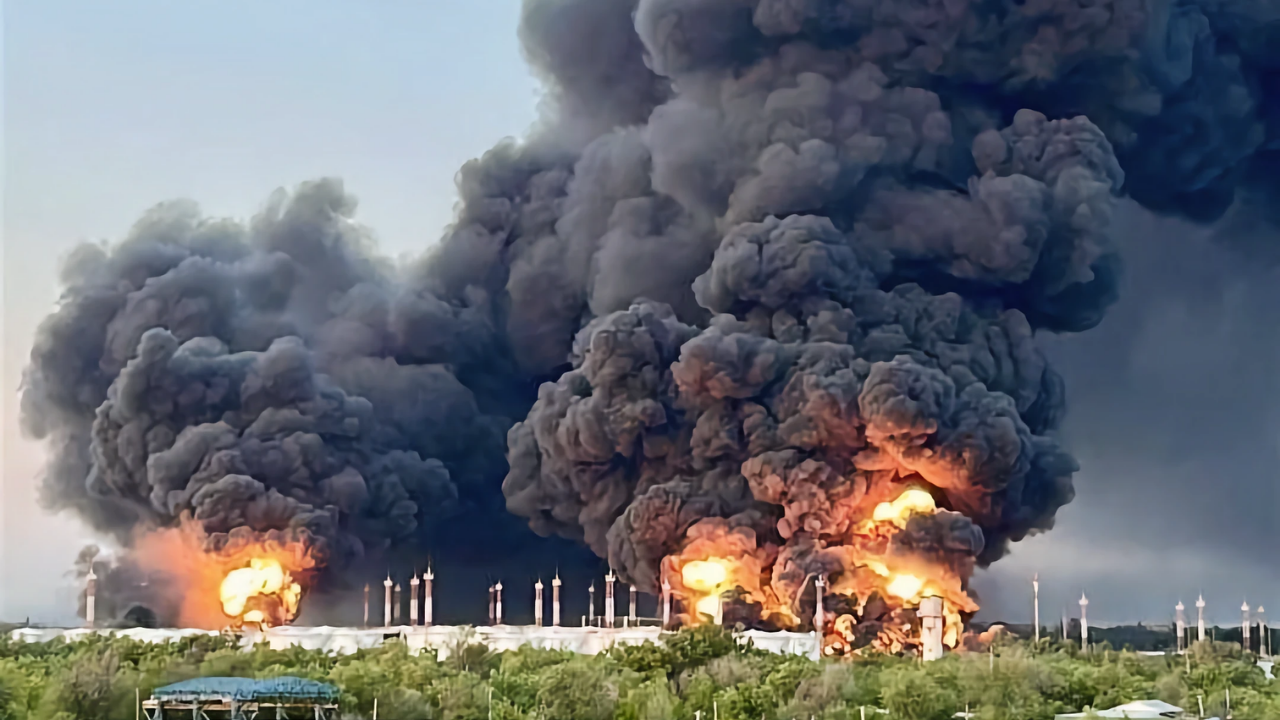
Flames and thick orange smoke rose over the Nevinnomyssk Azot chemical complex in Russia’s Stavropol Krai on the night of 3–4 December 2025, after what Ukrainian officials say was a long-range strike deep inside Russian territory. Emergency crews moved through the industrial site as a production workshop burned at a facility that can manufacture more than a million tonnes of ammonia and up to 1.4 million tonnes of ammonium nitrate each year. Ukrainian authorities describe the strike as part of a deliberate campaign to degrade Russia’s ability to sustain its invasion by hitting the industrial foundations of its armed forces.
Strategic Role in Russia’s War Effort

Nevinnomyssk Azot is identified by Ukraine’s General Staff as one of Russia’s largest chemical enterprises and a critical supplier of components used in explosives, propellants, and ammunition. With annual capacity exceeding 1 million tonnes of ammonia and about 1.4 million tonnes of ammonium nitrate, the plant feeds a network of defence-related manufacturers that turn these chemicals into shells, missiles, and bombs. Ukrainian military briefings and regional reporting portray the complex as an industrial backbone for Russia’s warfighting logistics, where any prolonged disruption reverberates across multiple arms plants and support depots.
Ukrainian officials frame the latest attack as a lawful act of self‑defence aimed at limiting Russia’s ability to wage war and occupy Ukrainian territory. By targeting a facility that supports both military and civilian production, Kyiv is seeking to impose cumulative strain on Russia’s industrial system rather than focusing only on front‑line units or border‑adjacent depots.
Military Impact and Russia’s Air Defence Challenge
The destruction of at least one production workshop is expected to curtail output of chemical precursors essential for explosives manufacturing, potentially reducing the volume of ammunition that Russian forces can bring to the front over the coming months. Even partial outages at a site with Nevinnomyssk Azot’s scale can introduce supply shocks for a military that relies on sustained, high‑intensity artillery fire.
Russian authorities reported intercepting several Ukrainian drones over Stavropol Krai during the same night, but the damage at the facility indicates that at least one strike platform evaded air defences. The incident highlights a growing challenge for Moscow: defending infrastructure more than 500 kilometres from the border against long‑range, low‑signature weapons. For Russian planners, the attack underscores that plants once considered safely in the interior are now within reach of Ukrainian systems, raising questions about the coverage and resilience of national air defence.
Economic and Industrial Consequences
Beyond the battlefield, Nevinnomyssk Azot is a significant economic asset. Based on recent global prices for industrial ammonia and ammonium nitrate, annual production at similar capacities can be valued in the range of hundreds of millions of dollars. A sustained shutdown could erase months of output, forcing Russian industry to seek alternative supplies or reconfigure production schedules at other plants.
The facility also anchors the local economy. Large nitrogen chemical complexes typically employ several hundred to around a thousand workers directly, with additional jobs in transport, maintenance, and services. Extended downtime risks wage losses, reduced regional tax income, and heightened uncertainty in a town closely tied to heavy industry. Local authorities may also have to address concerns about safety, possible contamination, and the prospect of further strikes.
This attack is not the first on Nevinnomyssk Azot. A previous Ukrainian strike in June 2025 contributed to a spike in ammonium nitrate prices in Europe and China, according to market analyses. The December incident compounds earlier damage and indicates that Ukraine sees repeated pressure on this site as a way to gradually weaken Russia’s armaments production and to inject volatility into related commodity markets.
Global Fertilizer Markets and Food Security
Ammonia and ammonium nitrate are central components of nitrogen fertilizers used worldwide. Any lengthy disruption at a plant of Nevinnomyssk Azot’s size has implications for agricultural supply chains, especially for importers that rely on Russian nitrogen products. After the June 2025 attack, traders and analysts observed rapid price increases and heightened uncertainty in fertilizer markets; a fresh outage raises the prospect of renewed volatility.
Higher or less predictable fertilizer prices can affect farmers’ decisions on planting and application rates, particularly in regions with tight margins. That, in turn, can influence food production costs and price levels at a time when global agriculture is already under pressure from climate impacts, energy costs, and logistics constraints. While other producers can compensate over time, the sudden removal or reduction of a major supplier often leads to short‑term dislocation in both regional and global trade flows.
Russian nitrogen products also play a role in non‑military industrial sectors, meaning the effects extend into broader manufacturing and transportation networks. Companies dependent on stable supplies of ammonia‑based inputs may need to adjust procurement strategies, accept higher costs, or cut back production if alternatives are limited or more expensive.
Escalation, Environmental Risks, and What Comes Next
The Nevinnomyssk strike formed part of a wider pattern of Ukrainian operations. Hours after the attack on the chemical plant, Ukrainian forces hit a Russian training area near Dokuchaievsk in occupied Donetsk Oblast, with Ukrainian sources reporting around 60 Russian servicemen killed or wounded. Taken together, these actions combine deep strikes on strategic infrastructure with attacks on fielded forces, signalling that Ukraine intends to pressure both Russia’s immediate combat strength and its longer‑term ability to replace losses.
Targeting large chemical facilities carries inherent environmental risks. Damage to production units, storage tanks, or pipelines can potentially release hazardous substances into the air or water, with consequences for nearby communities and ecosystems. While detailed assessments from Nevinnomyssk have not yet been made public, the incident reinforces wider concerns about the ecological dimension of strikes on industrial assets during the conflict.
As Ukraine demonstrates that it can repeatedly reach far inside Russian territory, the war is increasingly affecting economic and industrial centres, not only front‑line zones. Governments, markets, and humanitarian organisations are watching closely for signs of extended disruption to fertilizer supplies, food prices, and regional employment. The longer operations like those against Nevinnomyssk Azot continue, the more the confrontation is likely to shape not just military balances, but also the economic resilience and environmental safety of communities well beyond the battlefield.
Sources:
AFU General Staff Telegram statement on Nevinnomyssk Azot strike; Interfax-Ukraine report, 4 December 2025
ChemAnalyst “Ammonium Nitrate Prices Spike in June 2025 Following Attack on Russian Plant” market analysis, July 2025
Al Jazeera Russia-Ukraine war key events summary (Nevinnomyssk Azot strike and role as explosives component producer), 5 December 2025
RBC-Ukraine/General Staff coverage of Nevinnomyssk Azot as one of Russia’s largest chemical enterprises and key explosives precursor supplier, December 2025