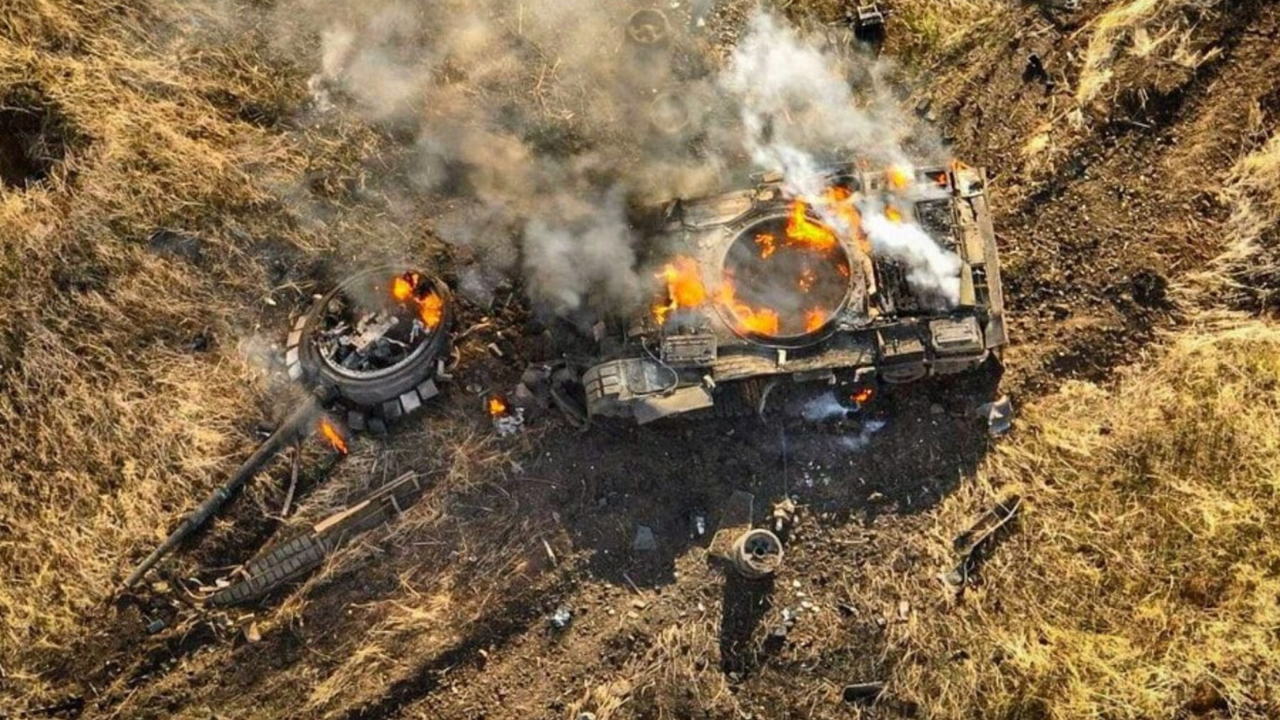
In summer 2022, Ukrainian drones and artillery hit Russian positions along the Donetsk front for over two days, striking many artillery sites in a short time. Russian crews tried to hide in trees and under camouflage nets, yet Ukrainian drone teams still found several self‑propelled howitzers and guided accurate fire onto them. This kind of attack demonstrated how a focused offensive can surprise Russian forces and remove key guns quickly.
The 2S19 Msta‑S is a key Russian weapon because it can move on tracks and fire a 152-millimeter gun to support troops and guard important areas. Open sources say it is one of the main artillery systems in Russian units, with many in service before the full‑scale invasion. Russia added upgrades over time, such as better fire‑control systems, so the Msta‑S remained in wide use. Analysts note that each destroyed Msta‑S puts extra pressure on Russian forces, as Ukrainian drones and gunners grow more accurate and force Russia to spread remaining guns over a long front.
Production Limits and Growing Losses
Market studies indicate that by 2000 manufacturers had built at least 663 Msta‑S systems, then slowed output, so Russia likely operated several hundred active guns and kept more in storage, not thousands. Wartime wear, sanctions, and old factories make it hard to repair or replace each howitzer, so every destroyed or badly damaged gun becomes a serious loss.
Open‑source projects that count only visually confirmed cases have reported well over 100 Msta‑S guns destroyed, damaged, abandoned, or captured since 2022, and some estimates of confirmed losses pass 150 when newer variants are included. Experts stress that these lists are incomplete, so the true number of lost guns is almost certainly higher than what cameras show.
Because pre‑war stocks were limited, analysts say this level of attrition wipes out years of industrial work and equals a large part of Russia’s Msta‑S fleet and several years of normal peacetime production. Open estimates suggest a single Msta‑S may cost on the order of 1,500,000–2,000,000 dollars, so the financial value of lost systems reaches into the hundreds of millions of dollars, even before counting crews and support gear.
Donetsk and other front‑line areas now act as testing grounds for Ukraine’s drone‑guided counter‑battery fire, where aerial scouts watch tracks, blast marks, gun flashes, and camouflage, then send exact target data to Ukrainian artillery. Once they spot patterns, Ukrainian units can hit these sites with precision, turning forests and former rear areas into dangerous zones for Russian guns.
Drones, Camouflage, and Russia’s Dilemma
Russian gun crews must choose between staying in one place and risking detection, or moving often and losing some accuracy and speed. Videos and reports show drones finding howitzers that tried to hide under nets or in trees, including Msta‑S vehicles, by using thermal and optical sensors.
Traditional camouflage can even backfire, because disturbed earth, nets, and track marks stand out from the air and mark the site for attack, especially when units reuse the same firing spots. This constant threat reduces the number of Msta‑S guns near the fiercest battles and hurts morale in Russian artillery units that know they are being hunted.
Russian leaders now face tough choices: rebuild Msta‑S stocks, restore older Soviet‑era guns, or put more resources into other weapons like missiles and tanks. Sanctions on key parts and the huge need for shells and barrels slow any attempt to replace every lost system.
Western analysts doubt that Russia can fully rebuild its Msta‑S force while losses continue at this pace, and they warn that artillery structure and doctrine may have to change. Ukraine, meanwhile, keeps improving drones, software, and links to Western radars, which raises its hit rate on later Russian deployments and pushes the question of whether Moscow can adapt as fast as Kyiv.
Sources:
National Security Journal, “Msta-S: Russia’s ‘Frankenstein’ Howitzer Still Thunders in Ukraine,” 3 Jun 2025
Oryx, “Attack On Europe: Documenting Russian Equipment Losses During The Russian Invasion Of Ukraine,” 23 Jan 2026
Defence‑Blog, “Russia Faces Heavy Losses of Msta-S Howitzers,” 4 Jun 2024
The Daily Digest, “Two Days of Devastation: When Ukraine Humbled Russia,” 2023
Militarnyi via Defence‑Blog, “Ukrainian Mechanics Refitted Self-Propelled Howitzer,” 7 Aug 2025
MSI² Sitrep, “Two for One… in Three Days: Ukraine Shocks Russia with Drone Innovation,” 4 Jun 2025