
For nearly a century, major policy choices in Washington have promised security, growth, and opportunity. Yet many left lasting marks on family finances, neighborhoods, and personal freedoms. From housing rules in the 1930s to economic and criminal justice shifts in the 1990s, these decisions continue to shape who owns a home, who holds a job, and who ends up behind bars.
Presidential signatures did more than address immediate crises. They triggered structural shifts that redirected wealth, reshaped regions, and expanded government power in ways still unfolding today. Ten of these policies stand out for their long-term effects, helping explain racial wealth gaps, mass incarceration, weakened safety nets, concentrated media, and the decline of stable manufacturing work.
Structural Shifts Masked as Reform

Many federal policies were framed as modernizations or fixes. Terms like “reform,” “deregulation,” or “free trade” implied improvement, but often favored powerful interests or short-term gains. Early warnings about long-term damage were largely ignored, leaving consequences that took decades to appear.
By the time the public saw collapsing safety nets, fragile banks, or hollowed-out factory towns, the laws and regulations were deeply entrenched. What seemed technical often became permanent shifts in how risk and opportunity were distributed. Families, neighborhoods, and communities bore the brunt, while policymakers rarely faced direct political consequences.
A Bipartisan Pattern Over Seven Decades
From the New Deal through the late 20th century, presidents from both parties contributed to these structural outcomes. Franklin D. Roosevelt, Harry Truman, Dwight Eisenhower, Richard Nixon, Ronald Reagan, George H. W. Bush, and Bill Clinton each presided over at least one policy now linked to long-term harm.
The pattern transcends ideology. Housing programs that excluded Black families, drug strategies that fueled mass incarceration, welfare reforms that reduced support, and trade and telecom policies that consolidated corporate power all emerged from different administrations. Together, they illustrate a recurring prioritization of economic growth, geopolitical advantage, or corporate influence over household stability and community well-being.
Federal Housing and the Racial Wealth Gap
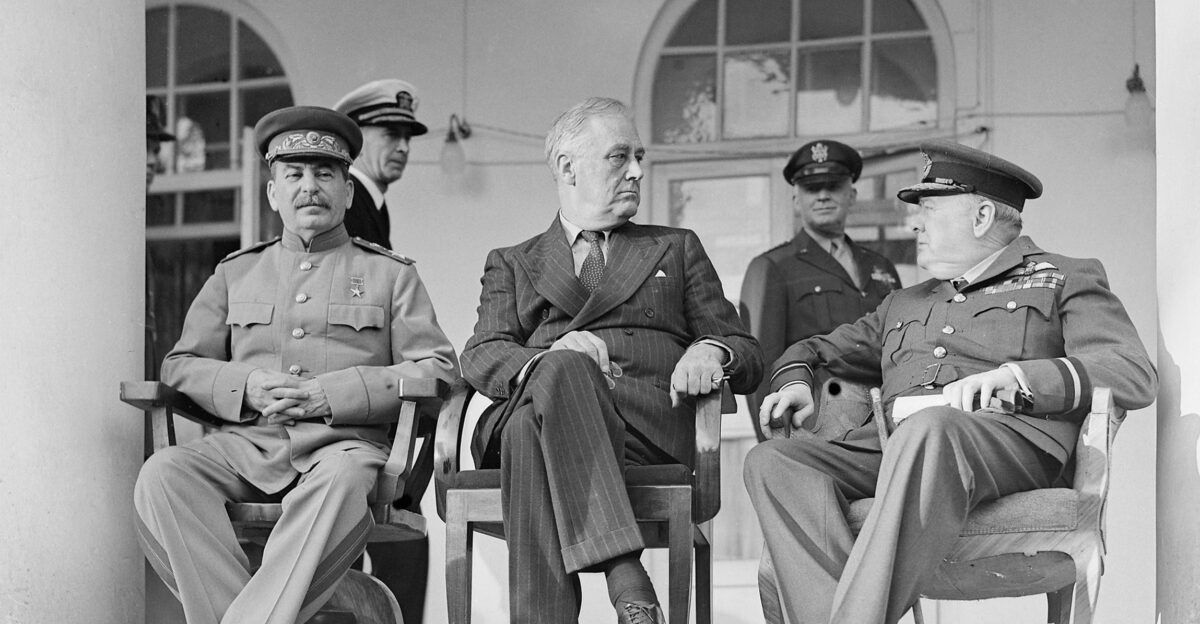
The Federal Housing Administration, created during the New Deal, systematically denied mortgage insurance to Black neighborhoods—a practice known as redlining—while supporting white homebuyers and suburban developments. This institutionalized racial segregation for decades. Today, median household wealth for Black Americans is $44,100 versus $284,310 for white households, a gap of roughly $240,000.
Homeownership, a key pathway to asset building, is held by 73% of white households but only 44% of Black households. The disparity reflects the accumulated effects of exclusion from federally backed home buying. Generations of families were denied access to wealth-building opportunities that compounded over time, shaping both neighborhood composition and long-term financial security.
The War on Drugs and Mass Incarceration

Richard Nixon launched the War on Drugs in 1971 to curb drug use and street crime. Instead, it helped build the world’s largest prison system. Hundreds of thousands remain incarcerated for drug offenses, and the U.S. holds roughly one-quarter of the world’s prisoners despite representing 5% of the global population.
At the system’s peak around 2008, about 2.3 million people were in custody. Drug availability persisted while prison populations surged, particularly in communities of color. The policy created long-lasting disparities in criminal justice outcomes, reshaping family structures, neighborhood stability, and economic opportunity in ways still evident today.
Welfare Reform and Financial Deregulation
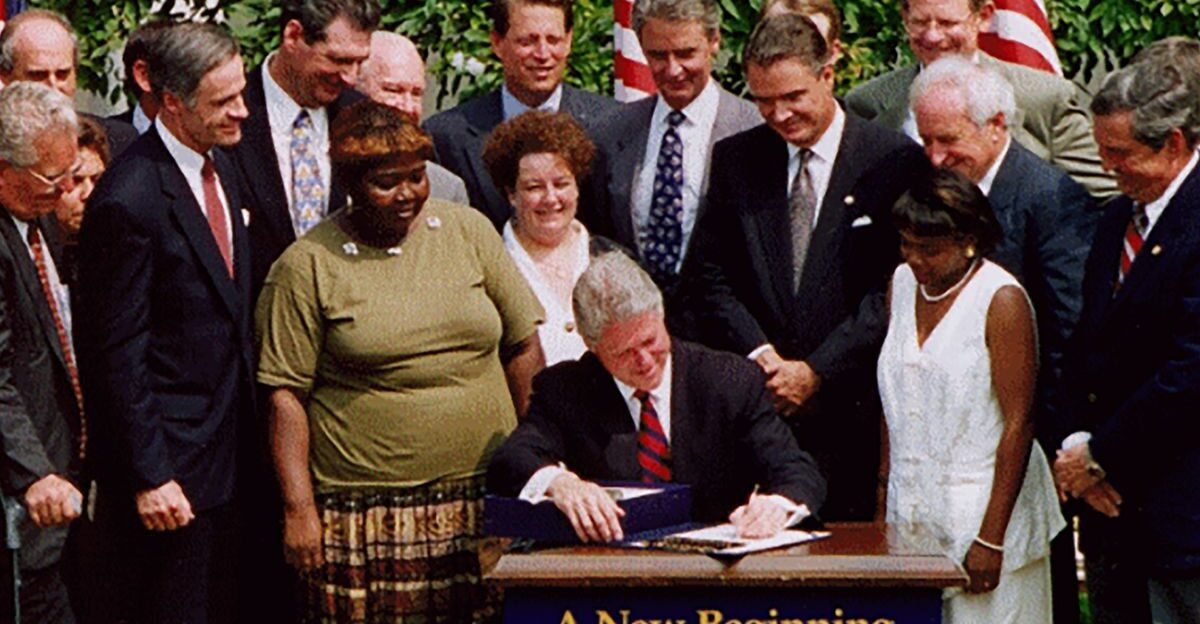
In 1996, President Bill Clinton signed the Personal Responsibility and Work Opportunity Reconciliation Act, replacing AFDC with TANF. Federal support that once reached 68% of poor families now covers roughly 23%, a decline of more than 60%. An estimated 3.5 million families live in extreme poverty despite at least one household member working.
Financial deregulation followed in 1999 with the Gramm-Leach-Bliley Act, which repealed Glass-Steagall protections. Commercial and investment banks merged, creating interconnected institutions. Less than a decade later, the 2008 financial crisis wiped out $11–19 trillion in household wealth, erased 8.7 million jobs, and triggered widespread foreclosures, highlighting the enduring consequences of these late-20th-century policies.
Trade, Media, and Infrastructure Shifts
NAFTA, signed in 1993, displaced roughly 690,000 U.S. jobs, mainly in manufacturing. Factory employment declined by 4.5 million positions over subsequent decades. The 1996 Telecommunications Act eased media ownership limits, reducing companies controlling major outlets from 50 to about six, concentrating information flow and narrowing public perspectives.
Infrastructure projects like the 1956 Interstate Highway Act uprooted over a million people and destroyed 475,000 households, often in low-income neighborhoods. Highways improved commerce but fragmented urban communities, severing networks that had taken generations to build. These changes reshaped work, media, and daily life, leaving long-term social and economic impacts.
Agriculture, Immigration, and Monetary Policy
Agricultural subsidies expanded from the 1970s, concentrating 60–74% of benefits in the top 10% of farms. Smaller family farms struggled to survive, while large agribusiness strengthened. The 1986 Immigration Reform and Control Act legalized 2.7 million immigrants but left many workers vulnerable, creating a long-lasting tier of labor with limited protections.
The 1971 Nixon Shock ended the Bretton Woods gold standard, introducing greater currency volatility and contributing to steady inflation. Household purchasing power, especially for those with stagnant wages, eroded over decades. These policies illustrate how government action reshapes economic opportunity across sectors, generations, and income brackets, often creating unforeseen challenges.
Conclusion
Behind statistics like a $240,000 racial wealth gap, 1.8 million people incarcerated, declining TANF coverage, and millions of families in deep poverty are lives shaped by rules they did not choose. Housing restrictions, welfare overhauls, trade policies, and financial deregulation collectively influenced wealth, work, and liberty for generations.
Understanding these historical policy impacts helps contextualize current debates on housing, criminal justice, infrastructure, and safety nets. The record shows that decisions today will echo far into the century. Lawmakers, communities, and individuals must weigh these long-term consequences carefully, ensuring policies strengthen opportunity rather than entrench inequity.
Sources:
Federal Reserve Survey of Consumer Finances 2022 (racial wealth gap data)
U.S. Bureau of Justice Statistics (incarceration rates, prison population data)
Economic Policy Institute (NAFTA job displacement, manufacturing employment studies)
U.S. Department of Labor / Bureau of Labor Statistics (Great Recession job losses)
HHS Office of Family Assistance (TANF coverage statistics)
USDA Economic Research Service (agricultural subsidy distribution)
Federal Communications Commission (media ownership consolidation 1983-2016)
U.S. Department of Transportation / Smart Growth America (Interstate Highway displacement estimates)