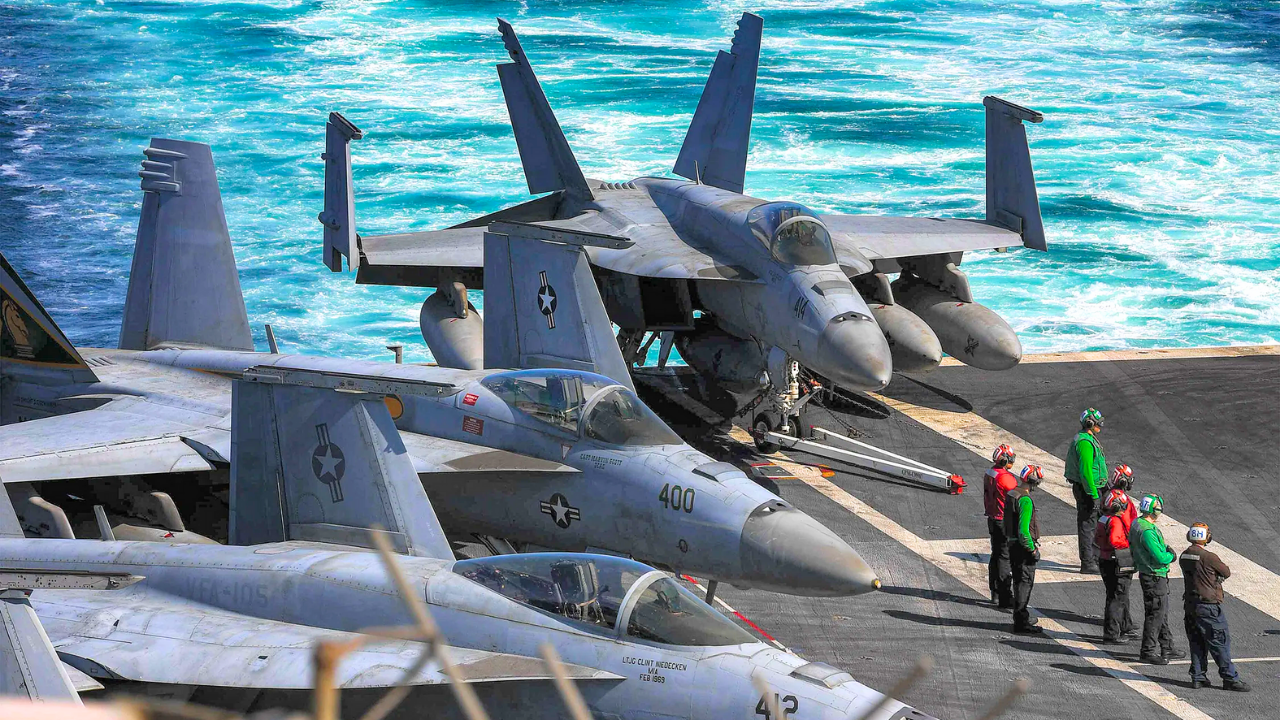
Within January 2026, the United States deployed F‑15E Strike Eagles from the 494th Fighter Squadron at RAF Lakenheath toward the Middle East, supported in transit by KC‑135 Stratotanker aerial refueling aircraft.
This combination of fighters, tankers, and a nuclear‑powered aircraft carrier such as the USS Abraham Lincoln increases U.S. ability to sustain air operations near Iran and is widely viewed as a visible signal of military readiness during a period of heightened tension. Public discussion in the United States often interprets these kinds of movements as preparation for possible conflict, even when officials describe them as deterrence measures.
Tankers And Carriers Before Combat
Modern U.S. air campaigns typically begin with the quiet buildup of logistics and enablers rather than with public declarations. In June 2025, for example, Operation Midnight Hammer against Iranian nuclear sites used a large package of aircraft, including B‑2 Spirit bombers refueled multiple times en route, supported by extensive aerial refueling and strike coordination.
Earlier conflicts such as U.S. operations in Iraq and Syria also relied on dense tanker “tracks” and nearby carrier strike groups to keep fighters and bombers on station for prolonged periods.
F‑15Es, Tankers, And A Supercarrier
On January 18, 2026, twelve F‑15E Strike Eagles from the 494th Fighter Squadron departed RAF Lakenheath for the Middle East with KC‑135 Stratotanker support, and their arrival at a regional base was confirmed by U.S. Central Command imagery.
Open‑source flight tracking and defense reporting indicate that these aircraft are joining other U.S. air assets already positioned at bases such as Muwaffaq Salti Air Base in Jordan. In parallel, President Donald Trump and Pentagon officials have said that the USS Abraham Lincoln carrier strike group, described publicly as part of a “massive armada,” is heading toward the Middle East to reinforce U.S. presence near Iran.
Why Americans See “War Prep” Patterns
The same 494th Expeditionary Fighter Squadron that is now arriving in the region previously took part in defending Israel against a large Iranian attack involving drones and missiles, shooting down many inbound threats in 2024. In June 2025, Operation Midnight Hammer saw U.S. forces strike three major Iranian nuclear facilities—Fordow, Natanz, and Isfahan—using B‑2 bombers, cruise missiles, and supporting aircraft.
When familiar platforms such as F‑15Es, KC‑135s, and a Nimitz‑class carrier move back toward the region amid renewed tension with Tehran, many Americans recall these recent episodes and associate similar deployments with the possibility of new strikes, even if officials emphasize that the goal is deterrence and crisis management.
Why KC‑135s Matter
The KC‑135 Stratotanker is a key enabler for U.S. air operations, allowing fighters, bombers, and intelligence aircraft to extend their range and time on station by offloading large quantities of fuel in flight. In past campaigns over Iraq, Syria, and during Operation Midnight Hammer, aerial refueling made it possible for aircraft to repeatedly reach targets in and around Iran and return safely, even from distant bases.
While current U.S. officials do not publish exact tanker numbers for operational security reasons, the documented presence of KC‑135 support for recent F‑15E deployments indicates an intention to maintain flexible, sustained airpower in the wider region.
Regional Postures And Reactions
U.S. reinforcements in the air and at sea come as Iran faces domestic protests and ongoing tensions with Israel and Gulf states, and Tehran has repeatedly warned that it will respond strongly to any new attacks on its territory or nuclear program.
Regional partners host U.S. aircraft and support assets, and previous crises have shown that American deployments can both reassure these governments and draw them deeper into confrontations with Iran. Israel, which has conducted long‑range strikes on Iranian‑linked targets using aircraft such as the F‑35I, views an expanded U.S. footprint as additional backing in its standoff with Tehran, even as all sides publicly signal they want to avoid uncontrolled escalation.
Energy, Markets, And Domestic Politics
Whenever U.S. carrier strike groups and bomber forces move closer to the Strait of Hormuz, analysts and financial markets often anticipate potential disruption to oil shipping, which can translate into higher price volatility and concern about global energy supplies.
Inside the United States, cycles of deployments and crises involving Iran shape political debate and media coverage, sometimes narrowing discussion into stark options between military action and restraint. If any clash between U.S. and Iranian forces were to cause casualties, past experience suggests that public pressure on Washington to respond forcefully could increase, complicating efforts to keep operations limited.
Force Buildup And Perceptions Of Risk
As of late January 2026, two developments are clearly documented: additional F‑15E Strike Eagles with KC‑135 tanker support have deployed from Europe to the Middle East, and the USS Abraham Lincoln carrier strike group with escort ships is moving toward the region amid tense U.S.–Iran relations. Historically, similar combinations of U.S. air and naval power have preceded both deterrent shows of force and actual strikes, including Operation Midnight Hammer in 2025.
It is therefore understandable that observers see the current moves as raising the risk of confrontation with Iran, even though U.S. leaders publicly frame the buildup as a way to prevent war and protect regional partners.
Sources:
- “US Sends F‑15s to Middle East as Trump Weighs Action Against Iran” – Air & Space Forces Magazine
- “U.S. Deploys F‑15 Fighters and KC‑135 Tankers to Jordan as Iran Tensions Trigger Major Airpower Repositioning” – Defence Security Asia
- “The U.S. Navy Is Sending a Supercarrier Right to Iran’s Backyard” – 19FortyFive
- “The U.S. Navy Is Sending a ‘Supercarrier’ To Iran’s Backyard Stacked with F/A‑18 Super Hornet Fighters and Missiles” – 19FortyFive
- “The Navy Is Sending a ‘Supercarrier’ and Warship Armada to Iran’s Backyard” – 19FortyFive
- “Iran warns of ‘total war’ as US carrier strike group nears Middle East” – Daily News Egypt