
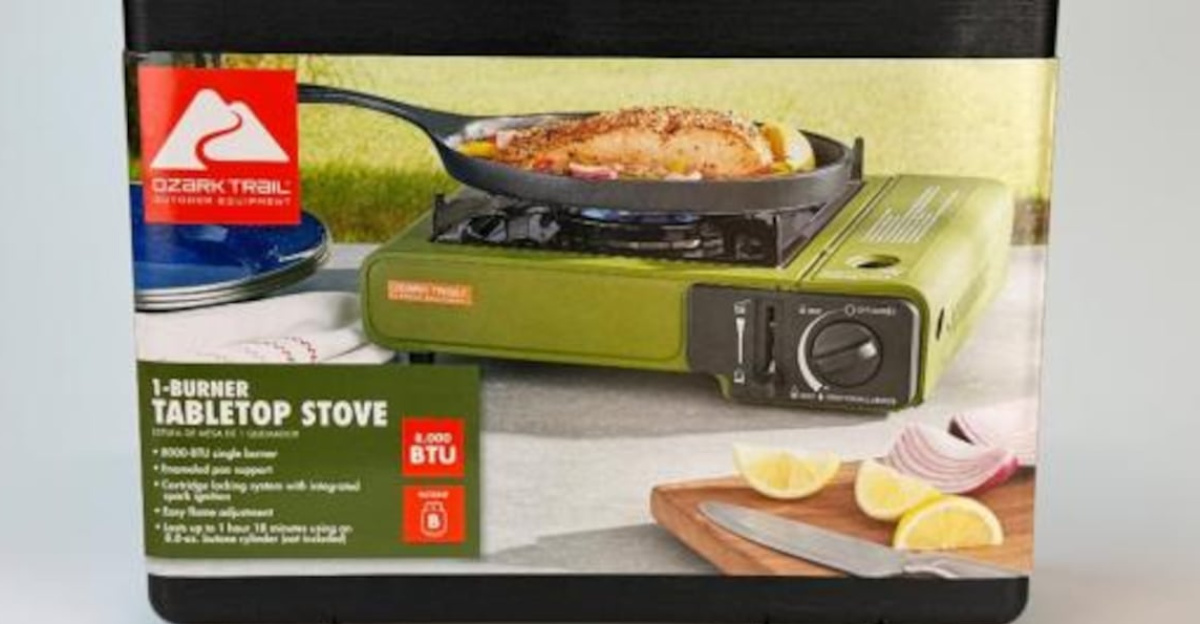
On November 26, 2025, the Consumer Product Safety Commission issued a recall for approximately 201,000 Ozark Trail Tabletop 1-Burner Butane Camping Stoves distributed through roughly 4,000 to 5,000 U.S. Walmart locations and Walmart.com. The stoves, priced between $8 and $45, were manufactured by China Window Industry Co., Ltd., and sold under Walmart’s trusted house brand for outdoor gear. According to CPSC documentation, the units “can explode or catch fire,” prompting an immediate nationwide recall and full refund directive for all consumers.
The hazard severity becomes apparent through incident data: the manufacturer reported 26 explosions or fires and 16 documented injuries, including second-degree burns requiring medical intervention. This injury-per-incident rate of 62 percent—meaning roughly six of every ten reported incidents caused bodily harm—far exceeds typical product recall patterns, where many events result in property damage or near-misses rather than human injury. The stoves circulated across three consecutive camping seasons from March 2023 through October 2025, creating a 30-month window during which risk accumulated undetected.
The Underreporting Problem
Consumer product injury reporting remains notoriously incomplete, particularly for inexpensive items consumers view as disposable. With 201,000 units in circulation over 2.5 years, the reported 0.013 percent incident rate suggests either implausibly perfect safety performance or substantial underreporting. Users experiencing minor flare-ups, ignition failures, or small burns frequently attributed problems to operator error rather than equipment defects, especially with low-cost camping gear where premium engineering expectations are minimal.
Outdoor-focused users rarely navigate federal reporting bureaucracy; incidents occurring at remote campsites or national forests seldom become formal CPSC reports. Attribution bias—the tendency to blame oneself for accidents—combined with hassle avoidance and limited recall system awareness creates conditions where only the most severe incidents reach official statistics. Academic and regulatory analyses indicate official injury counts understate real-world events by factors of 10 or more in dispersed environments. If even a fraction of users who witnessed sudden flame bursts, popped canisters, or intense heat near fuel compartments never reported incidents, the actual hazardous event count could easily reach hundreds rather than dozens.
Design Vulnerability and Manufacturing Risk
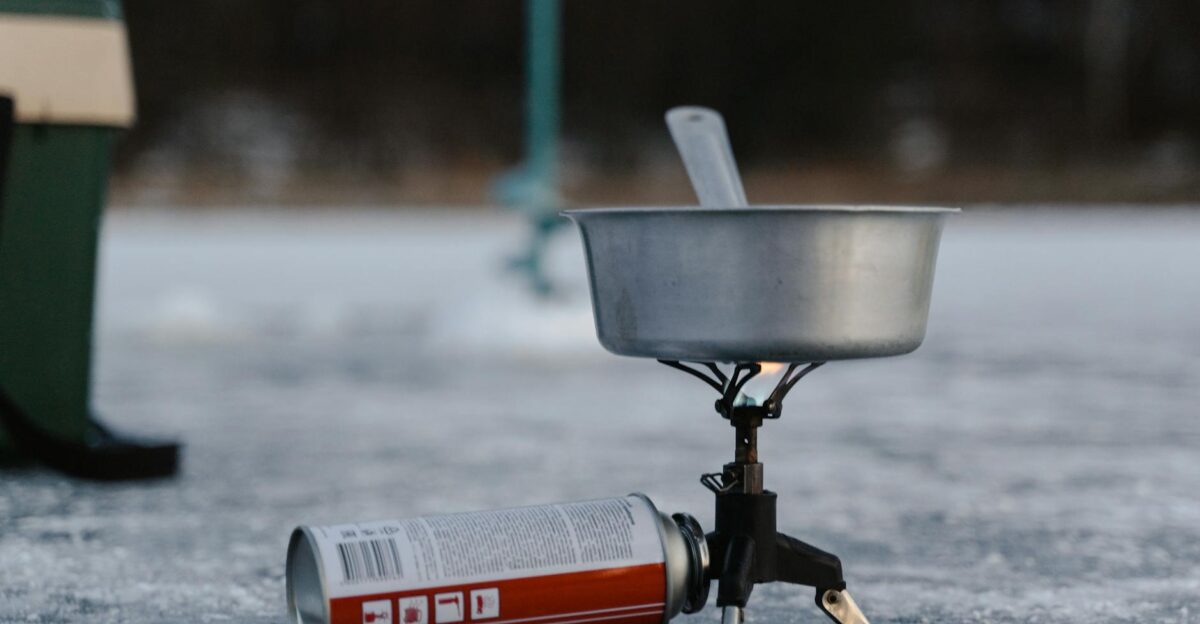
Butane stoves inherently store energy as pressurized fuel in removable canisters. If canisters fail to lock fully or design tolerances permit operation while misaligned, gas leaks and accumulates near burners, igniting suddenly in flash flames or explosive bursts when sparked. Properly engineered stoves include multiple protection layers: interlocks preventing ignition unless canisters correctly engage, temperature-triggered shutoffs, robust over-pressure vents, and materials withstanding sustained heat.
At Ozark Trail’s price point, evidence suggests critical safeguards either never existed or performed unreliably across volume production. International regulatory examinations of non-compliant butane cookers reveal thin metal, incorrect clearances, weak or missing over-pressure vents, and latches allowing operation with improperly seated canisters—all triggering explosions or fireballs. Walmart’s ability to sell at $8 reveals cost-cutting origins: aggressive cost-down manufacturing, squeezed materials and tolerances, and reliance on third-party Chinese lab audits that frequently miss critical failure modes during volume production scaling.
The House Brand Liability

Ozark Trail is Walmart’s flagship private brand for outdoor goods—tents, coolers, lanterns, camp stoves. This house-brand identity communicates that Walmart “underwriters” the product, assuring shoppers that rock-bottom prices do not compromise family safety. But here, Walmart’s own badge became a burn hazard. House brands concentrate risk: a single manufacturing or engineering failure affects hundreds of thousands of identical products and rebounds directly onto retailer reputation rather than distant suppliers.
U.S. product liability law holds retailers and importers jointly responsible for product safety, particularly when controlling branding, specifications, and distribution. Walmart is not a passive retailer; it is the named importer and seller, with recall notices explicitly attributing products to Walmart and directing consumers to Walmart customer service for refunds. Federal law prohibits selling recalled products, obligating Walmart to pull remaining units from shelves, block online sales, and prevent third-party resales through its channels.
Economic and Reputational Consequences
At 201,000 units sold for $8 to $45, recall retail value runs $1.6 million to $9 million—non-trivial but manageable for a company with hundreds of billions in annual revenue. True economic costs extend far beyond refunds. Each serious burn injury generates tens of thousands in medical expenses, lost work time, and long-term care that courts frequently assign manufacturers and retailers in liability suits. Walmart absorbs logistics for reverse shipping, unit destruction, customer support staffing, communication campaigns, and legal fees.
For tight-budget households, Walmart represents not merely a store but a default “good enough” product source, presumed safe because of corporate scale and visibility. Camp stoves exploding or catching fire directly contradicts implicit safety assurances that Walmart private labels meet basic safety adequacy. Trust broken by visceral events like second-degree burns erodes far beyond product categories involved; customers question whether other Walmart-brand electronics, toys, or household items harbor similar unseen risks. Behavioral research on recall responses shows consumers over-generalize from salient negative events, generating long-term brand perception shifts even when incident absolute numbers seem small relative to units sold.
Systemic Oversight Failures
The 2.5-year delay between initial sales and the November 2025 recall reveals systemic weakness in third-party testing and globalized risk management. Walmart, like most big-box retailers, relies heavily on third-party labs and inspection firms certifying imported products meet safety standards before shipping. But third-party assurance only matches test protocols, sampling plans, and underlying incentives; testing only a handful of early production samples under ideal conditions easily misses failure modes emerging when factories accelerate, swap suppliers, or reduce material thickness to save pennies per unit.
Quality control studies of Chinese manufacturing—including outdoor and gas appliances—show defect drift over time is common without continuous on-site oversight and aggressive lot testing. Either the original test regime never simulated realistic misuse and edge conditions, or later production deviated from tested designs undetected. This represents classic globalized risk: a U.S. retailer brand fronting complex, opaque production chains with diffused accountability, while consumers become de facto crash-test dummies discovering design limits through injury.
Forward Implications
The Ozark Trail recall reflects broader heightened scrutiny around low-cost energy-converting devices—anything storing or releasing heat, pressure, or electricity. Recent years show regulators targeting unsafe space heaters, faulty lithium-ion batteries, and substandard gas appliances, recognizing budget products in these categories can transform living spaces, tents, and RVs into death traps during failure. Climate-driven extremes and infrastructure stress push more people toward backup gas stoves and portable heaters; regulators face pressure tightening standards, demanding rigorous certification, or restricting designs prone to catastrophic failure.
The 201,000-unit recall represents more than 26 explosions and 16 documented burn injuries; it exemplifies how modern retail, globalized manufacturing, and weak oversight convert minor cost savings into system-wide hazards. Walmart’s importer, brand owner, and distributor roles mean it cannot claim ignorance; fronting products with Ozark Trail identity nationwide for years effectively vouched for non-existent safety. Until structural reforms arrive—stricter pre-market fuel-device testing, mandatory reporting thresholds for near-misses, aggressive production batch sampling, and regulatory penalties making “wait-and-see” economically irrational—consumers rationally approach ultra-cheap life-safety gear skeptically, especially under opaque house brands.
Sources:
CBS News – Coverage of Walmart stove and helmet recalls, incident counts, and recall details.
Newsweek – Walmart recall update, model BG2247A1 details, injuries, and Walmart statements.
Yahoo / Other news outlets – Summaries of recall magnitude, price range, and manufacturer identification.
The Hill – Reporting on Walmart recalling 200K camp stoves over burn risk.
Queensland RSHQ – Technical analysis of non-compliant butane gas cookers and typical failure modes.
ProQC and similar quality-control sources – Discussion of quality control challenges for outdoor stoves manufactured in China.
Multi-outlet recall roundups and analyses – Context on recall patterns, injury underreporting, and consumer safety trends.