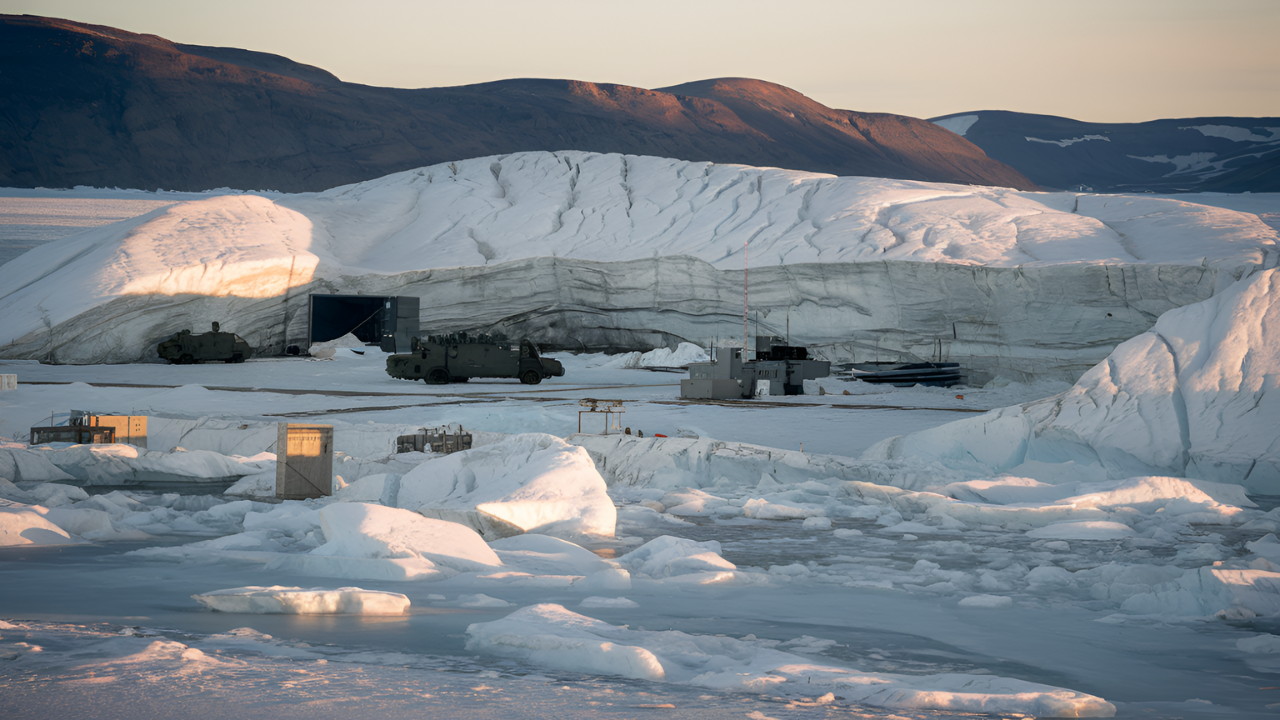
In April 2024, a NASA research jet scanning Greenland’s ice for sea-level clues unexpectedly uncovered Camp Century, a buried Cold War base now threatening to release its toxic cargo as the ice thins.
This forgotten outpost, abandoned decades ago, holds diesel fuel, sewage, industrial chemicals, and radioactive waste once thought permanently sealed by accumulating snow. NASA’s radar images have thrust it back into view, highlighting how warming temperatures could mobilize these pollutants into Arctic waters.
The Hidden Ice City
Built in 1959 about 200 kilometers from Greenland’s northwest coast, Camp Century spanned 55 hectares of tunnels under the ice sheet—equivalent to 100 football fields. U.S. Army engineers created living quarters, labs, a chapel, and a barbershop, powered initially by a nuclear reactor. Tracked vehicles supplied the site through surface vents, while newsreels hailed it as a futuristic polar outpost amid Cold War tensions.
A Secret Missile Plan
Beneath the research facade lay Project Iceworm, a covert U.S. scheme to embed mobile nuclear missiles in ice tunnels targeting the Soviet Union. Located on Danish territory, the plan bypassed full approval from Danish leaders. Declassified documents in the 1990s exposed its scale, shocking officials. Engineers deemed it unfeasible due to shifting ice, abandoning it while leaving waste behind.
Rapid Build and Retreat
Construction ramped up swiftly post-1959, but the ice proved unstable: tunnels deformed, ceilings buckled. The reactor was removed by 1964, and the full base shut down in 1967. Left buried were buildings, machinery, 200,000 liters of diesel, 240,000 liters of wastewater including sewage, PCBs—persistent chemicals tied to cancer and immune issues—and low-level radioactive coolant, plus solid debris across the site.
NASA’s Radar Revelation
Flying a Gulfstream III with UAVSAR radar in April 2024, NASA scientists mapped ice layers to study flow and bedrock for sea-level projections. Analyzing the data revealed unnatural reflections: Camp Century’s tunnels and structures. “We were looking for the bed of the ice and out pops Camp Century,” said NASA cryospheric scientist Alex Gardner.
Climate’s Unsealing Effect
The waste now rests 36 to 93 meters deep, but Greenland’s ice is melting and flowing faster. High-emissions models predict a shift to net surface melt by the 2090s near the site, thinning ice overhead. Meltwater could infiltrate tunnels, dissolving contaminants like PCBs and radioactive material, channeling them toward streams, fjords, and the Arctic Ocean. These pollutants may enter food webs, accumulating in plankton, fish, seals, and whales, potentially reaching distant communities reliant on seafood.
Legacy of Multiple Sites
Camp Century headlines a cluster of at least five U.S. Cold War sites in Greenland with undocumented waste, including fuel drums, asbestos, and ordnance. The 1951 U.S.-Denmark agreement permitted bases but left cleanup ambiguous, stranding responsibility in legal limbo as international law lags on climate-exposed old hazards.
Forward Risks and Urgency
No dedicated cleanup plan exists for Camp Century’s deep waste, despite 2017-2018 Denmark-Greenland pacts funding other sites. Technical hurdles loom large in an active ice sheet. As radar exposes these relics, the stakes sharpen: without action, melting could quietly spread Cold War toxins through ecosystems and diets, demanding clearer accountability amid accelerating Arctic change.
Sources:
NASA – “Camp Century: Put on Ice, But Only for So Long” – October 23, 2025
Cooperative Institute for Research in Environmental Sciences (CIRES) – “Greenland and the Legacy of Camp Century” – May 29, 2024
Colgan et al. – “The abandoned ice sheet base at Camp Century, Greenland, in a warming climate” – August 16, 2016
Jeff D. Colgan – “Climate Change and the Politics of Military Bases” – January 31, 2018
Brown University / Jeff D. Colgan – “Study on climate’s impact on abandoned military base in Greenland” – October 13, 2016