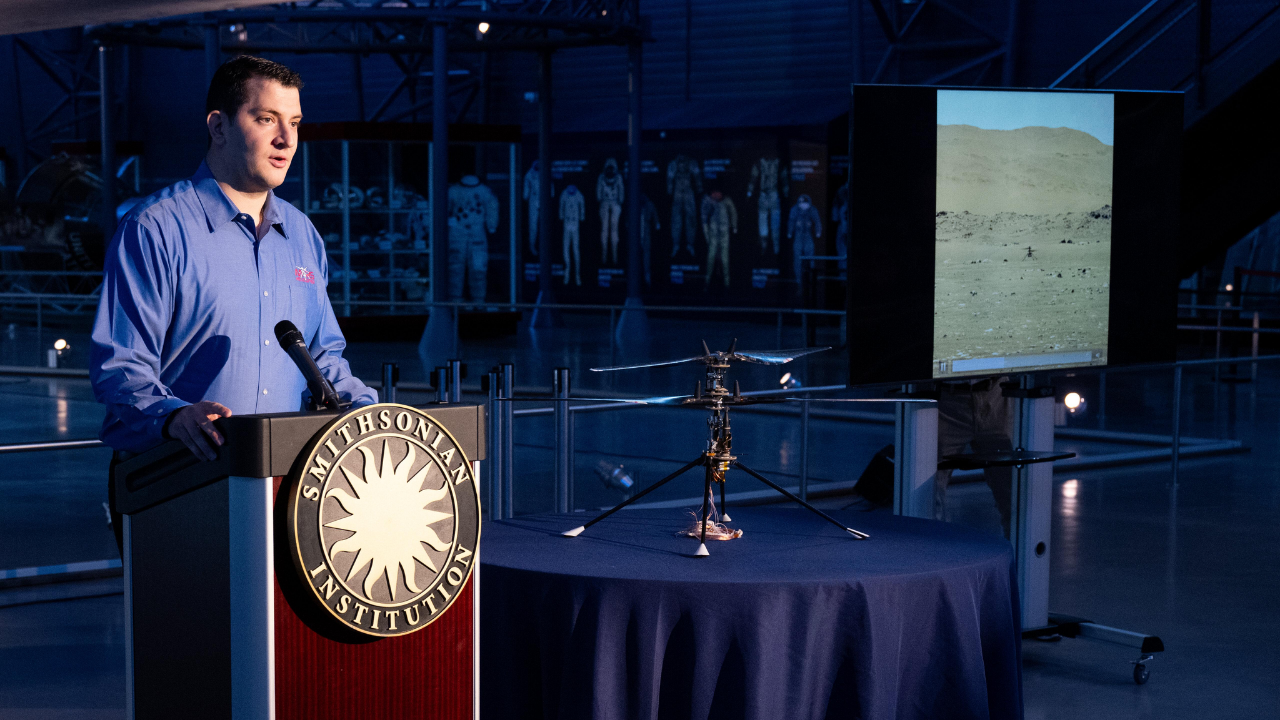
When NASA’s Ingenuity helicopter lost contact just above the surface of Mars on January 18, 2024, it marked the end of a groundbreaking chapter in space exploration. The small, four-pound helicopter had far exceeded its original expectations. Initially planned for a short, one-month test of five flights, it went on to survive nearly three Earth years and perform 72 flights. Its final mission ended when damage to its rotor blades made further flight impossible. What began as a side experiment turned into one of NASA’s greatest success stories, a model for future flying machines on other worlds.
Ingenuity’s achievements changed how scientists think about exploring planets. It proved that powered flight could happen on a world with an atmosphere just one percent as thick as Earth’s. More than that, it showed that a small, lightweight craft could become an essential partner to a Mars rover, helping to scout routes and explore terrain from above.
From One-Month Test to Long-Term Explorer
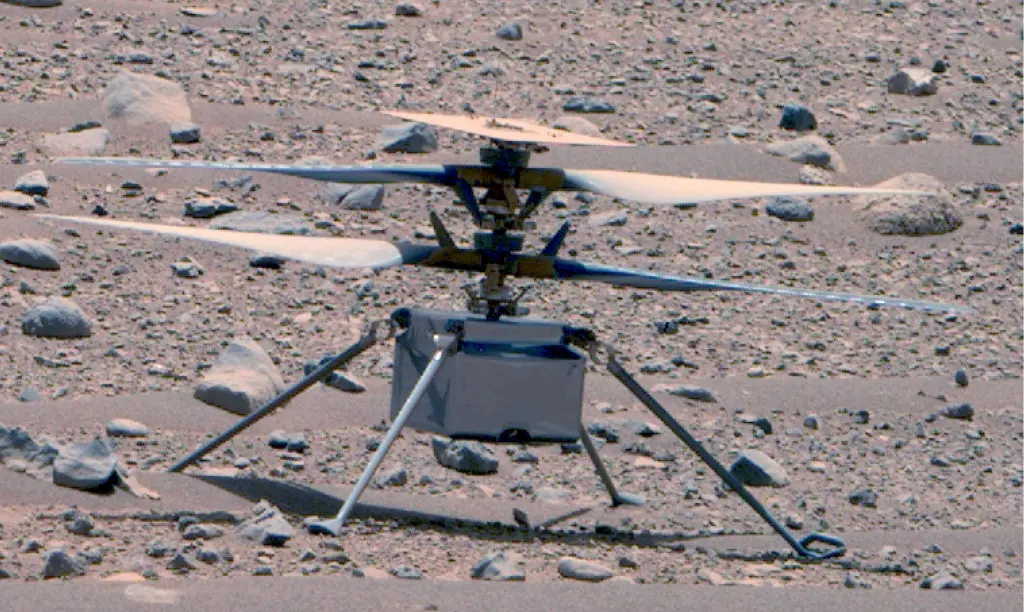
Ingenuity was originally built to fly only five times over a period of 30 days, mainly to prove a concept: that flight was possible in the thin Martian air. Instead, the helicopter remained active for more than 1,000 Martian days, or nearly three Earth years. During that time, it logged over two hours of flight time and traveled more than fourteen times farther than expected.
Its first flight took place on April 19, 2021, a moment NASA compared to the Wright brothers’ historic flight in 1903. In a symbolic gesture, Ingenuity carried a small piece of fabric from the Wright Flyer, connecting the birth of flight on Earth to its first steps on another planet.
Flying on Mars was no easy task. The planet’s atmosphere is so thin that Ingenuity’s rotor blades had to spin incredibly fast to lift off the ground. Temperatures could drop to minus 100 degrees Fahrenheit, threatening its batteries and electronics. Dust storms also dimmed sunlight and coated its solar panels. Originally built for just a short mission, Ingenuity had to adapt to survive, relying on clever power management and software updates sent from Earth. Over time, it became more than a test vehicle, it became a functional scout for the Perseverance rover, spotting hazards and identifying areas scientists wanted to study.
Changing How We Explore Other Worlds
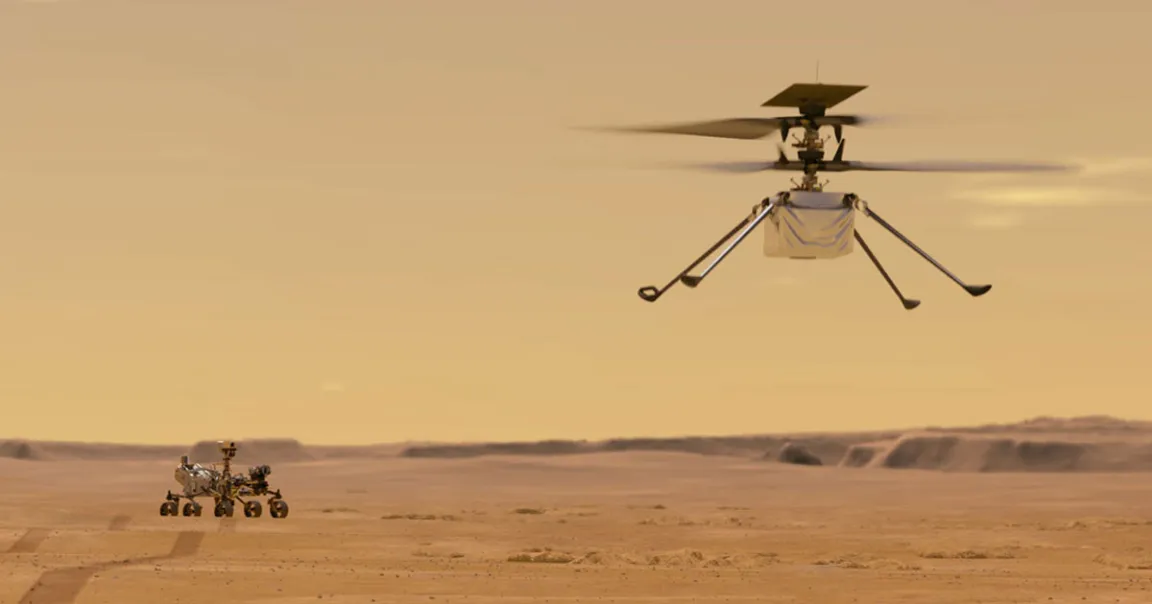
Throughout its time in Jezero Crater, Ingenuity explored 48 separate landing zones, essentially a network of tiny airfields across Mars. It survived several emergency landings, collecting valuable data on how autonomous aircraft react to sudden changes in terrain and conditions.
One of the most surprising lessons from Ingenuity’s mission came from its hardware. Many of its parts were not custom-built for space, they were commercial off-the-shelf components, similar to those found in consumer drones. Yet they endured years of cold, dust, and radiation, challenging assumptions about what kind of technology can survive beyond Earth.
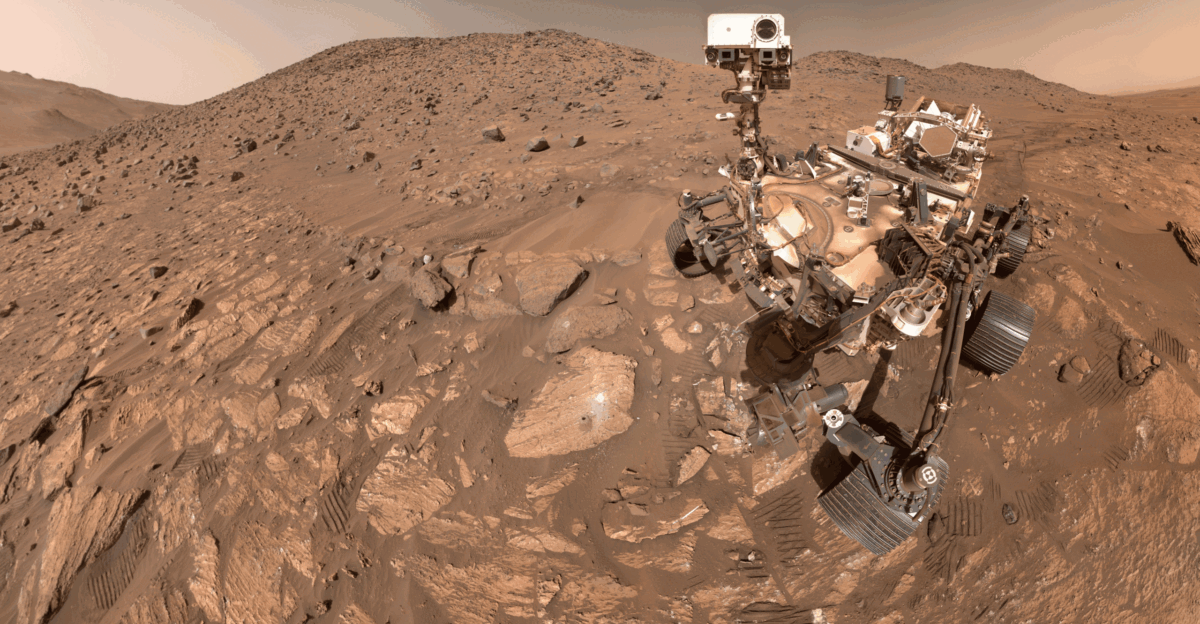
The helicopter’s work also revealed the limits of its design. During colder Martian winters, engineers had to carefully time operations to conserve power. These challenges are now shaping how future missions plan for energy shortages and extreme conditions. Still, the advantages of aerial scouting proved undeniable. While the Perseverance rover moves just tens of meters per day, Ingenuity could cover large distances in minutes. With the helicopter grounded, Perseverance’s daily missions are once again slower and more cautious, but the detailed maps and images Ingenuity provided continue to guide its journey.
A Rough Landing and a Lasting Legacy
Ingenuity’s final flight, its 72nd started like many before. It climbed smoothly to about 40 feet, hovered, and began descending. Then, communication was lost. When contact resumed the next day, the helicopter was upright and still able to send data, but images revealed that its rotor blades were severely damaged.
NASA’s investigation found that Ingenuity had flown over a patch of sand with too few visual features for its navigation camera to track. The helicopter’s system relies on surface details like rocks or ripples to estimate speed and position. Without those clues, it misjudged its motion, touched down too fast, and hit uneven ground. The impact bent and snapped parts of its carbon-fiber blades, ending its ability to fly, though the rest of the craft was still operational. NASA officially ended the mission on January 25, 2024.
Despite its final mishap, Ingenuity’s accomplishments were remarkable. It flew more than fourteen times as many missions as planned and lasted thirty times longer than expected. Its ending was not a failure but a natural conclusion to a bold experiment that far exceeded anyone’s hopes.
Ingenuity’s impact reaches far beyond Mars. NASA is already designing new aerial vehicles inspired by its success, ones that will carry science instruments, make independent decisions, and operate for years at a time. Its GPS-free navigation system and power management methods are also being applied to drones and robotics on Earth, especially in environments where satellite signals are weak or unavailable.
For students, engineers, and dreamers on Earth, Ingenuity became a symbol of creativity and perseverance. It proved that even a small, experimental craft could redefine exploration. On Mars, it now rests forever as a silent witness to a new era, one where flight is not limited to Earth, but reaches out into the skies of other worlds.
Sources
“After Three Years on Mars, NASA’s Ingenuity Helicopter Mission Ends.” NASA Jet Propulsion Laboratory, 25 Jan 2024.
“NASA Performs First Aircraft Accident Investigation on Another World.” NASA, 10 Dec 2024.
“Mars Helicopter Ingenuity Holds Piece of Wright Brothers History.” Smithsonian Magazine, 31 Mar 2021.
“Ingenuity, NASA’s Mars Helicopter.” The Planetary Society, 24 Jan 2024.