The first evidence of atmospheric sputtering has been recovered thanks to NASA’s MAVEN spacecraft. This significant step details how solar winds have eroded the red planet’s atmosphere over the last 4 billion years, which is why the once water-laden world has become a desert.
Catalogued in a May 2025 Science Advances paper, the breakthrough showed escape rates that are higher than models predicted, a development that is more than reshaping our understanding of the planet’s climate history.
Solar Wind’s Relentless Erosion
Mars’ upper atmosphere is struck by heavy ions from the solar wind at altitudes of 350-400 kilometers. The impact ejects neutral atoms into space like a cannonball splashing into a pool and propelling water outward. Without a global magnetic field to shield it from the onslaught, Mars has to, and has always been, endure this cosmic sandblasting uninterrupted.
From 2014 to 2024, MAVEN’s three instruments tracked argon-40, a noble gas ideal for measuring loss. A 9.8-fold density increase was observed at high altitudes during particle precipitation, with escape rates of 2.1×10²³ atoms per second. This observation is four times what had been theoretically estimated.
Statistical tests for categorical data confirmed these spikes with 99.21% confidence. However, it was noted that intense events amplified the effect. In January 2016, argon densities surged over 100-fold due to an interplanetary coronal mass ejection. Four billion years ago, the sun’s activity likely intensified, eroding Mars’ atmosphere and leaving the barren planet we see today.
Evidence of a Wet Ancient Mars
Water volumes that could fill half the Atlantic were present on Mars billions of years ago. This vast mass of water could potentially form the Oceanus Borealis, which could have covered 36% of the planet’s surface, and at depths of 100-1500 meters. From isotopic data, scientists deduced losses exceeding six times the water in the planet’s current polar caps.
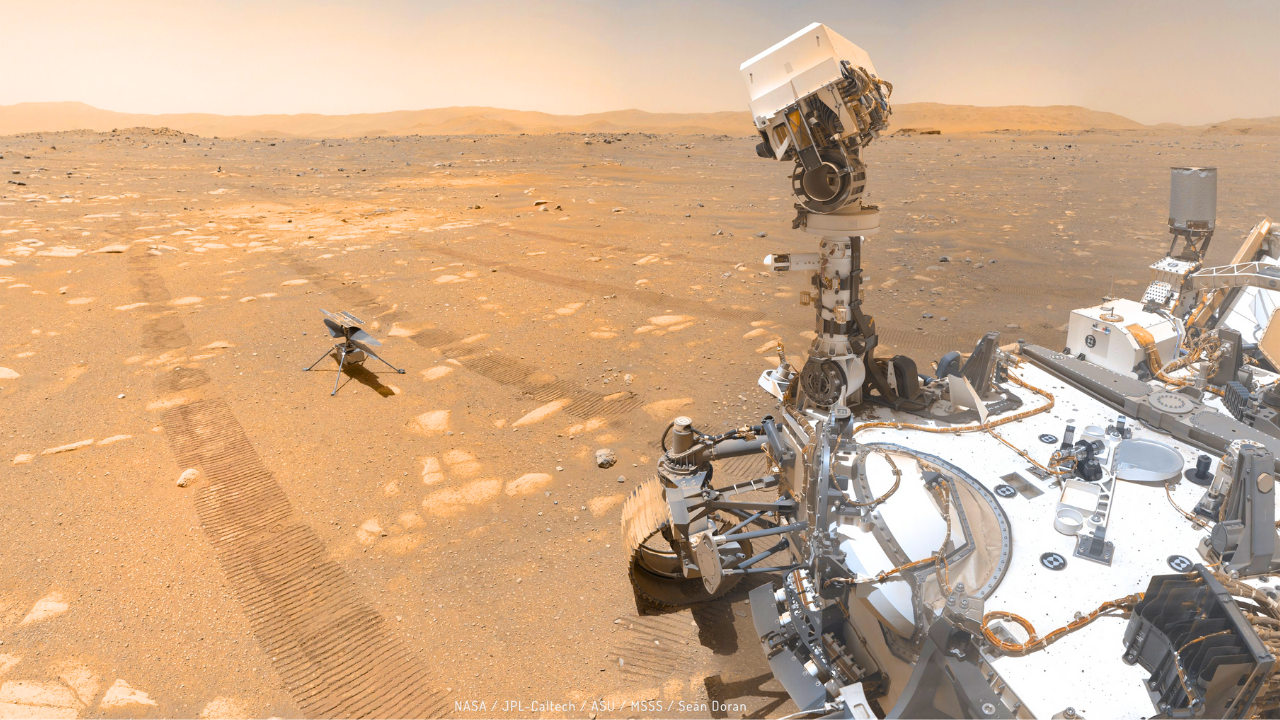
This theory has been confirmed by rovers on the planet, including Curiosity’s mudstones in Gale Crater’s Yellowknife Bay, which are 3.5-3.8 billion years old, indicating lakes with microbial-friendly chemistry and wet-dry cycles lasting millions of years. Perseverance is probing Jezero Crater’s river delta for information like biosignatures from flood flows.
Magnetic Collapse and Geological Scars
While scientists are still debating the timing, some suggest that Mars’ magnetic dynamo was present in specific spots until some 3.9 billion years ago. However, without shielding, solar winds eroded the atmosphere, which, in turn, lowered the pressure below the liquid water stability limit. What remains now are features like Valles Marineris, which speak of powerful water bodies that once dominated the planet’s surface.
Mars’ temperature now averages -81°F. At the planet’s equator, highs come in at a toasty 70°F, while the poles see temperatures as low as -225°F. The planet’s 95% CO2 atmosphere exerts just 6-7 millibars—one percent of Earth’s, which means there’s scant insulation and wild gradients. The planet was likely habitable from 4.45 to 3.5 billion years ago.
MAVEN’s Uncertain Future
On December 6, 2025, NASA lost contact with MAVEN. Solar conjunction, which lasts until January 16, 2026, has blocked any recovery attempts, which has left the mission in limbo. These findings offer a cautionary model for exoplanets. Even worlds that boast water and organic life can become uninhabitable when their magnetic protection is shredded.
Sources:
“First direct observations of atmospheric sputtering at Mars.” Science Advances, May 2025.
“NASA’s MAVEN Makes First Observation of Atmospheric Sputtering at Mars.” NASA Science, May 2025.
“Mars Curiosity rover finds evidence of ancient lakes in Gale Crater.” Science Magazine, Dec 2014.
“Perseverance rover reveals an ancient delta-lake system and flood deposits at Jezero crater, Mars.” Science Magazine, Oct 2021.
“Revisiting timeline that pinpoints when Mars lost its dynamo.” Harvard Gazette, Nov 2023.
“NASA loses contact with MAVEN, Perseverance continues sample collection.” NASA Spaceflight, Dec 2025.