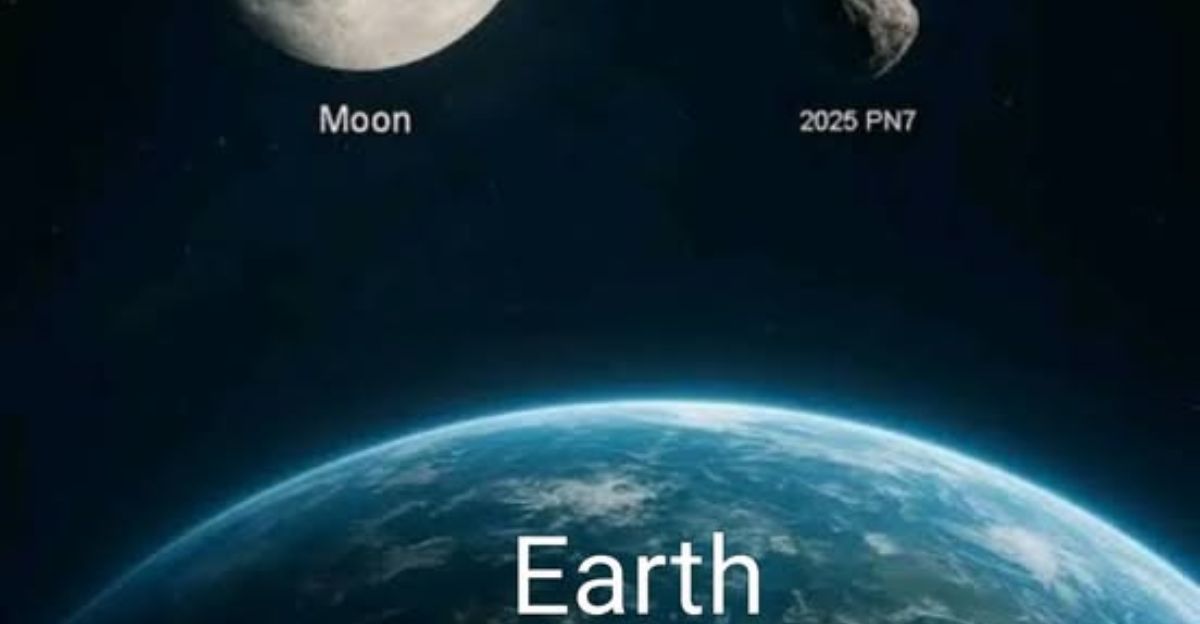
NASA has confirmed that a small asteroid named 2025 PN7 is moving with Earth like a mini moon, staying nearby in space until about 2083, but it is not a true second moon like the one in our night sky.
Astronomers describe it as a near-Earth asteroid that just happens to match Earth’s path around the Sun so closely that it appears to tag along with our planet for decades.
Earth’s New Mini Moon
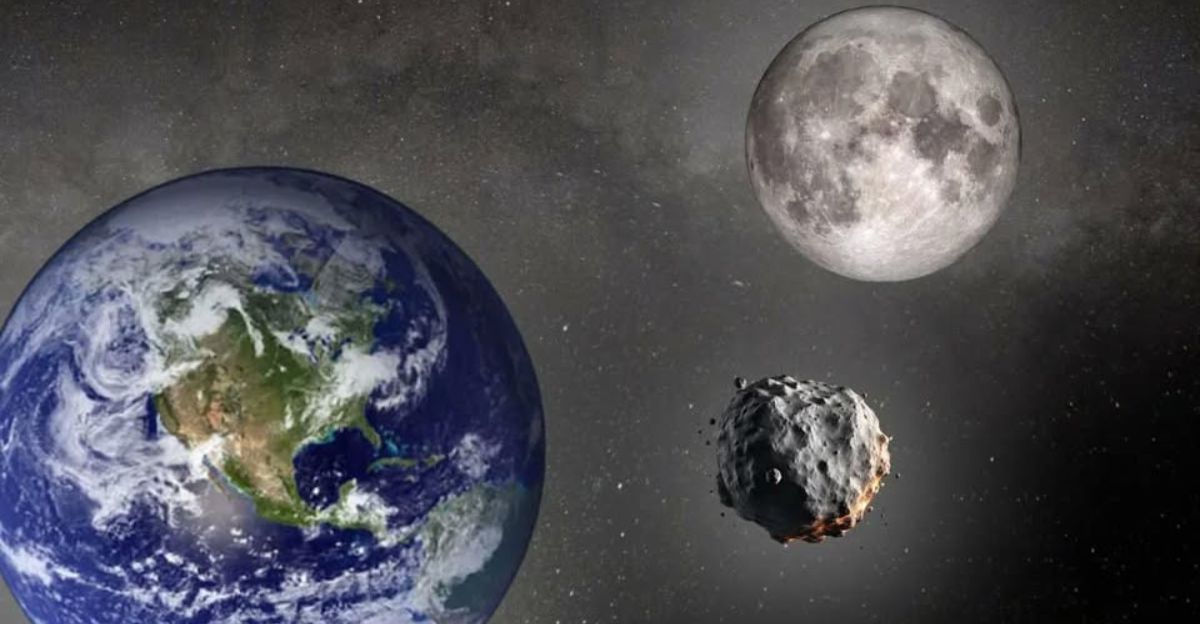
NASA has identified asteroid 2025 PN7 as a new mini moon, a small space rock that travels around the Sun in almost the same path and pace as Earth. It will remain near our planet in this special orbital pattern until roughly 2083, meaning today’s children could still be hearing about it when they are older adults.
Experts stress that this object is not a true second moon but a near-Earth asteroid whose orbit resonates with Earth’s, making it appear to follow us through space.
What Makes 2025 PN7 Special?
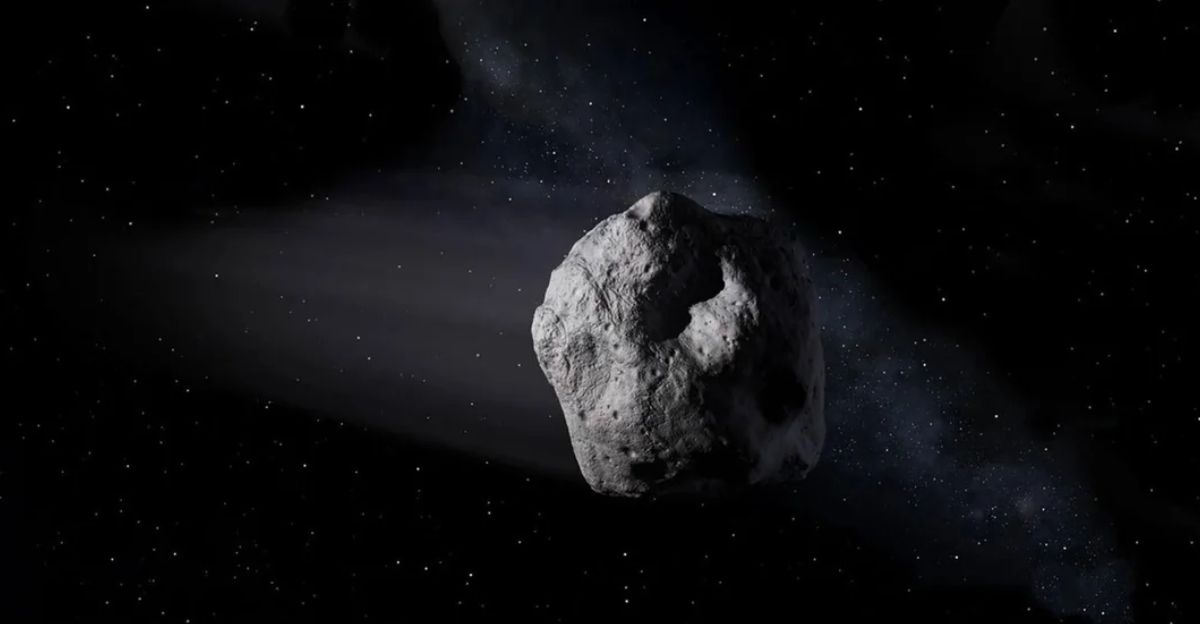
Astronomers classify 2025 PN7 as a quasi-moon or quasi-satellite, meaning it shares Earth’s year-long journey around the Sun rather than circling Earth directly. Its orbit is tightly synchronized with ours, so over long periods it stays close in a repeating pattern instead of quickly drifting away like many other passing asteroids.
Official recognition came when NASA’s databases and the International Astronomical Union’s Minor Planet Center agreed that its motion fits a long-lived co-orbital relationship with Earth, not a one-time flyby.
The Orbit In Simple Terms
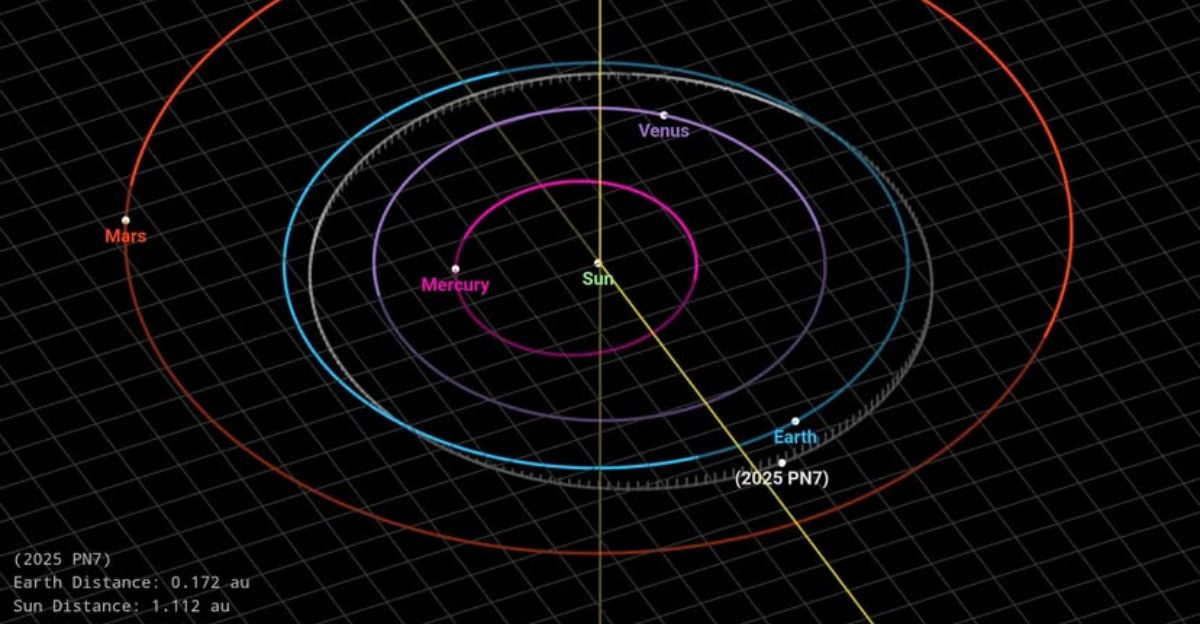
In practical terms, 2025 PN7 takes about one Earth year to go around the Sun, just like our planet does. Its path is only slightly stretched (a small eccentricity) and only a little tilted compared with Earth’s orbit, so the asteroid spends its time in a very Earth-like lane of the solar system highway.
Because the orbits are so similar, the asteroid never strays very far from Earth’s neighborhood, even though the Sun’s gravity, not Earth’s, is what actually controls its motion.
Discovered On A Hawaiian Mountaintop

2025 PN7 was first flagged as a new asteroid in August 2025 by the Pan-STARRS survey, which uses powerful wide-field telescopes in Hawaii to scan the sky for moving objects. These telescopes, located at the Haleakalā Observatory, repeatedly image huge swaths of sky, looking for faint dots that shift position from night to night.
After the initial detection, astronomers went back through older images from observatories on Maunakea and elsewhere and found that the same object had been recorded as far back as 2014, hiding in plain sight.
How Astronomers Confirmed The Mini Moon
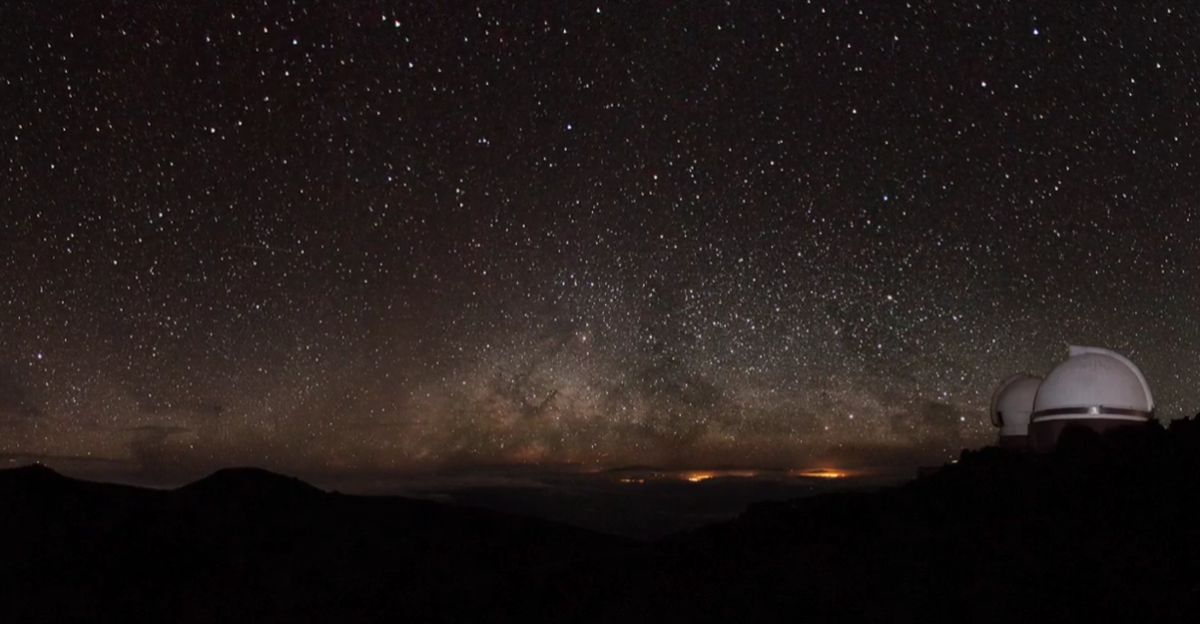
Once the Pan-STARRS team submitted precise position measurements, the Minor Planet Center, which serves as the global clearinghouse for asteroid data, issued an official announcement and assigned the temporary name 2025 PN7. Orbital specialists then combined observations spanning more than a decade, from 2014 to 2025, to calculate a reliable orbit and test whether the asteroid was just passing by or truly sharing Earth’s path.
NASA’s orbital database confirmed that the asteroid’s period matches Earth’s within a tiny fraction, sealing its status as a quasi-satellite companion rather than a one-time visitor.
A Bus-Sized Rock You’ll Never See
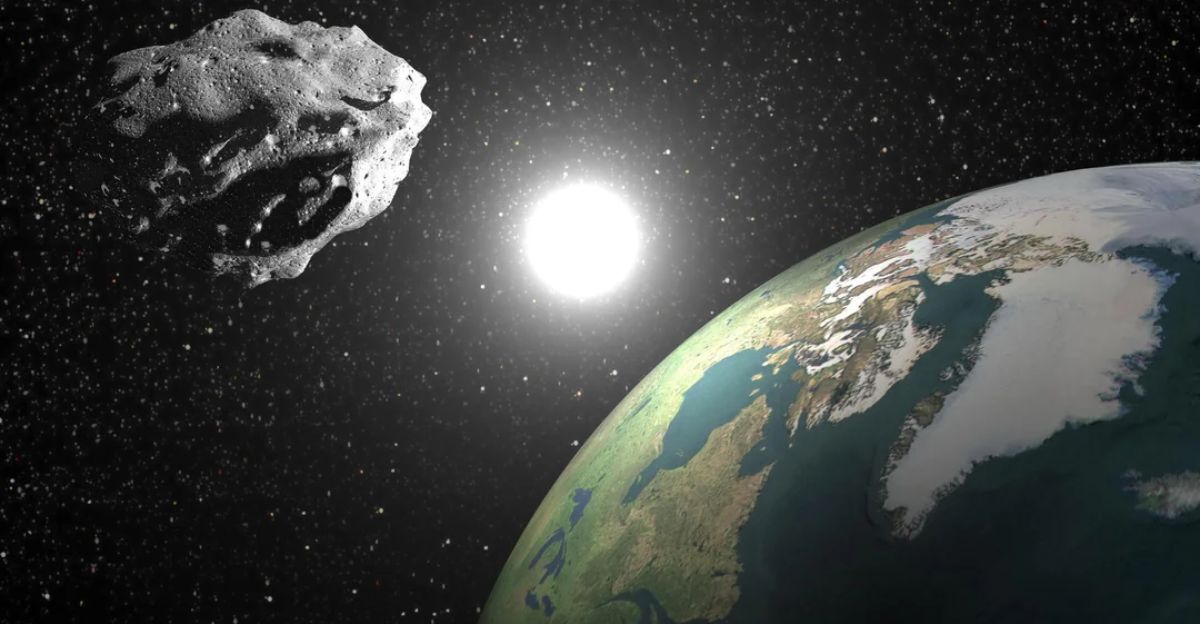
From its faint brightness, astronomers estimate that 2025 PN7 is about 19 to 20 meters across, roughly the size of a city bus or a small house. That might sound large, but in space terms it is tiny, and combined with its distance, this makes the asteroid incredibly hard to spot except with large professional telescopes.
Its absolute magnitude is around 26, far dimmer than anything the human eye can see, which explains how it could evade notice even while traveling near Earth’s orbit for years.
How Close Does It Really Come?
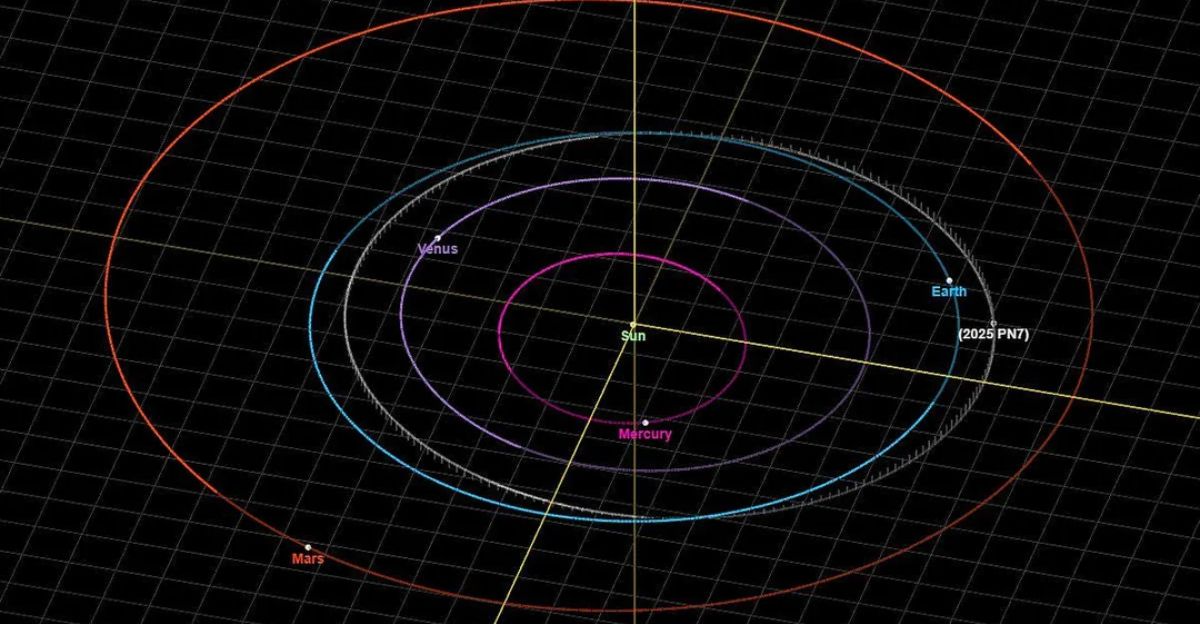
Even though 2025 PN7’s orbit runs close to Earth’s, that does not mean the rock swoops dangerously past our planet. Calculations show that the closest parts of its orbit and Earth’s orbit are roughly comparable to the average Earth–Moon distance when measured as track-to-track separation, not as actual flyby distance.
In real space, current models suggest that its closest approaches will still leave it millions of kilometers away, far too distant to show up as a bright object in the sky or to have any physical effect on Earth. NASA emphasizes that this is a harmless companion, one that comes close only on paper, not in any way that people on the ground would notice.
The Corkscrew Path Around Earth
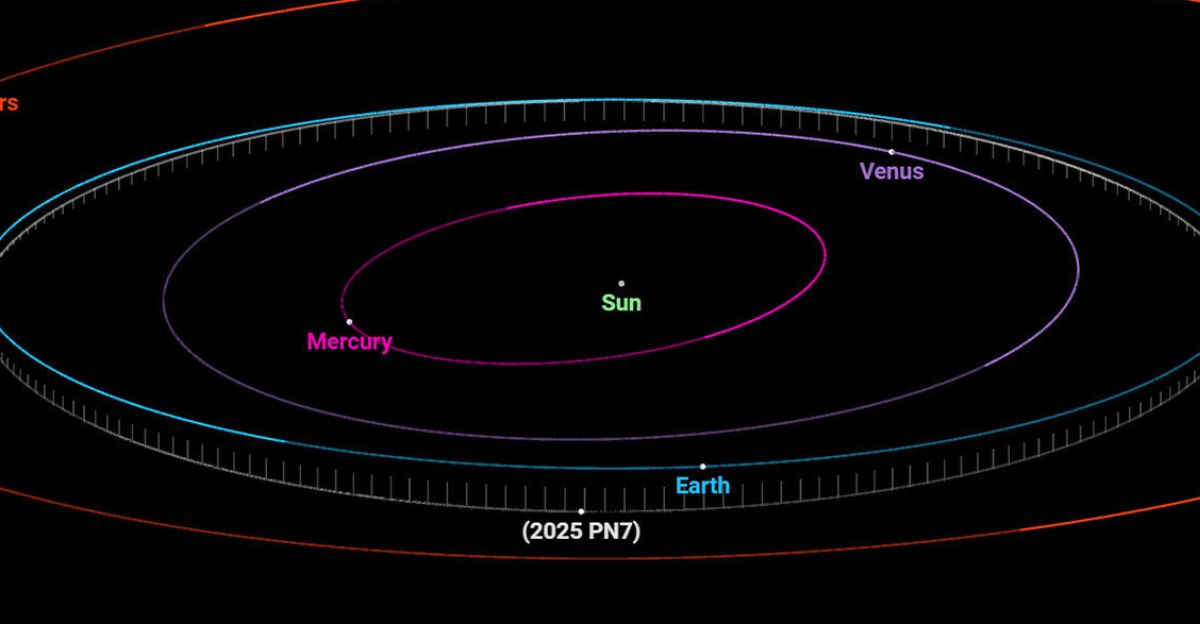
Because 2025 PN7 shares Earth’s orbital period but travels on a slightly offset path, its motion appears very strange when plotted from Earth’s point of view. Over months and years, diagrams of its position show a looping or corkscrew pattern, as if the asteroid is slowly circling around Earth while both bodies actually orbit the Sun together.
This optical illusion comes from what astronomers call a 1:1 mean-motion resonance, where Earth and the asteroid complete orbits in step, so the asteroid seems to drift ahead of and behind us in a repeating cycle.
Why It’s Called A Quasi-Satellite
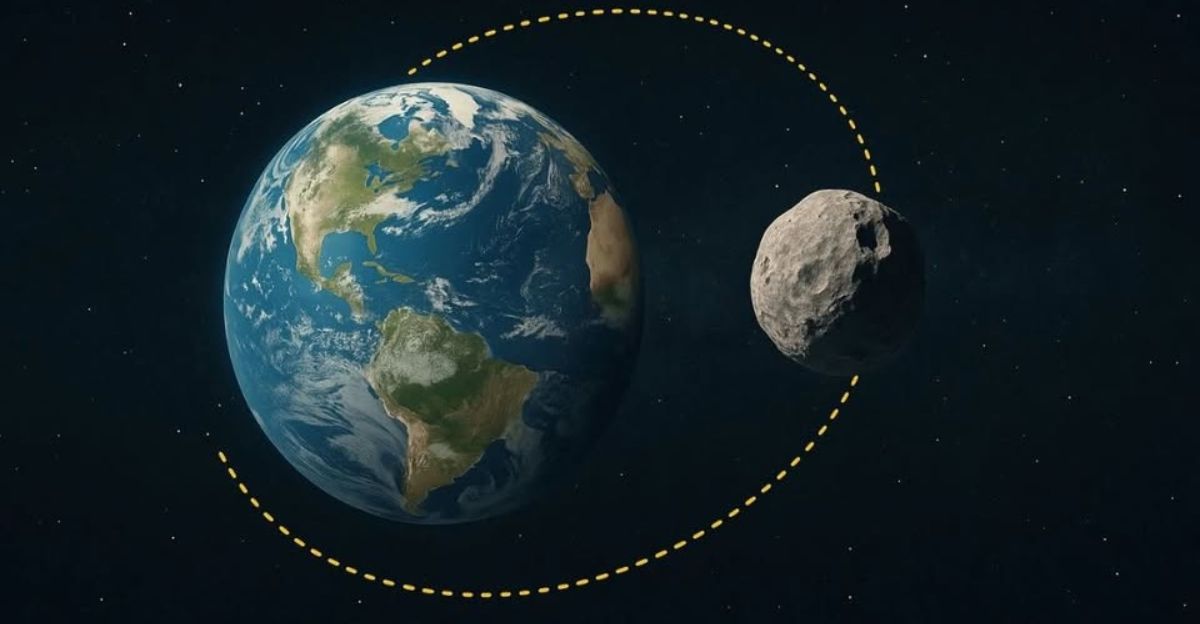
The term quasi-satellite signals that 2025 PN7 behaves like a moon in some ways but is not bound to Earth by gravity the way our main Moon is. Instead, it orbits the Sun on a track that stays near Earth’s orbit, and over many years its average position relative to Earth remains confined to a limited region rather than wandering all around the sky.
From our perspective, that makes it look like a shy second moon, always hovering nearby but never getting close enough to join the Earth–Moon system.
A Long-Term Companion

Computer simulations of 2025 PN7’s motion show that it has probably been in this quasi-satellite arrangement with Earth for several decades already and will keep us company until around 2083. That span of nearly 60 years makes it one of the longest-lasting quasi-moons known, since many similar objects stay in Earth-like orbits for only a few years before drifting away.
For astronomers, this long stay provides a rare chance to follow the same small body over a big chunk of a human lifetime, watching how subtle forces and gravitational nudges slowly reshape its path.
One Of The Most Stable Tag-Alongs
Studies of 2025 PN7 indicate that its shared orbit with Earth is unusually stable, resisting disruption from the gravitational pulls of other planets for at least five to six decades. This stability, combined with its Earth-like orbit, makes it stand out among co-orbital objects and places it among the most dynamically steady companions discovered so far.
Scientists use such examples to refine their understanding of how resonant orbits work and why some small bodies remain trapped in these configurations while others quickly escape.
Why There’s No Danger Of A Crash
Even though the phrase second moon can sound dramatic, detailed orbit modeling shows no realistic chance that 2025 PN7 will hit Earth in the coming decades. Its resonant motion keeps it oscillating around a safe track that never brings it anywhere near our atmosphere, and current solutions show no pathways that would change that while it remains a quasi-satellite.
NASA and other agencies classify it as non-hazardous, meaning there are no predicted impacts, even when factors like gravitational nudges from planets are taken into account.
The Subtle Forces Guiding Its Journey
Over time, 2025 PN7’s motion is influenced by more than just the gravity of the Sun and Earth. Tiny effects like solar radiation pressure and the Yarkovsky effect, where sunlight warms the asteroid and it re-emits that heat unevenly, can slowly push on the rock, changing its orbit by small amounts over many years.
These gentle nudges will eventually ease the asteroid out of its current quasi-satellite state, sending it into a slightly different, still safe orbit elsewhere in the inner solar system.
A Real-Life Lesson In Orbital Resonance
Because 2025 PN7’s year is almost exactly the same length as Earth’s, it offers a clear example of what astronomers call a 1:1 mean-motion resonance. In this arrangement, two bodies share nearly identical orbital periods yet manage to avoid hitting each other, thanks to differences in the shapes and tilts of their orbits and the timing of their motion.
By tracking this asteroid precisely, researchers can test theories about how such resonant configurations form, how long they last, and what finally breaks them apart.
What It Shows About Our Blind Spots
The story of 2025 PN7 also highlights how easy it is to miss small asteroids, even when they travel in our own orbital lane. The object showed up in archival images years before its nature was recognized, revealing that current sky surveys, though powerful, still have gaps when it comes to very faint, slow-moving rocks.
Astronomers warn that dozens or even hundreds of similar objects could be sharing Earth’s orbital zone without yet being cataloged, simply because they are too small and dim to stand out in routine scans.
If We Missed This, What Else Is Out There?
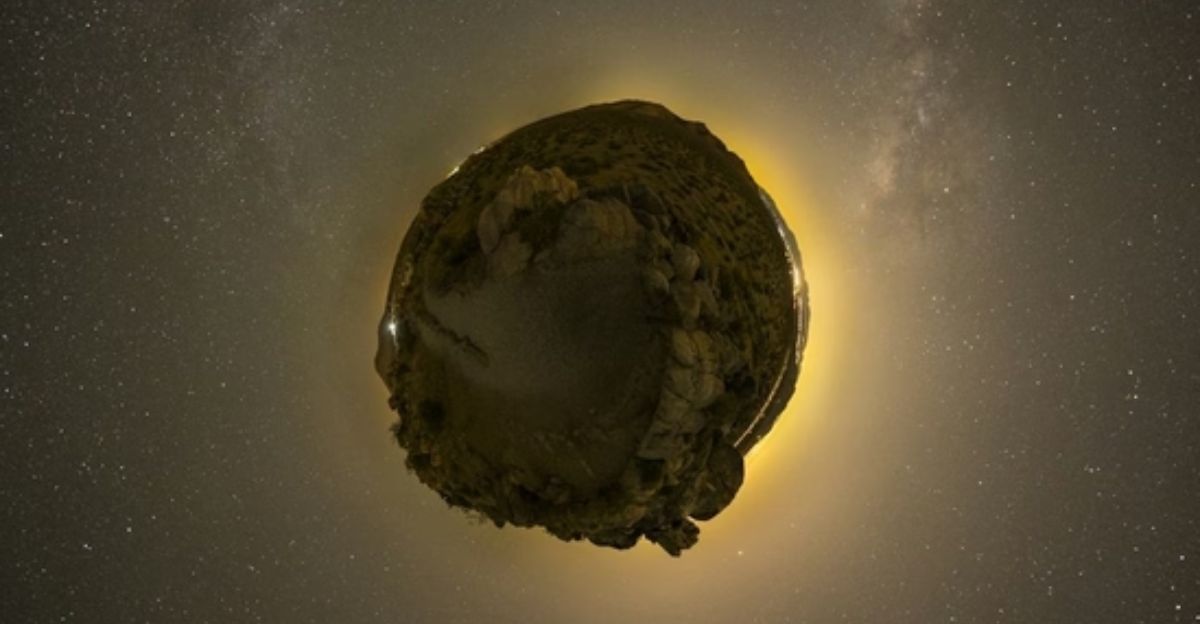
Because 2025 PN7 is only around 20 meters wide and extremely faint, its late identification suggests that many other small asteroids could be traveling near Earth unnoticed. Researchers estimate that the number of similar co-orbital or quasi-satellite objects might reach into the dozens or more, forming a hidden population that current surveys are only starting to uncover.
This realization is pushing observatories to develop more sensitive instruments and smarter software that can pick out faint, slow-moving points of light from the noisy background of stars and galaxies.
Lessons For Planetary Defense
Although 2025 PN7 itself is not dangerous, its size puts it in the same class as objects that could cause serious local damage if they ever struck Earth. Studying its orbit and physical behavior helps refine the models used to predict how potentially hazardous asteroids move and respond to small forces over time.
These insights are vital for planning future deflection missions, where tiny changes in an asteroid’s path, applied years in advance, could steer it safely away from Earth.
A Natural Target For Future Missions
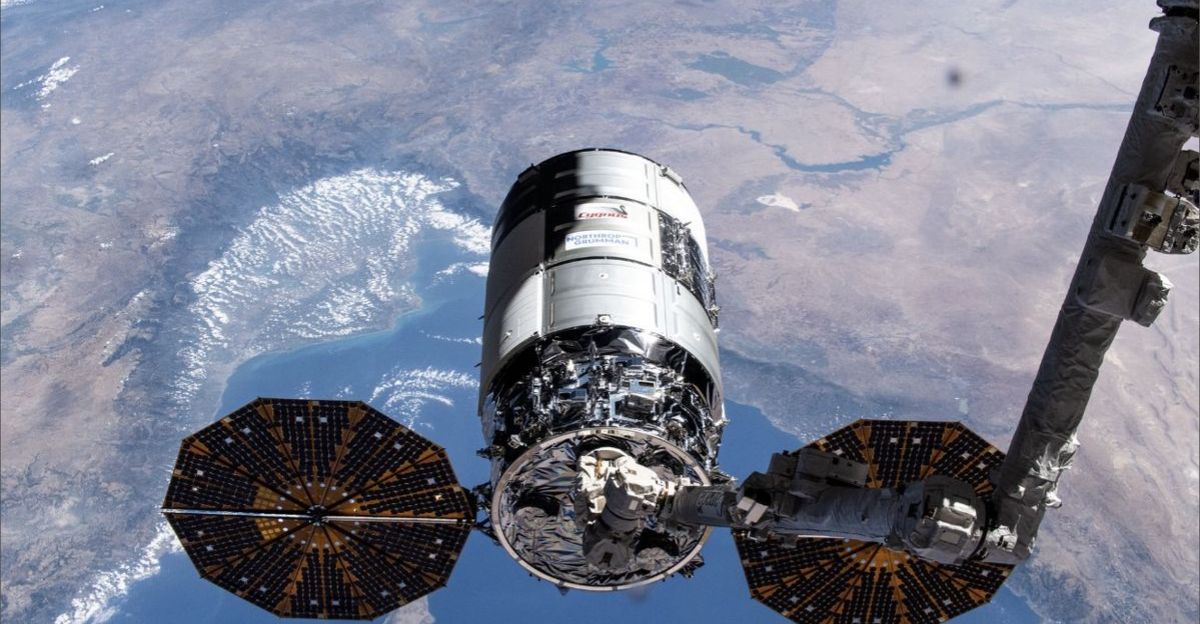
Because 2025 PN7 moves almost in lockstep with Earth for decades, it is an appealing target for spacecraft wanting to practice operations around small bodies. Its relatively low relative speed and predictable trajectory would reduce the fuel needed to reach it and make it easier to plan close passes, landings, or even sample-return missions.
Engineers could use such a mission to test precision navigation, anchoring systems, and instruments that search for useful materials, all in a setting much closer than the main asteroid belt.
How This Mini Moon Differs From Our Real Moon

Earth’s main Moon is a massive natural satellite that orbits our planet directly, strongly shaping tides, eclipses, and the look of the night sky. In contrast, 2025 PN7 is a tiny asteroid that orbits the Sun and only appears to stick near Earth because its path and timing closely match ours.
It is far too small and faint to see without powerful telescopes, and ordinary people would never notice its presence without hearing about it from astronomers.
One Of Several Quasi-Moons, But A Special One
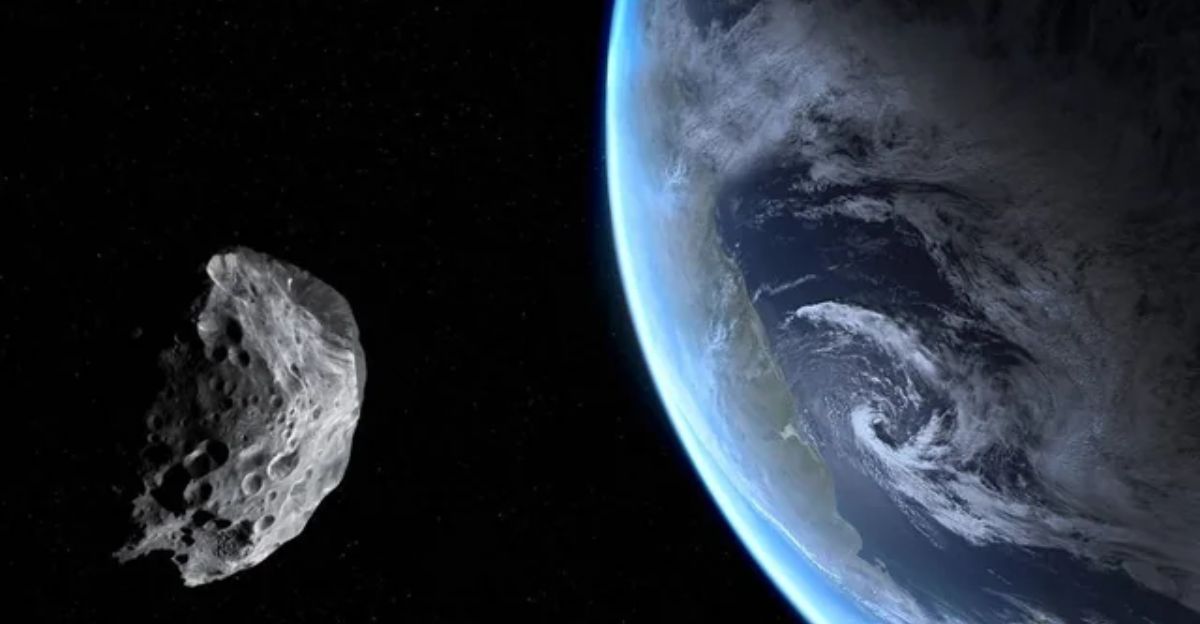
2025 PN7 joins a small family of other known quasi-moons, such as Kamoʻoalewa, that also share Earth-like paths for limited periods. Together, these objects help scientists understand how near-Earth asteroids evolve, how fragments from larger bodies can get trapped in resonant niches, and how long such arrangements can last.
What makes 2025 PN7 stand out is its long, roughly 58-year stay and its potential as a stable, nearby target for both science and technology demonstrations.
Sources:
NASA / JPL – Center for Near-Earth Object Studies overview of 2025 PN7 and quasi-moons
CNN – “Meet 2025 PN7, Earth’s unseen quasi-moon companion”
Earth.com – “NASA confirms Earth has a new quasi-moon for the next 50 years”
Northeastern University News – “Experts: Earth Could Have Six More ‘Quasi-Moons’ Like 2025 PN7”
Getaway Magazine – “NASA confirms Earth has a new quasi moon that will stay for 50 years”