NASA’s Jet Propulsion Laboratory (JPL) is carefully watching an asteroid called 2025 XM, a space rock about 84 feet (26 meters) wide, roughly the size of a Boeing 737 jet. This asteroid is moving through the solar system at around 9,753 miles (15,700 kilometers) per hour. It made its closest approach to Earth on December 9, 2024, coming within 295,000 miles (475,000 kilometers).
That may sound close, but it’s actually about 1.2 times farther away than the Moon, whose average distance from Earth is about 239,000 miles. That means 2025 XM passed well outside the Moon’s orbit and nowhere near the satellites we rely on every day. Most communication satellites are about 22,000 miles above Earth, while GPS satellites orbit at about 12,500 miles. NASA’s calculations showed no danger of impact, and the asteroid was so faint and fast that it could only be seen through powerful professional telescopes.
This kind of close pass isn’t unusual. Thousands of small asteroids pass near Earth each year, and NASA closely monitors them to make sure none pose a danger. 2025 XM’s safe flyby is a good reminder of how active and ever-changing our solar system is.
Speed, Size, and Safety
Even though 2025 XM isn’t very large, it’s traveling incredibly fast. At 9,753 miles per hour, it could circle the Earth almost four times in a single hour if it were in orbit here. Its motion is driven by the Sun’s gravity and by tiny tugs from the planets it passes.
With a size smaller than a basketball court or about 20 school buses lined up end to end, 2025 XM doesn’t qualify as a “potentially hazardous asteroid.” NASA gives that label only to objects larger than 492 feet (150 meters) that come within 4.6 million miles (7.5 million kilometers) of Earth. Since this asteroid is much smaller and still quite far away by space standards, it’s rated as Level 0 on the Torino Impact Hazard Scale, meaning it poses no threat at all.
Even so, scientists keep track of asteroids like this one to understand how their orbits change over time. Studying their behavior helps experts improve their early warning systems for any future asteroids that might come too close for comfort.
How NASA Tracks Asteroids
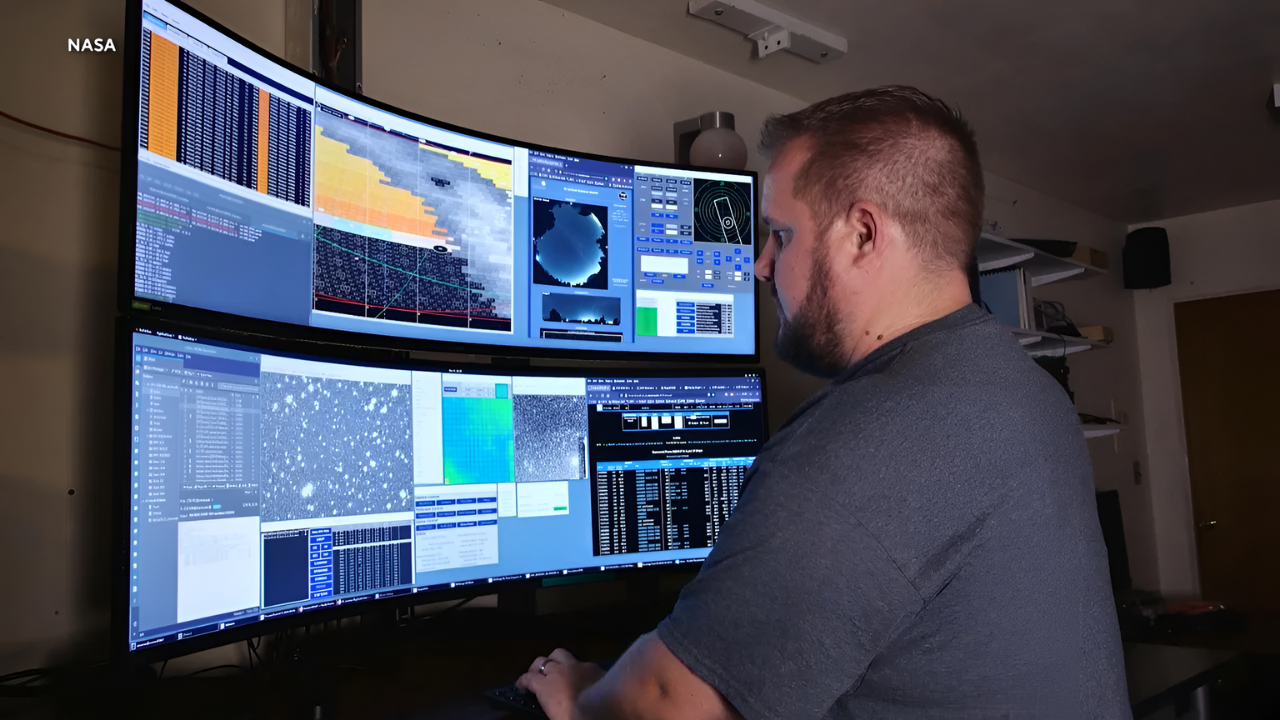
NASA’s main asteroid-monitoring team works out of the Center for Near-Earth Object Studies (CNEOS) at JPL in Pasadena, California. They use powerful radar systems such as Goldstone Deep Space Communications Complex in California, plus telescopes around the world and even spacecraft-based infrared sensors. All these tools combine data to determine the exact paths of asteroids as they move through the solar system.
Two important computer systems called Scout and Sentry automatically analyze newly discovered asteroids. They calculate where these objects will be years into the future, accounting for factors such as gravity from planets and the push of sunlight on their surfaces. The Minor Planet Center collects and shares this data internationally so that astronomers everywhere can contribute to precise tracking.
So far, NASA and partner teams have cataloged over 33,000 near-Earth objects (NEOs), and they find more than 3,000 new ones each year. Many small asteroids, however, remain hidden because they are faint or travel through areas of the sky difficult to observe, such as near the bright glare of the Sun. Despite those challenges, the network of observatories continues to expand, improving detection capabilities every year.
A Busy Sky and Why Vigilance Matters
The flyby of asteroid 2025 XM was just the start of a busy cosmic schedule that month. Within 48 hours of its pass, two more small asteroids also came by Earth: the 48-foot-wide 2019 XN3 on December 10, which passed at a distance of 1.36 million miles, and the 140-foot-wide 1999 SF10 at 1.95 million miles. These “clusters” of close approaches happen because many space rocks share similar orbital paths shaped by Earth’s and Jupiter’s gravity.
Every year, more than 2,000 objects pass closer than the Moon’s distance, and scientists expect to spot even more as detection tools improve. However, surveys like Pan-STARRS in Hawaii and ATLAS only find about 40% of asteroids smaller than 140 meters, leaving many still unknown.
If an object the size of 2025 XM ever hit Earth, it could create a 1-kilometer-wide crater and release energy equal to hundreds of thousands of tons of TNT, enough to cause serious local or regional damage through shockwaves, fires, and, if it struck an ocean, tsunamis. It wouldn’t threaten the entire planet, but the impact would be devastating nearby.
This is why NASA and other space agencies stay alert. While small asteroids like 2025 XM pose no risk, tracking them helps scientists prepare for the rare but dangerous cases. The continuing improvements in observation technology show that Earth’s planetary defense systems are working well, keeping watch over the constant stream of rocks passing through our solar neighborhood.
Sources:
JPL Asteroid Watch – Live NEO monitoring and close approach data.
How We Track Asteroids – Details on telescopes, radar, and CNEOS systems – Astronomy
Eyes on Asteroids – Interactive 3D visualizations of orbits like 2025 XM. – Eyes NASA
Asteroid Impact Effects – Simulations of regional devastation from small impacts. – Physics World