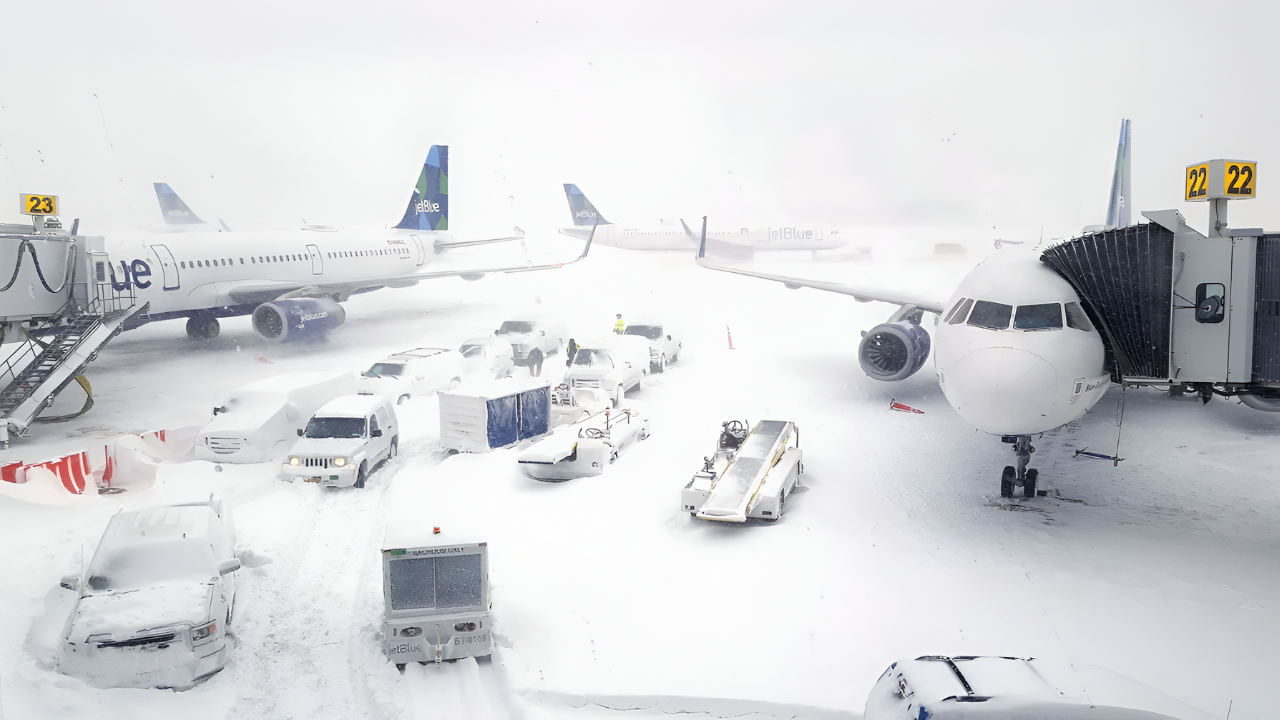
Bomb Cyclone Ezra arrived as families were boarding planes and packing cars for the holidays, then swiftly turned one of the busiest travel periods of the year into a coast-to-coast shutdown. Spanning more than 20 states, the storm fused record warmth and sudden Arctic cold into dangerous snow, ice, and wind. By New Year’s Eve, more than 9,000 flights had been disrupted and entire regions were struggling with whiteouts, power failures, and treacherous roads. Over Lake Erie, the system was so intense it physically sloshed the lake, swinging water levels by more than a dozen feet between shorelines.
Holiday Travel in Turmoil
Winter Storm Ezra struck just as airports were operating at full capacity. Within days, more than 9,000 flights were delayed nationwide and about 850 were canceled, stranding families in terminals from Detroit to Boston. Travelers slept on terminal floors, waited in hours-long customer service lines, and scrambled to rebook once, twice, or more as the system pushed problems into early January.
The aviation disruption rippled through major hubs including Detroit, Newark, and Boston Logan. De-icing bottlenecks and crew shortages compounded the weather problems, ultimately affecting nearly 2 million passengers. Airlines waived some change fees, but many stranded travelers still faced missed connections, lost luggage, and days-long delays as carriers worked through a backlog created by the storm.
Highways offered little relief. Interstates including I-75 in Michigan, I-35 in Iowa, and I-80 in Pennsylvania were shut down at times by multi-vehicle collisions. In Minnesota alone, state troopers responded to hundreds of crashes in a single day. Officials across several states pleaded with residents to stay off the roads, warning that even short trips could become life-threatening as visibility vanished and ice took hold.
Inside a “Bomb Cyclone”

Ezra became a “bomb cyclone” when its central pressure dropped more than 24 millibars in 24 hours, the threshold meteorologists use for this term. That rapid deepening created a strong pressure gradient, driving winds that, in some places, rivaled coastal storms normally seen in warmer seasons.
At Mount Washington in New Hampshire, gusts exceeded 100 mph during the storm period, while Buffalo’s airport logged winds near 80 mph, just under its all-time record. These inland gusts, unusually strong for a winter system, snapped trees, tore down power lines, and generated large waves on exposed shorelines. At the same time, snow bands intensified, with some areas seeing snowfall rates up to three inches per hour, fast enough to turn previously clear pavement into a complete white curtain within minutes.
In the Great Lakes and Upper Midwest, Ezra dropped heavy snow across more than two dozen states. Michigan’s Mt. Arvon recorded nearly 28 inches, and parts of Wisconsin and New York saw drifts surpassing 20 inches. Lake-effect zones downwind of the Great Lakes were forecast to receive as much as four feet of additional snow. At one point, roughly 40 million people were under winter storm or blizzard alerts, while high-wind warnings covered about 114 million residents across the eastern half of the country.
Temperature Whiplash and an Icy Northeast
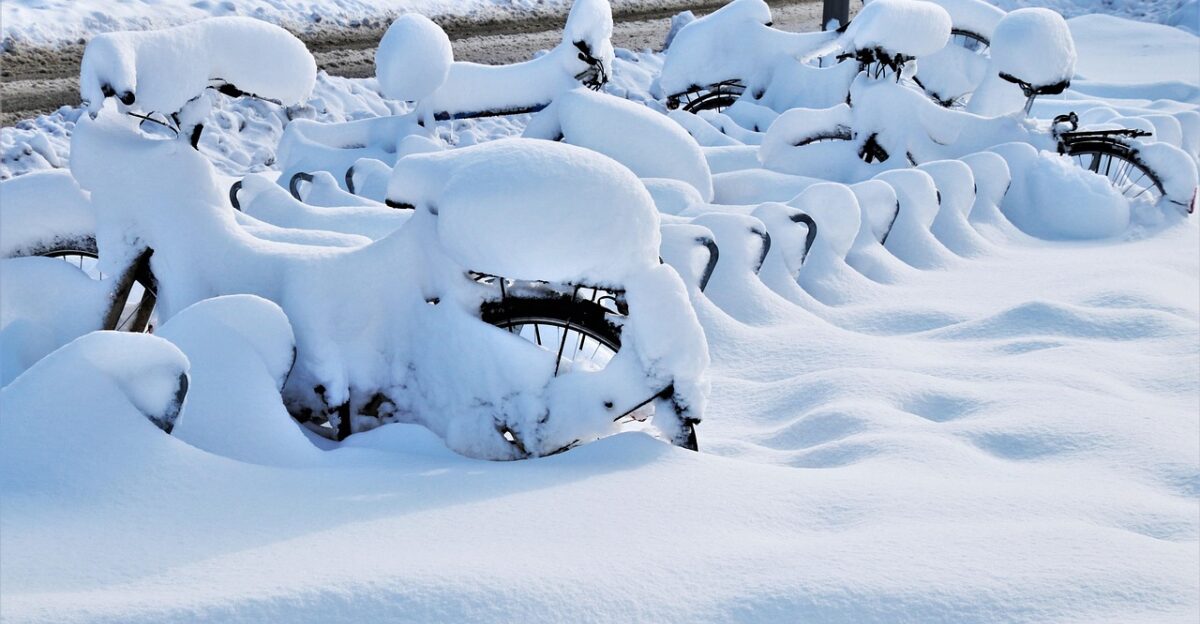
One of Ezra’s defining features was the speed and scale of its temperature swing. St. Louis reached 78 degrees Fahrenheit, its warmest December reading on record, before tumbling more than 50 degrees into the 20s overnight. Similar plunges unfolded across the central United States as an unusually warm air mass gave way almost instantly to Arctic air. The swings broke local records and underscored the storm’s intensity.
While the Midwest and Great Lakes contended with deep snow and bitter cold, the Northeast faced a different threat: ice. From parts of the Appalachians into New England, a glaze up to an inch thick coated trees, power lines, and roads. That amount of ice added enormous weight to branches and overhead wires, increasing the risk of outages and falling limbs. Emergency responders in rural areas resorted to tire chains and slow convoys to navigate back roads that had become slick, glassy surfaces.
The storm’s southern flank produced yet another hazard. In Illinois and Indiana, survey teams confirmed at least a dozen tornadoes, some rated EF1. The combination of blizzard conditions to the north and tornadoes to the south in a single, connected system was described by forecasters as highly unusual. At least one person was reported dead in a storm-related multi-vehicle crash on Interstate 35 in Iowa.
Power Loss, Lake Erie’s Seiche, and the Cost
As winds increased and heavy snow and ice accumulated, power systems faltered. More than 300,000 homes lost electricity at Ezra’s peak, leaving close to a million people exposed to subfreezing conditions. By Monday night, about 200,000 customers in New York, Pennsylvania, and the Great Lakes area were still without power. Utility crews worked in dangerous wind chills to repair downed lines and restore service, but in some communities, residents endured days without reliable heat in the middle of the cold snap.
On Lake Erie, Ezra’s winds produced one of the storm’s most dramatic effects. Persistent, strong west-to-east gusts forced water to pile up on the eastern end of the lake and withdraw from the western shore, creating a phenomenon known as a seiche. Near Toledo, water levels dropped more than six feet, exposing portions of the lakebed and revealing shipwrecks usually hidden below the surface. Near Buffalo, levels rose by a similar amount, creating a total swing of about 13 feet. Forecasters described it as one of the most notable events of its kind on the lake in decades.
Economic assessments estimated Ezra’s overall cost in the tens of millions of dollars, including damage to structures, lost power, halted business operations, and transportation shutdowns. The less visible toll included missed family gatherings, postponed medical procedures, and communities cut off by impassable roads.
In the aftermath, governors and local leaders reiterated calls for caution during severe winter systems, urging residents to heed forecasts, avoid unnecessary travel, and prepare for possible outages. Ezra’s reach, from record warmth to sudden deep freeze, from heavy snow to tornadoes and lake seiches, underscored how fast conditions can change and how vulnerable modern transportation and power networks remain when a far-reaching winter storm intensifies over a large swath of the country.
Sources
Reuters, Winter Storm Ezra snarls US travel as meteorologists warn of ‘bomb cyclone’, 2025-12-28
Weather.com, Winter Storm Ezra Triggers Seiche on Lake Erie, 2025-12-30
USA Today, Lake Erie’s floor exposed in ‘seiche’ caused by strong wind, 2025-12-29
Yahoo News, Officials raise alarm after documenting record-shattering warmth and whiplash cold in St. Louis, 2025-12-30
Final Call, Bomb cyclone strikes the Northeast and Midwest, 2026-01-05