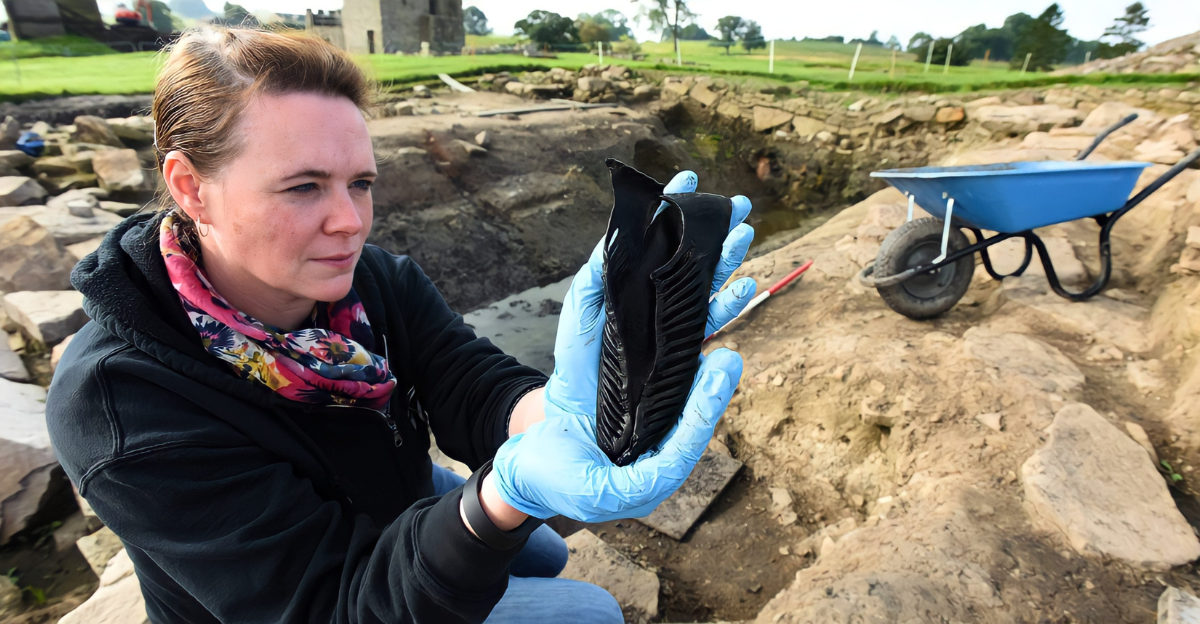
Along South Africa’s Cape south coast, scientists have long been puzzled by fossil footprints with unusually crisp edges and no visible toe impressions.
These striking track patterns, preserved in ancient aeolianites (cemented sand dunes), date to roughly 70,000–150,000 years ago. The footprints’ sharp, rectangular outlines challenge assumptions that early humans walked habitually barefoot.
Some show “rounded anterior ends [and] crisp margins” but lack any toe marks. Why are the toe prints missing? This mystery has set the stage for a remarkable story about early technology and adaptation along the prehistoric shore.
Hidden Evidence

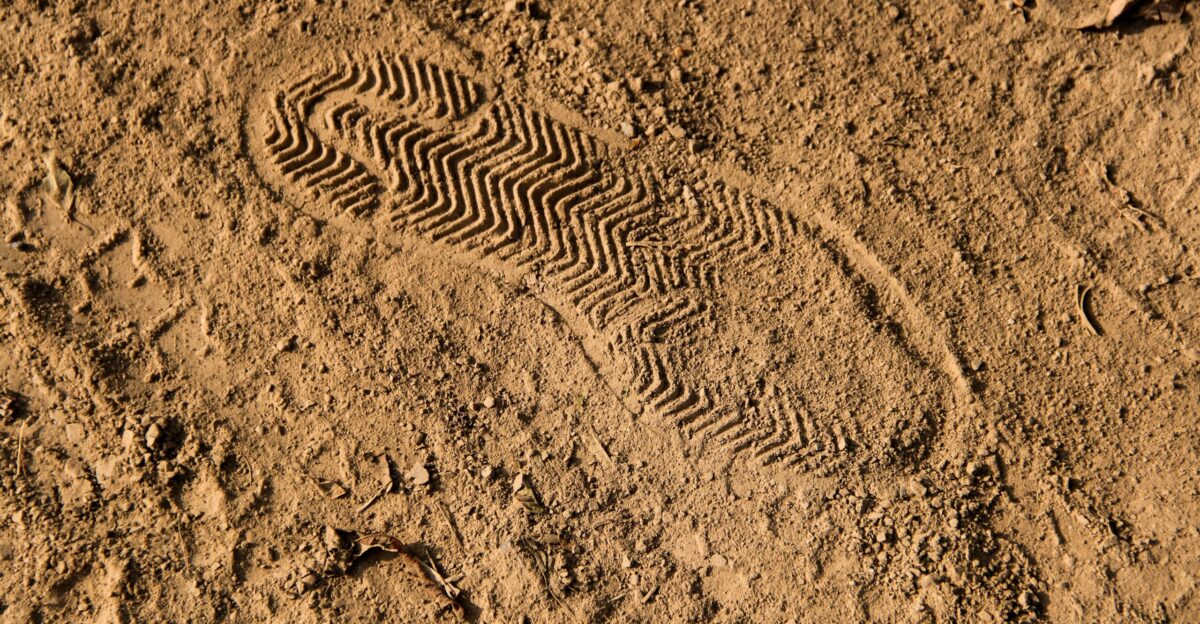
Closer inspection revealed that these odd footprints resemble shoe prints more than barefoot tracks. The South African tracks consistently lack digit impressions, yet they show clear, sharp contours and even hints of strap attachment points.
The prints look more like those made by wearing a hard sole than an uncovered foot.
For example, some prints have sharply defined forefoot edges and flat heel areas, unlike ordinary barefoot tracks.
This evidence suggested a radical idea: Middle Stone Age people on the Cape coast might have been wearing footwear to protect their feet.
Coastal Heritage

The Cape Coast’s aeolianite formations – ancient cemented sand dunes – create perfect natural “time capsules” for footprints.
Here, the sand was moist and cohesive, then rapidly buried and turned to rock, preserving every trace of life from long ago. These rare coastal deposits have yielded an extraordinary number of Pleistocene tracks – not only by humans, but by giraffes, elephants, and even ancient sea turtles.
In the Garden Route National Park alone, researchers have recorded over 50 vertebrate tracksites, and countless more along the wider coast.
This rich cache is a paleontologist’s dream – offering snapshots of daily life on the shore 100,000 years ago.
Scientific Pursuit
Ichnologist Dr. Charles Helm of Nelson Mandela University has led decades of work documenting these coastal trackways. Starting in the early 2000s, his team mapped hundreds of track-bearing surfaces.
They catalogued both barefoot Homo sapiens tracks – with clear toe marks – and the mysterious toe-less prints.
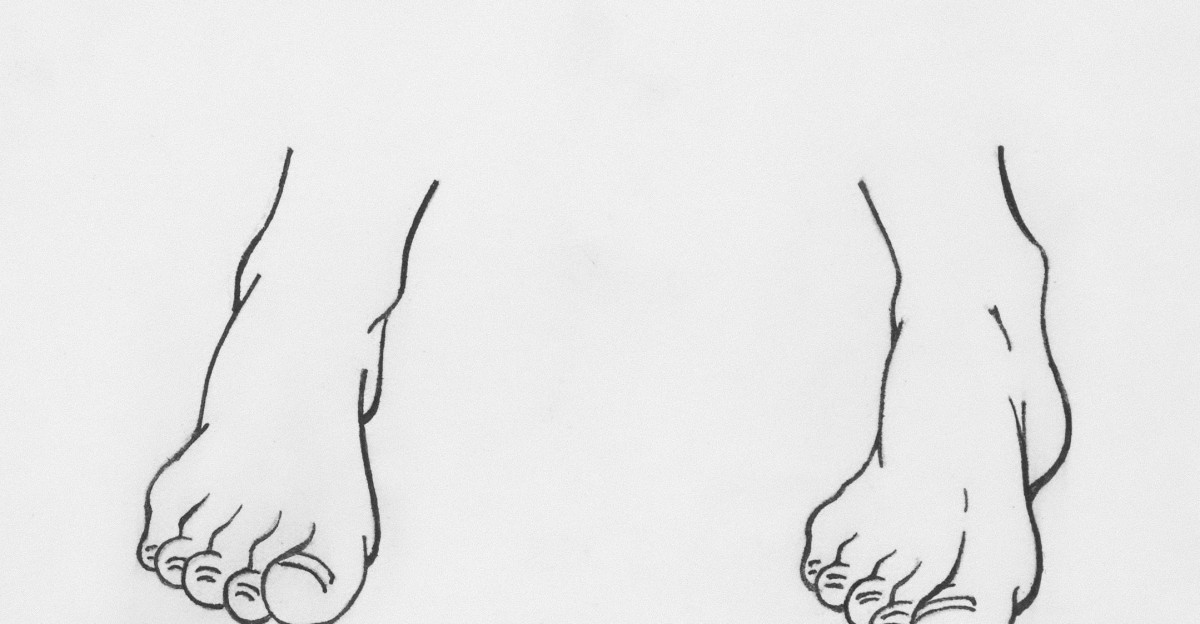
To solve the puzzle, Helm worked with podiatrists and archaeologists to develop new methods to tell shod from unshod tracks. He drew on knowledge of ancient technologies worldwide, seeking clues about when humans first made clothes and shoes.
Their systematic approach combined geology, archaeology and even foot biomechanics.
Sandaled Ancestors
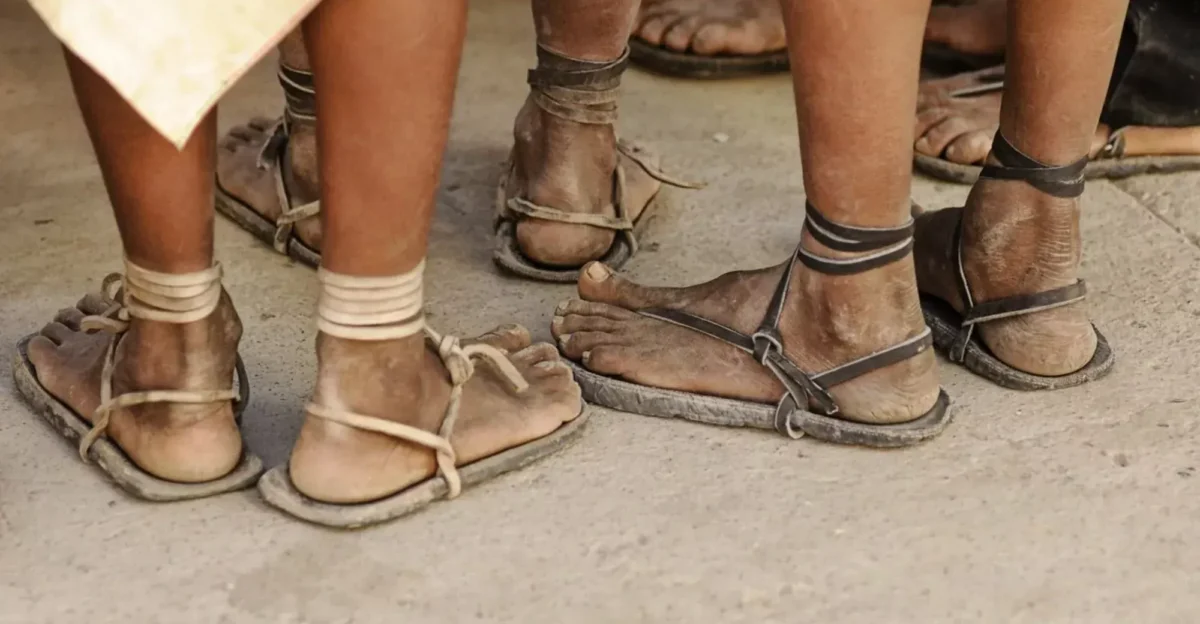
In 2023 the team published their key findings in the journal Ichnos. They identified three Cape coast sites – at Kleinkrantz, Goukamma and Woody Cape – with footprints clearly consistent with hard-soled sandals.
At these sites, trackways lacked toes yet corresponded in size to small Homo sapiens feet.
The researchers even replicated ancient shoes: they made simple sandals (inspired by San people footwear) and walked along the same dunes.
The result? The replica prints matched the fossils exactly. “Though the evidence is not conclusive, we are excited about our discoveries,” said Helm, noting that these finds support the idea that southern Africa was a cradle of early innovation.
Regional Impact

Why put on shoes so early? The Cape south coast has sharp volcanic rocks, tidal pools, and sea urchins underfoot – hazards that could seriously injure bare feet. In one scenario painted by the researchers, a 100,000-year-old stonecut or urchin puncture could prove deadly without protection.
The South African environment thus provided strong motivation to improve footgear.
Coastal foraging was rich but risky: the region’s ancestors had mastered seafood, shellfish and fished along rugged shores. A protective sandal could prevent infection or lacerations, increasing survival odds in a perilous habitat. Necessity likely drove early humans here to fashion and wear sturdy sandals.
Human Stories
Local experts and heritage officials are amazed by the discovery’s story. Bernhard Zipfel, a Wits University curator and trained podiatrist on the team, explained: “We all assumed people were habitually barefoot.
However, the Southern Cape Coast had very sharp rocks at the time. It makes sense that people would use footwear to protect themselves.
One hundred thousand years ago, an injury to the foot could have been fatal.”.
Their work reminds us that behind every fossil track is a real person who faced daily dangers on ancient beaches.
Global Context

Before this finding, the oldest known evidence for shoes came mainly from Europe and Asia, and was much younger. Only about four pre-30,000-year-old sites (Neanderthal and early Homo sapiens) had been suggested as having shoe-tracks.
In fact, global records of shod footprints were scarce, mostly from Upper Paleolithic Europe.
The new Cape coast data push back the timeline by roughly 40,000 years and mark the first such evidence in sub-Saharan Africa.
This implies that footwear technology may have been invented independently in different human populations. As one researcher notes, inhabitants of these Middle Stone Age foraging communities had “the means, motive and opportunity to fashion footwear” even before Europeans are thought to have done so.
Preservation Science

The Cape tracks’ survival is due to extraordinary preservation conditions. Footprints form in damp, compacted sand, then must be buried quickly by dune blowouts or rains. Over time, minerals cement the sand into rock.
On the exposed coast, new tracksites appear as cliffs collapse, but the “half-life” of these exposures is often weeks – storm surges, rain, and erosion can obliterate them.
Researchers work frantically to document prints after exposure. (In fact, one promising site in 2022 deteriorated and slumped into the sea before it could be studied.) Scientists use 3D photogrammetry and plaster casts to capture every detail before the next tide washes it away.
Experimental Breakthrough

To validate the shoe hypothesis, the team built simple hard-soled sandals and walked in them on the same beach.
They tried open-sole designs with toe straps – much like indigenous San footwear – walking on damp, compact sand. The resulting tracks came out sharp-edged with no toe marks, sometimes showing an impression where the strap lay against the sole.
“There were amazing correlations,” said Zipfel about matching their experimental prints to the fossils. The replicas even left strap‑imprint marks at positions similar to points seen on the ancient tracks, reinforcing the link to footwear use.
Scientific Skepticism

Despite the compelling match, researchers remain cautious. As Zipfel and Helm acknowledge, the evidence is still inconclusive by strict standards.
No actual sandals have been found, and alternative explanations (for instance, very poor preservation of toes) cannot yet be ruled out.
In the original study words, the team “do not consider the evidence conclusive” and emphasize that their interpretation is the most plausible hypothesis so far.
At this stage, the claim is framed as a suggestion of sandal use rather than a definitive proof.
Research Evolution

The discovery came from decades of incremental work by Helm and colleagues. Interestingly, Helm started his career in medicine (he’s an M.D. by training) before shifting to paleontology and coastal geology.
This interdisciplinary background – combined with Zipfel’s podiatry expertise – helped the team interpret tracks in creative ways.
Early coastal track research in South Africa began only in the 1960s (three fossil tracks at Nahoon Cave) and really took off in the 2000s.
Helm’s collaboration across geology, archaeology and biomechanics exemplifies how modern paleo-research is a team effort.
Technology Development

High-tech methods played a key role. The team used digital imaging and computer analyses to compare fossil and experimental prints. Photogrammetry created 3D models of the track surfaces, which could be overlaid with pictures of modern footprints in sandals.
These “amazing correlations” noted by Zipfel came from precise digital alignments.
By quantifying track dimensions and pressure points, they could demonstrate statistically that the ancient prints matched hard-soled shoes more than barefoot feet.
This novel approach sets new standards for analyzing prehistoric footprints.
Future Research

The Cape coast is both a treasure trove and a race against time. With each storm, new sites emerge – and old ones vanish. The research is ongoing: scientists patrol miles of shore, ready to document prints in days or even hours.
It’s estimated that many known sites survive only for a few weeks after exposure.
Teams plan frequent surveys, using drones to spot surfaces quickly. Meanwhile, they are on the lookout for more and longer hominin trackways, which could confirm patterns.
Every season of erosion may reveal a new snapshot of ancient life before it’s lost to the sea.
Timeline Revolution

If these findings hold up, they rewrite the timeline of human tech in Africa. They suggest that advanced problem-solving – like making shoes – emerged tens of thousands of years earlier than believed.
This pushes back complex behavior well before the Late Stone Age. It also broadens our picture of Middle Stone Age sapiens as creative innovators, not just tool-users.
The Cape coast was already famous for early jewelry (75,000-year-old beads) and fishing technology; now it may be the scene of the first shoes.
The discoveries hint that sophisticated thinking was flourishing much earlier, a potential paradigm shift in understanding our ancestors’ minds.
Archaeological Significance
The sandals story joins a pattern: southern Africa’s Middle Stone Age is bursting with firsts. Along the Cape, people were making and using symbols, harvesting seafood, and crafting specialized tools.
At Blombos Cave (South Africa), for example, perforated shell beads dating to ~75,000 years ago show clear evidence of symbolic culture.
Nearby Pinnacle Point and other sites reveal deep knowledge of marine resources and tidal rhythms. These findings, together with the footwear, reinforce that this region was a hotbed of innovation.
Early Homo sapiens here weren’t just surviving – they were inventing new technologies and cultural practices long before similar advances appeared elsewhere.
Continental Connections

The Cape Coast tracks fit into a broader African narrative. Late Pleistocene footprints have also been found in other parts of the continent, offering comparison points.
For instance, in January 2024 scientists reported 85 human footprints on a Pleistocene beach at Larache, Morocco, dating to ~90,000 years ago. These Northwest African prints – among the oldest Homo sapiens tracks known – show that humans were moving skillfully on sandy coasts across the continent.
Such finds suggest a widespread pattern: from the Cape to Morocco and East Africa, people adapted to shores and dunes.
Together, these discoveries trace ancient human journeys and innovations across diverse African landscapes.
Environmental Adaptation

The evidence paints a picture of resourceful coastal survival. Cape foragers developed not only footgear but also advanced fishing and gathering techniques.
Archaeologists know they used bone harpoons to spear fish, collected shellfish at low tide, and navigated complex tidal flats. Foot protection would have been part of this adaptive toolkit – allowing travel over sharp rocks and through cold surf.
These strategies required a deep understanding of local ecosystems: when tides were safe, where to harvest mussels, and how to avoid predators.
Making sandals was just one clever response among many to the challenges of the Pleistocene shoreline.
Cultural Innovation

Creating effective footwear is a sophisticated endeavor. It requires abstract thinking about materials and anatomy – one must decide on sole shape, fastening methods, and construction techniques.
Such planning indicates advanced cognition. Indeed, some experts note parallels with other cultural leaps: just as shell beads at Blombos show symbolic thought, sandals imply foresight and knowledge of craft.
Shoes also suggest a shared technology – knowledge passed through learning and culture.
The sandals hint that Middle Stone Age people in Africa were capable of complex invention and transmission of ideas, qualities once thought to come much later.
Legacy Questions
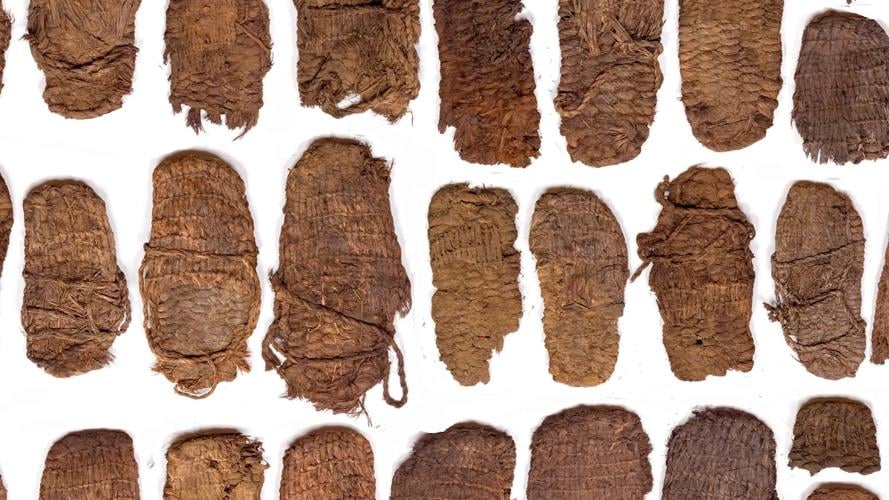
These findings raise big questions about the antiquity of human ingenuity. For perspective, the oldest surviving shoe artifacts are the Fort Rock sandals of Oregon, dated to around 10,400 years ago.
No organic shoe has lasted back to the Middle Stone Age, so footprints are the only clue. If our interpretation is right, footwear use in Africa predates Fort Rock by well over 100,000 years.
This challenges archaeologists to rethink the origins of technology.
How many other early innovations have we missed simply because the materials didn’t survive? Future research will seek new ways (and new sites) to probe these deep mysteries of our ancestors’ capabilities.