
For decades, astronomers have mapped the Milky Way using visible light, but much of our galaxy has remained hidden behind thick veils of dust. Now, a new radio image is revealing a previously invisible side of the Milky Way, exposing stellar nurseries, supernova remnants, and other cosmic structures in unprecedented detail. This breakthrough is not just a sharper picture—it is reshaping how scientists understand the life and death of stars in our galactic neighborhood.
A New View of the Milky Way
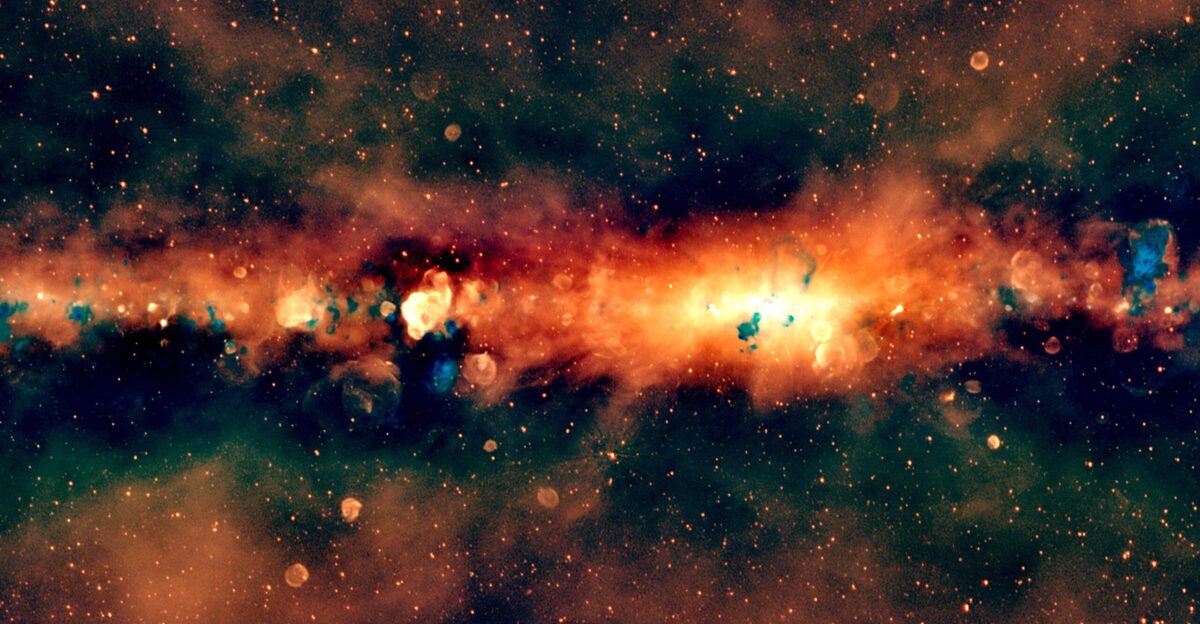
On October 28, 2025, astronomers released the most detailed and extensive radio image of the Milky Way ever produced at low radio frequencies. The GLEAM-X survey, based on data from the Murchison Widefield Array (MWA) in Western Australia, combines more than 2,000 observations into a single, multicolor view of the Southern Galactic Plane. With twice the resolution and ten times the sensitivity of earlier images, it captures features that were previously too faint or too obscured to see.
This image does not show visible light but instead maps radio emissions across 20 frequency bands. Different colors represent different physical processes: blue hues trace heat-related radiation from regions where stars are forming, while red tones highlight emissions from the remnants of exploded stars. The result is a rich, layered portrait of the Milky Way’s inner workings, from stellar birth to stellar death.
Closing the Supernova Gap
Astronomers estimate that about 2,000 supernova remnants should exist in the Milky Way, but only around 300 have been identified so far. This large gap has long been a major obstacle in understanding how stars die and how their explosions shape galaxies. Many of the missing remnants are old, faint, and buried in the galaxy’s complex radio background, making them difficult to distinguish with older instruments.
The GLEAM-X data is helping to close this gap. By providing a much more sensitive and detailed map of the galactic plane, it reveals candidate remnants that were previously undetectable. However, the challenge remains: these candidates must be confirmed with follow-up observations at higher radio frequencies and in other wavelengths, such as infrared and X-ray, to rule out false signals and ensure accurate identification.
Technology and Data at the Limits
The MWA, which began operations in 2013, is a powerful low-frequency radio telescope, but processing its data has been a massive computational task. The GLEAM-X team collected nearly 2,000 observations over seven years, requiring supercomputers to spend 18 months and more than 1 million CPU hours to assemble the final image.
This effort reflects a broader shift in astronomy: discovery is increasingly driven by big data and advanced computing rather than by individual observers at a single telescope. The GLEAM-X project is part of this new era, where large teams manage petabytes of data and rely on sophisticated algorithms to extract meaningful signals from the noise.
Southern Skies and Global Collaboration

Western Australia’s location in the southern hemisphere gives the MWA a clear view of the Southern Galactic Plane, a region that is largely obscured from northern observatories. This vantage point has allowed GLEAM-X to catalog more than 98,000 radio sources, including star-forming regions, pulsar environments, and potential supernova remnants.
The project is led by Silvia Mantovanini, a doctoral researcher at Curtin University and the International Centre for Radio Astronomy Research (ICRAR). Her work focuses on identifying supernova remnants in the GLEAM-X data, and her leadership highlights the growing role of early-career scientists in major astronomical projects. The effort is supported by ICRAR, a partnership between Curtin University and Australia’s national science agency, CSIRO, and involves multiple universities and research institutions across Australia and internationally.
What Comes Next
The GLEAM-X data has been released openly, allowing astronomers worldwide to search for new objects and phenomena. This open-science approach is accelerating discovery, as researchers in Japan, Europe, North America, and elsewhere can now analyze the same dataset for pulsars, magnetic fields, and other cosmic features.
Meanwhile, the global radio astronomy community is preparing for the next generation of instruments, including the Square Kilometre Array (SKA), expected to begin operations around 2032. Until then, projects like GLEAM-X, South Africa’s MeerKAT, and Chile’s ALMA are pushing the limits of what can be seen at radio wavelengths, combining competition and collaboration in the race to understand the universe.
The success of GLEAM-X also underscores the importance of long-term observational programs and sustained funding. As radio astronomy faces increasing competition for government support, the detailed view of the Milky Way provided by GLEAM-X strengthens the case for continued investment in foundational science. The next decade will be critical in determining how many of the Milky Way’s hidden supernova remnants can be found—and what new technologies will be needed to uncover the rest.
Sources
Mantovanini, S., et al. (2025)GaLactic and Extragalactic All-sky Murchison Widefield Array survey eXtended (GLEAM-X) III: Galactic planePublications of the Astronomical Society of Australia (PASA), October 28, 2025
ICRAR News Release (October 31, 2025)A new, expansive view of the Milky Way reveals our Galaxy in unprecedented radio colourInternational Centre for Radio Astronomy Research official announcement
CSIRO News Release (October 29, 2025)A new, expansive view of the Milky Way reveals our Galaxy in unprecedented radio colourCommonwealth Scientific and Industrial Research Organisation official announcement
Hurley-Walker, N., et al. (2015)GaLactic and Extragalactic All-sky Murchison Widefield Array (GLEAM) surveyPublications of the Astronomical Society of Australia (PASA), June 21, 2015
Pawsey Supercomputing Centre (Project Code: pawsey0272)GLEAM-X: GaLactic and Extragalactic All-sky MWA survey—eXtendedPawsey Supercomputing Centre project documentation