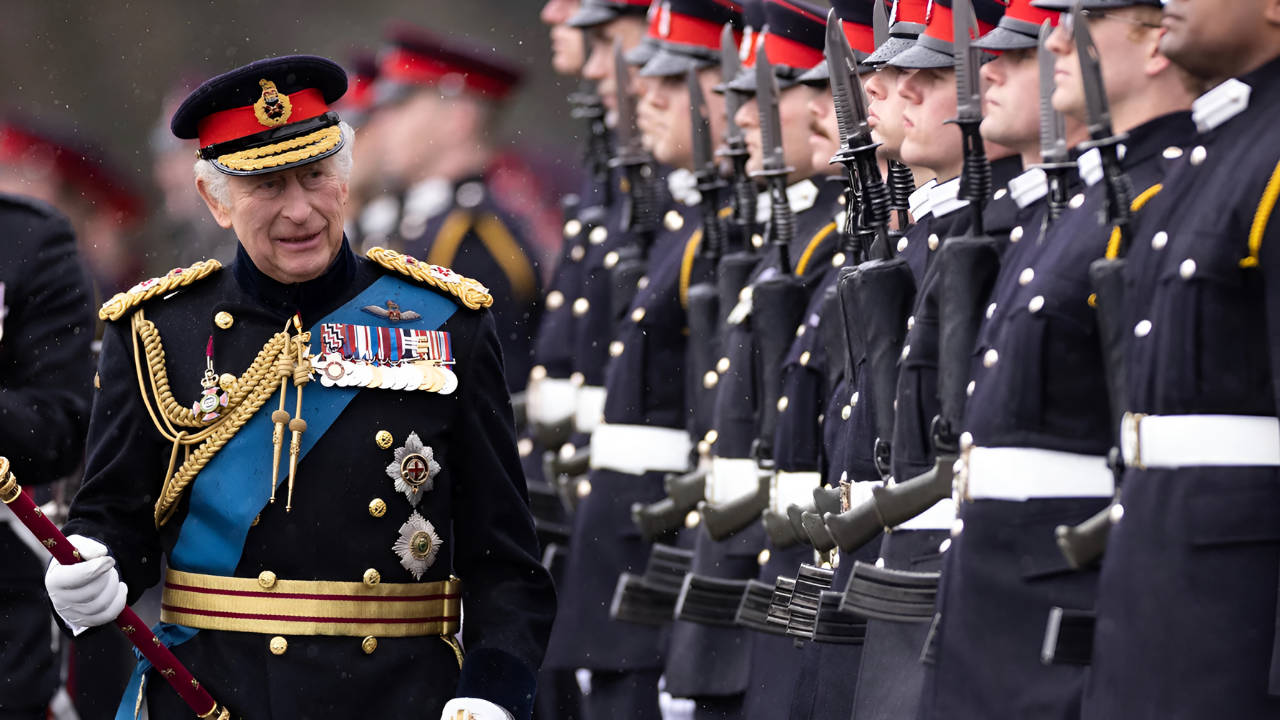
King Charles III’s return to the public stage in December 2025, while still undergoing cancer treatment, became the backdrop for one of the most direct royal interventions in European security politics in decades. At a state banquet in Windsor Castle for German President Frank-Walter Steinmeier, the 76-year-old monarch departed from long-standing royal caution and identified Russia as a direct threat to Europe, aligning the ceremony with a broader strategic realignment between the United Kingdom and Germany.
A Monarch Breaks with Royal Caution
For most of the postwar era, British monarchs avoided naming foreign adversaries in public remarks. That restraint ended on December 3, 2025. Speaking to 152 guests at Windsor Castle, King Charles warned of “further Russian aggression,” a phrase palace sources later said was carefully crafted with government advisers rather than improvised. Delivered partly in German, and directed in part at Steinmeier, the speech underscored concerns that Europe can no longer assume unconditional U.S. protection. The King’s message implied that European states must be prepared to shoulder their own defense responsibilities in a more unpredictable security environment.
Steinmeier, addressing the UK Parliament the following day, reinforced the same theme. He said Russia’s “brutal attack” on Ukraine was not only an assault on one country but on the entire post-1945 order that had sought to prevent borders from being changed by force. He described the situation as “a new security situation in Europe, if not in the whole world,” suggesting that the assumptions underpinning European security since the end of the Second World War had been fundamentally altered by Moscow’s actions.
From Historic Enemies to Treaty Allies
The symbolism of Steinmeier’s state visit extended beyond speeches. It followed a major shift in UK-German relations earlier in 2025, when the two countries signed the Kensington Treaty, their first bilateral defense treaty since the end of World War II. The agreement, concluded in July 2025 at the Victoria and Albert Museum in London—an institution rooted in the 19th-century partnership of Queen Victoria and her German-born husband Prince Albert—formally aligned two former wartime enemies in mutual defense.
The Kensington Treaty built on the Trinity House Agreement of October 2024, under which London and Berlin committed to developing long-range precision-strike weapons capable of reaching more than 2,000 kilometers. This capability would allow both countries to strike targets deep inside Russia if required. The two governments also intensified their role as co-chairs of the Ukraine Defence Contact Group, which has coordinated an international package of $23.5 billion in support for Kyiv. Together, these arrangements signaled that the UK and Germany are prepared to plan for high-intensity conflict scenarios in Europe, rather than relying solely on NATO’s traditional framework or U.S. military guarantees.
War Ruins, Reconciliation, and Shared Security
The state visit also featured a powerful act of remembrance and reconciliation at Coventry Cathedral. On November 14, 1940, German air raids destroyed the medieval cathedral, killing 568 people and leveling thousands of homes. Eighty-five years later, Steinmeier laid a wreath at the site, joined by clergy and local leaders who emphasized Coventry’s postwar partnerships with German cities such as Kiel and Dresden, themselves heavily bombed by Allied forces during World War II.
Steinmeier presented those relationships as evidence of what can be achieved when former enemies choose reconciliation. The appearance of Prince Edward, Duke of Kent, underscored the long-term effort behind this shift. Now 90, recently widowed and a longstanding patron of UK–German friendship organizations, the Duke has spent three decades supporting initiatives aimed at bridging the divide left by wartime destruction. His presence at Coventry linked King George VI’s visit to the bombed city in 1940 with the current royal generation’s effort to frame the UK and Germany as democratic partners confronting a common threat from Russia.
Brexit Strains and a New Strategic Partnership
In his address to Parliament, Steinmeier acknowledged the “difficult years” after the UK’s 2016 decision to leave the European Union, quoting a British rock lyric—“Don’t Look Back in Anger”—to suggest that both sides should focus on the future rather than past political disputes. Prime Minister Keir Starmer described the modern partnership as “growing from strength to strength,” reflecting how London and Berlin have tried to recast a once-fractious relationship into a focused security alliance.
Beyond defense cooperation, the two governments agreed on a joint approach to irregular migration. As part of a new action plan, Germany pledged to introduce legislation criminalizing the facilitation of illegal migration to the UK, closing a gap in German law that previously applied only within the EU. The plan envisages closer coordination between law enforcement agencies and prosecutors, as well as joint operations targeting smuggling networks, indicating that the renewed partnership extends into internal security and policing.
Security Abroad, Dissent at Home
The state visit unfolded against a domestic backdrop that highlighted tensions within the UK’s own democratic practices. Thames Valley Police warned that they might arrest protesters from the anti-monarchy group Republic if they displayed banners or heckled during the German president’s visit. The group had planned to question King Charles over unresolved issues surrounding his brother Prince Andrew’s association with Jeffrey Epstein. Republic’s leader said the police stance amounted to effectively banning protests, raising questions about the balance between public order and free expression at the same moment the UK was presenting itself internationally as a defender of democratic values against authoritarian regimes.
Despite his ongoing cancer treatment, King Charles used the visit to signal that the UK, Germany, and France—the so-called E3—intend to serve as a central pillar of European defense, even in a scenario where American engagement becomes less predictable. The combination of formal treaties, joint weapons programs, and coordinated support for Ukraine points toward a more autonomous European posture. For the UK, which has spent years redefining its role after Brexit, the emerging partnership with Germany offers a new framework built on military capability and shared threat perceptions rather than membership in EU institutions.
As Russia’s war in Ukraine continues and debates about the future of NATO and U.S. commitments intensify, the December 2025 visit may come to be seen as a turning point. A recovering monarch, a German president invoking the end of the old security order, and ceremonies held amid the ruins of wartime bombing together framed a clear message: Europe is preparing to rely more on its own alliances, resources, and political will. How durable this new architecture proves to be—in the face of external pressure from Moscow and internal pressures on democratic norms—will shape the continent’s security for years to come.
Sources:
Sky News–German President State Visit Coverage,December 3–5,2025
BBC News–King Charles State Banquet Speech & German President Parliamentary Address,December 3–4,2025
Reuters–UK-Germany Kensington Treaty & Defence Cooperation,July–December 2025
AP News–German President Coventry Cathedral Visit & WWII Reconciliation,December 5,2025
UK Government Official Press–Treaty between the United Kingdom and Federal Republic of Germany,July 2025
Bundespraesident.de–German President Steinmeier Speeches & State Visit Remarks,December 2025