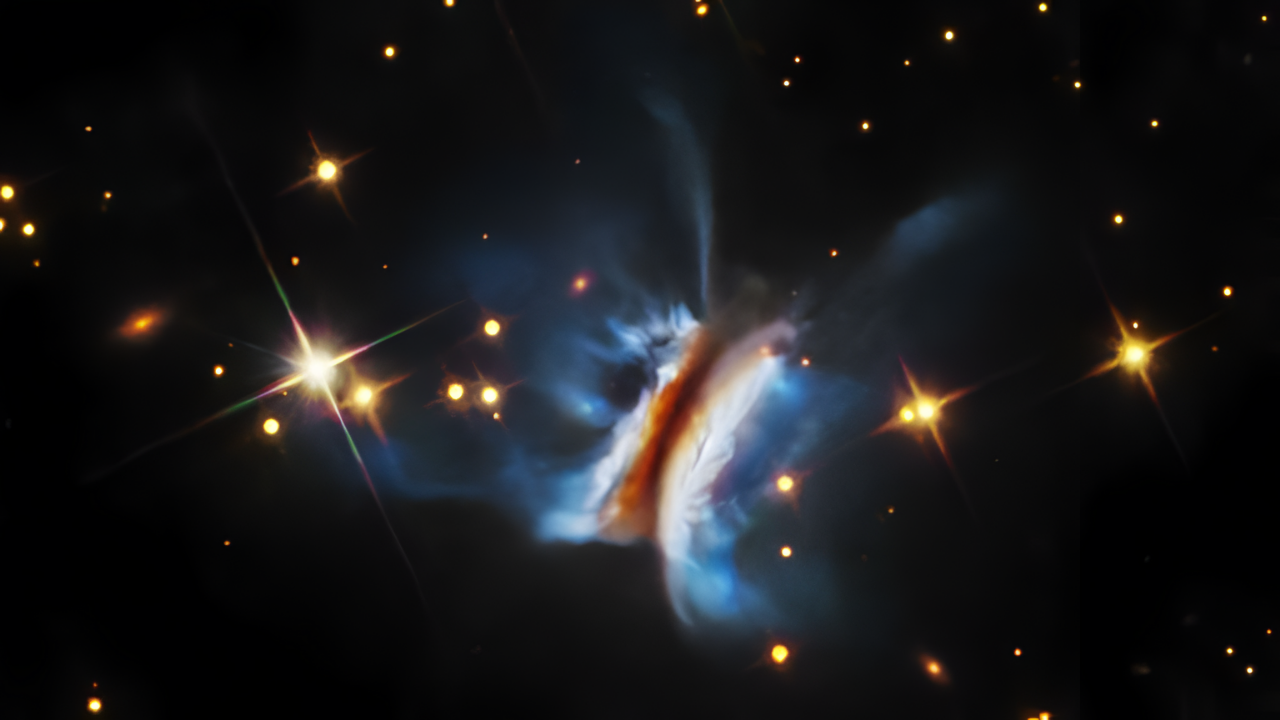
Protoplanetary disks are the birthplaces of planets, but few discoveries have stretched scientific expectations like IRAS 23077+6707. Using NASA’s Hubble Space Telescope, astronomers have confirmed this object hosts the largest planet-forming disk ever observed, measuring about 400 billion miles across, roughly 40 times the diameter of our solar system.
Even more surprising, the disk is violently turbulent and lopsided rather than smooth and orderly. These findings challenge long-standing assumptions about how young planetary systems evolve. Here’s what’s happening and why it matters.
A Long Mystery Comes Into Focus
IRAS 23077+6707 was first detected by the Infrared Astronomical Satellite in the 1980s, but its true nature remained uncertain for decades. The object reappeared in optical surveys in 2016, prompting closer investigation. Definitive confirmation came from Hubble observations taken on February 8, 2025, with NASA announcing the results on December 22, 2025.
For the first time, astronomers could see the structure in visible light and confirm it as a massive protoplanetary disk viewed edge-on. The new data revealed extraordinary detail, allowing researchers to measure its immense size and observe behavior never before documented in such a system. What once looked like an obscure infrared source is now recognized as a landmark discovery in planet formation research.
A Disk on an Unmatched Scale
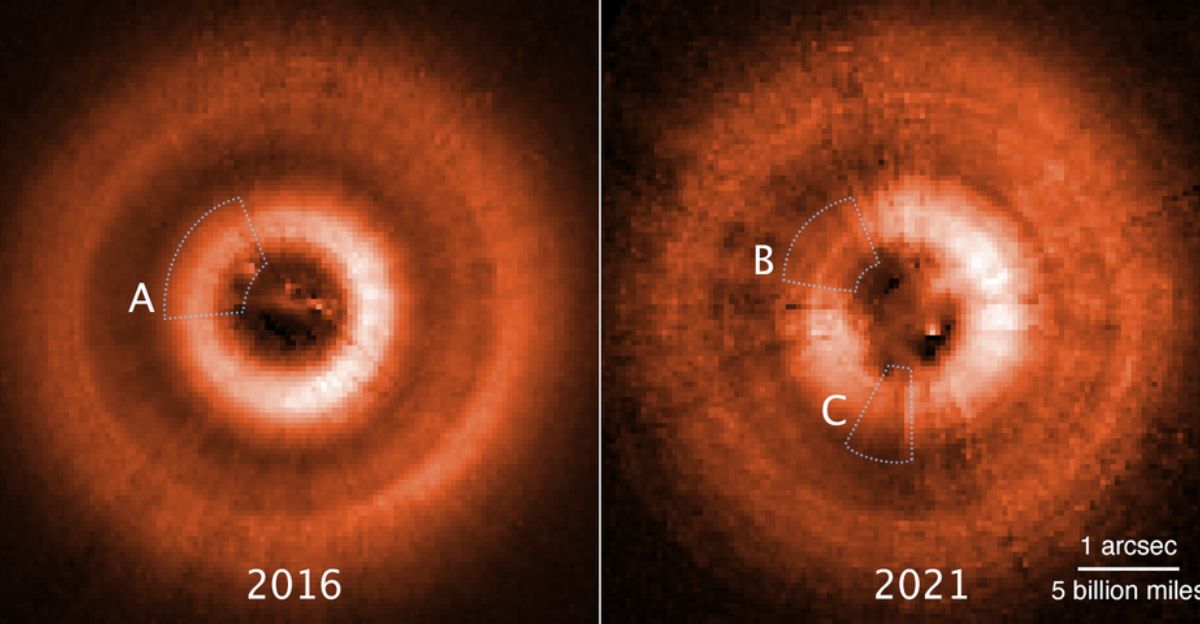
The disk surrounding IRAS 23077+6707 spans roughly 400 billion miles, or about 640 billion kilometers, from end to end. This makes it far larger than typical planet-forming disks, which usually extend only a few hundred astronomical units. According to NASA, the disk is so dense and expansive that it completely blocks the light from its central star when viewed edge-on.
Its sheer scale suggests an enormous accumulation of material during the system’s earliest stages. Such dimensions push beyond what astronomers thought possible for a stable disk, raising questions about how it formed and how long it can persist. Size alone sets IRAS 23077+6707 apart, but its internal behavior makes it even more unusual.
Turbulence Where Calm Was Expected
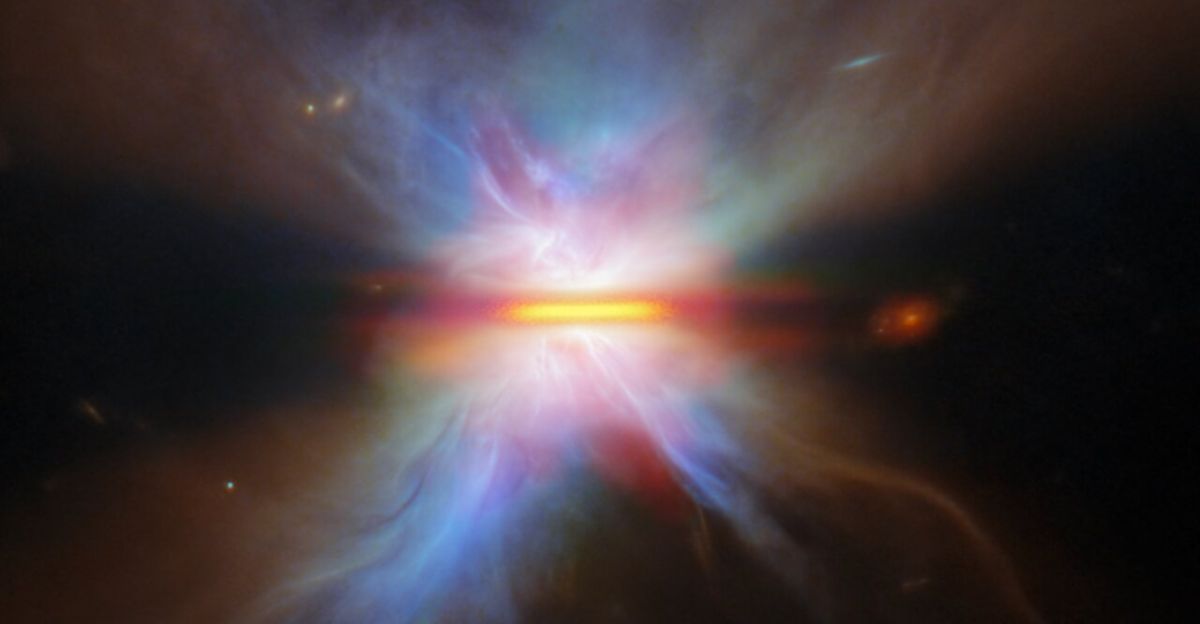
Hubble images show bright, uneven wisps of material stretching above and below the disk’s midplane. Lead researcher Kristina Monsch of the Space Telescope Science Institute described the structure as “much more active and chaotic than we expected,” according to NASA’s official announcement. Extended filaments appear prominently on one side, while the opposite edge looks sharply cut off.
This level of asymmetry is rarely seen in protoplanetary disks. Instead of gentle, layered motion, the disk shows signs of intense turbulence. These features suggest large-scale disturbances that disrupt orderly rotation, hinting that early planet-forming environments can be far more violent than traditional models predict.
What Could Be Shaping the Chaos
Most known planet-forming disks appear roughly symmetrical, reflecting stable rotation and gradual evolution. IRAS 23077+6707 breaks that pattern. NASA scientists suggest its dramatic imbalances may result from large-scale instabilities within the disk, material flowing in from surrounding space, or gravitational influences from nearby stars.
The central star, or possibly a binary system, remains hidden behind thick dust. Infrared emission patterns indicate it is likely young and hot, but its exact properties are still unknown. Understanding this central source is key to explaining why the disk grew so large and turbulent. For now, the system offers a rare look at disk evolution operating under extreme conditions.
A Massive Reservoir for Planet Building
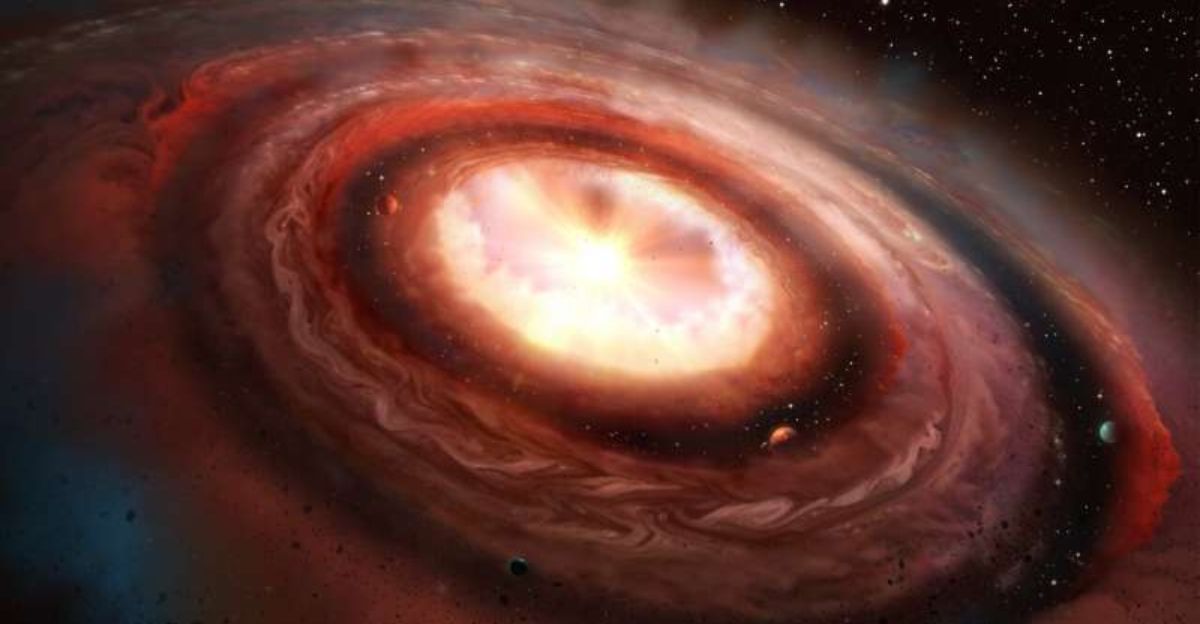
Brightness and opacity measurements indicate the disk contains an enormous amount of gas and dust. NASA estimates the total mass at about 10 to 30 times the mass of Jupiter. That reservoir could support the formation of numerous planets, including large gas giants, across a vast region.
Compared with systems like HL Tauri or PDS 70, which show organized rings and gaps on much smaller scales, IRAS 23077+6707 appears disorderly and oversized. Its informal nickname, “Dracula’s Chivito,” reflects its dramatic appearance, but its scientific value lies in demonstrating that planet formation may occur across a much wider range of environments than previously recognized.
Rethinking Planet Formation at the Extreme
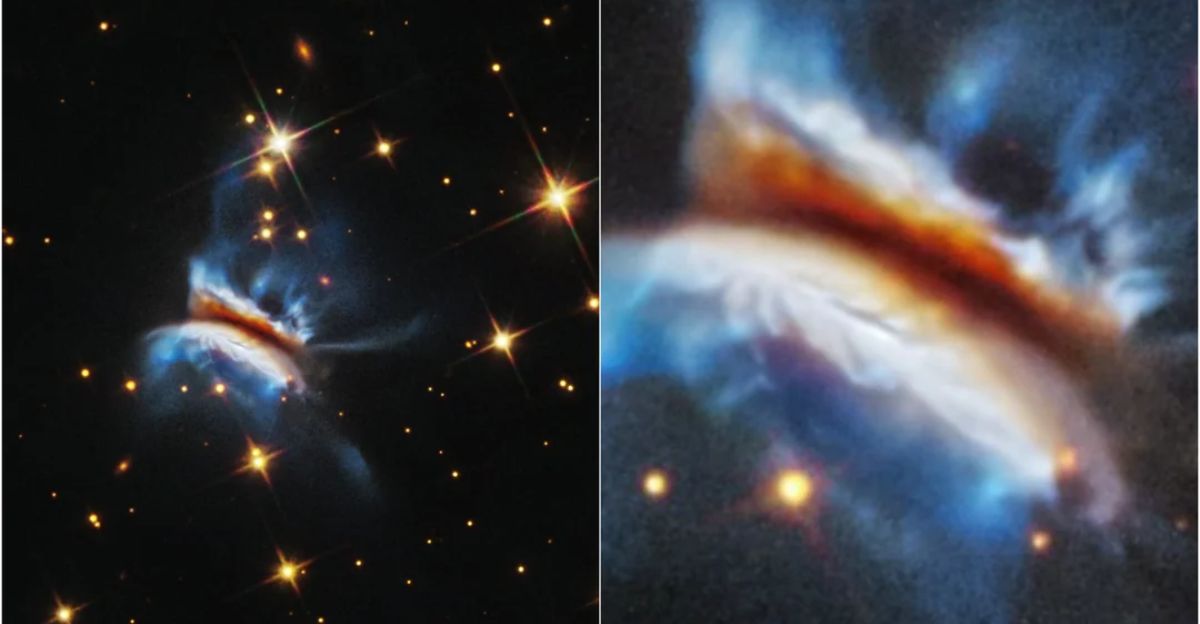
IRAS 23077+6707 forces astronomers to reconsider simplified views of planet formation. The disk’s size, mass, and turbulence suggest planets can emerge in environments shaped by chaos as much as calm. Such conditions could lead to unusual planetary architectures and complex migration histories unlike those seen in our solar system.
Future observations with radio and infrared telescopes aim to peer deeper into the disk, searching for hidden substructures or forming planets. By studying this extreme system, scientists can test whether familiar physical laws scale upward or if new processes dominate. The discovery confirms that the universe builds planets in ways far more diverse than once believed.
Sources:
NASA’s Hubble Reveals Largest Found Chaotic Birthplace of Planets. NASA Science, December 22, 2025
Dracula’s Chivito (IRAS 23077+6707). NASA Science, December 22, 2025
NASA’s Hubble Reveals Largest Found Chaotic Birthplace of Planets. Space Telescope Science Institute, December 22, 2025
Circumstellar disc IRAS 23077+6707. ESA/Hubble, October 31, 2024
Dracula’s Chivito. Wikipedia (consolidated NASA/STScI citations), Updated 2024
A Giant Cosmic Butterfly’s Nature Is Revealed. Smithsonian Institution, May 13, 2024