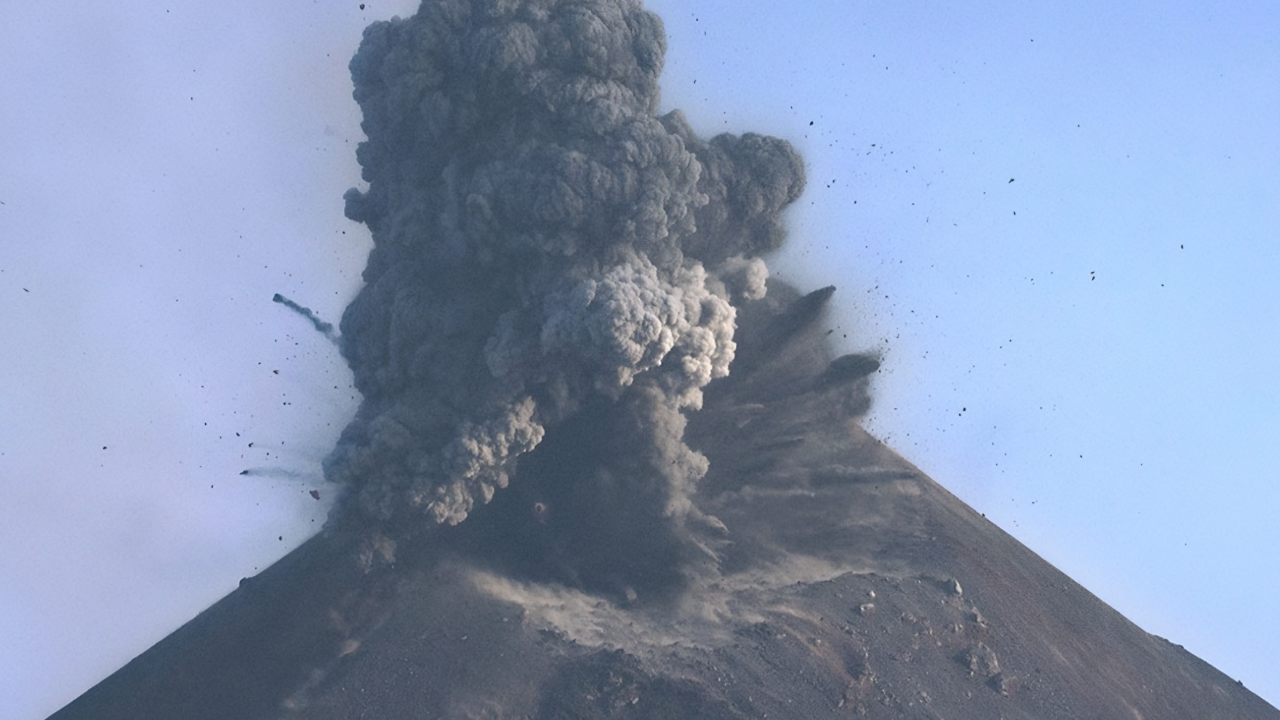
Great Sitkin Volcano sits in Alaska’s Aleutian Islands, under busy flight paths between Asia, North America, and Europe. Lava has been flowing from the volcano for years, slowly filling the summit crater and spilling into nearby valleys. The Alaska Volcano Observatory reports thick lava near the vent and steady, low-level activity rather than dramatic explosions.
Planes pass overhead every day, with thousands of passengers on routes that cross this region. Volcanic ash is the main danger to aviation because it can damage engines without being easily visible. Since 1980, ash from Alaskan volcanoes has hit more than a dozen aircraft, causing repair costs in the hundreds of millions of dollars.
One famous case in 1989 involved a Boeing 747 that lost power in all four engines after flying through ash from Redoubt Volcano. The crew managed to restart the engines and land safely, but repairs cost tens of millions of dollars. Great Sitkin is about 26 miles from Adak Island, so it poses similar risks if ash rises into flight paths. Because of this, the alert level is set to WATCH, and the aviation color code is ORANGE, which warns pilots but does not close the airspace.
How the Current Eruption Unfolded
Unrest at Great Sitkin started years before the current lava flow. From around 2016, small steam blasts and earthquakes showed that magma was moving underground. By early 2021, the crater became hotter, quakes grew more frequent, and gas emissions increased. On May 25, a series of strong earthquakes prompted officials to raise the alert to WATCH, and within an hour, the volcano erupted, sending ash high into the sky.
That blast briefly pushed the alert to WARNING before it was lowered again. About two months later, satellite images revealed a new lava dome in the crater that had not been there days earlier. The lava and gas kept the area hot, and the volcano stayed at WATCH status. Lava soon reached the rim of the crater and then began to spill down the outer slopes in several directions. Different sides of the volcano saw flows over time, with rockfalls marking the slow advance of the lava.
In mid-2022, the flows shifted direction and piled up within the crater rather than moving farther downslope. In 2023 and 2024, lava flow directions changed several times, and warm zones remained free of snow while older flows iced over. A past eruption in 1974 followed a similar pattern of an explosion followed by slow dome building, and at least eight eruptions in the 1900s show that this behavior repeats over decades.
A Remote Island Under Close Watch
Great Sitkin Island is about 11 miles long and nearly round, lying west of the community of Atka in the central Aleutians. Only a few hundred people live in nearby settlements, but the island holds important history and modern monitoring systems. During World War II, the United States Navy built a base at Sand Bay that housed hundreds of personnel and large fuel tanks until it closed in the early 1960s.
Several crashes near the island between the 1950s and 1970s caused the loss of dozens of lives, underscoring the harsh conditions in the region. Today, a dense network of instruments tracks the volcano around the clock. Seismic stations detect tiny quakes caused by lava movement and rockfalls. Infrasound sensors listen for explosions that clouds might hide. Satellites from space agencies and private companies map heat and very small ground movements, while other regional networks monitor lightning associated with ash plumes.
Despite all this, scientists cannot predict every change. They could see signs hours before the 2021 explosion, but the later shift from explosive activity to slow lava flow still came as a surprise. Recent reports describe low shaking, weak heat, and lava that oozes only a few yards each day. It is unclear whether the eruption will end quietly or return to stronger explosions, but regular data helps improve warning systems. For flight planners and emergency teams, this long-lived eruption is a reminder that even a moderate volcano can be dangerous when it sits under busy air routes.
Sources:
- AVO Eruption Details, Great Sitkin 2021/05, 2021
- Volcano.si.edu, Report on Great Sitkin (United States), January 2026
- USGS Fact Sheet 030-97, Volcanic Ash–Danger to Aircraft in the North Pacific, 2003
- USGS Alaska Volcano Observatory, Daily Update Notice, January 20, 2026
- USGS SIR 2024-5062, Infrasound for Volcano Monitoring, 2024
- Frontiers in Earth Science, Alaska Volcano Observatory Alert and Forecasting Timeliness by Cameron et al., 2018