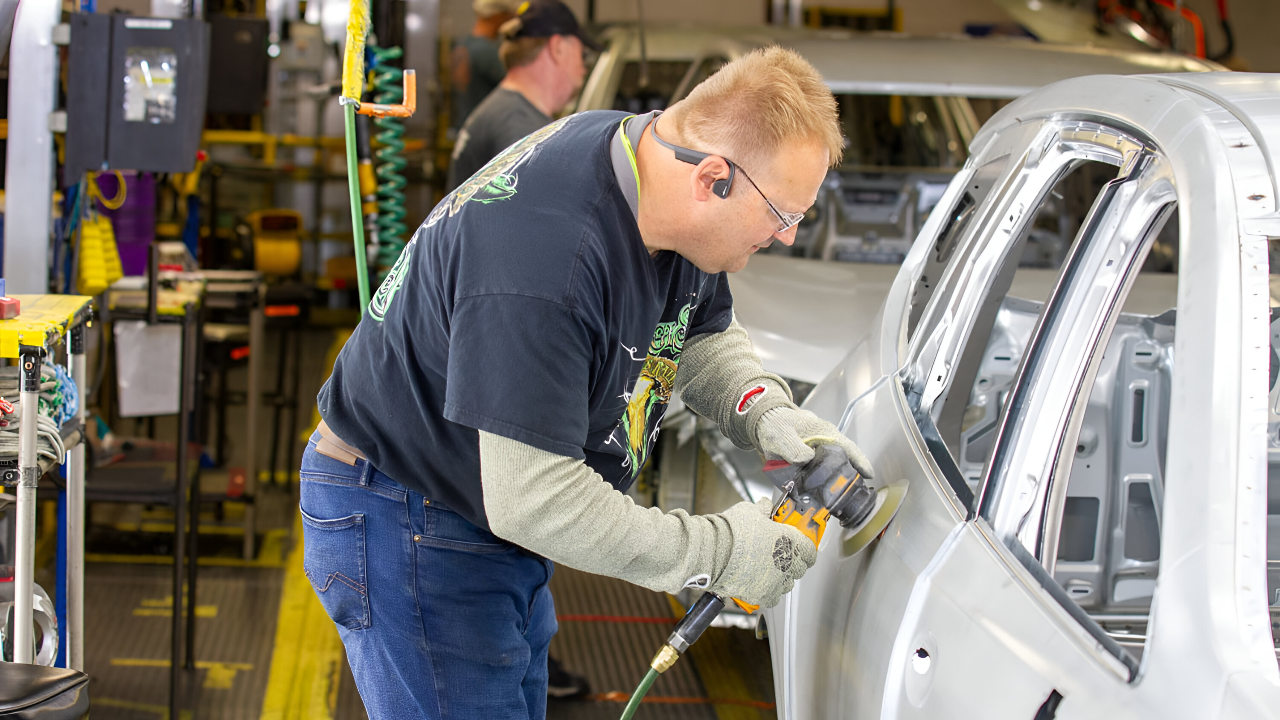
General Motors entered 2026 having absorbed a $7.6 billion blow to its electric vehicle ambitions, a reversal that undercut years of confident forecasts about a rapid shift away from gasoline. The company is not abandoning EVs, but it is sharply scaling back capacity, writing down investments, and refocusing on profitable trucks and hybrid paths as demand and policy support weaken in the United States.
A Wave Of Charges And Restructuring
The financial impact crystallized in late 2025. GM disclosed $7.1 billion in charges in the fourth quarter alone, including $6 billion tied directly to its EV operations and $1.1 billion related to restructuring in China. Combined with a $1.6 billion charge earlier in the year, the total EV-linked hit came to $7.6 billion for 2025.
Much of that money was tied to commitments GM had made when it anticipated much higher EV volumes. About $4.2 billion went to settlements with suppliers that had expanded tooling and factory capacity based on GM’s projected orders. As GM cut back, those partners were left with stranded investments, forcing negotiations to unwind contracts while trying to preserve long-term relationships. Another $1.8 billion was recorded as non-cash asset impairment, reflecting the reduced value of EV-focused facilities and equipment.
At the same time, GM booked a separate $1.1 billion charge to overhaul its operations in China, primarily involving its joint venture with SAIC. The step acknowledged that domestic Chinese manufacturers now dominate that market, especially in EVs, making it far harder for Western companies to compete profitably.
Demand Shifts And Policy Whiplash
Behind the write-downs was a sharp slowdown in U.S. EV demand. GM’s U.S. electric vehicle sales fell 43% year-over-year in the fourth quarter of 2025, to just over 25,000 units. The downturn was magnified by the end of a key incentive: the $7,500 federal EV tax credit expired on September 30, 2025 under President Trump’s “One Big Beautiful Bill Act.”
In the months before the credit disappeared, dealers used the incentive to advertise out-the-door prices thousands of dollars below sticker, such as a Cadillac Lyriq effectively priced at $52,490 instead of $59,990. When the credit ended, that price gap reappeared overnight. October EV sales dropped 48.9% compared with September, revealing how much demand had been pulled forward.
By the fourth quarter, every GM EV model was affected. The Cadillac Lyriq recorded a year-over-year decline of more than 45%. The Blazer EV fell by nearly 80%. The Equinox EV dropped 71.75% to 5,111 units. The pattern cut across segments and price points, pointing less to individual product failures and more to a broader market pullback once subsidies and early-adopter enthusiasm faded.
Inside GM, leadership acknowledged that the assumptions underpinning its EV build-out no longer held. In a January 5 message to employees, CEO Mary Barra said that recent capacity plans had been driven by steadily tightening fuel economy and emissions rules. With what she described as an evolving regulatory framework and the end of federal consumer incentives, she told workers it had become clear that near-term EV adoption would be lower than GM had previously expected.
Factories, Jobs, And A Strategic Pivot
The financial reset quickly translated into changes on the factory floor. GM announced indefinite layoffs and production cuts affecting 3,400 workers across multiple facilities, signaling that this was a structural shift rather than a brief pause.
In Detroit, the company’s Detroit-Hamtramck Assembly plant—renamed Factory Zero to symbolize GM’s electric future—moved from two shifts to one. Around 1,200 workers there were placed on indefinite layoff. The plant had been configured to build a high-profile EV lineup, including the Silverado EV, Sierra EV, Hummer EV, and Cadillac Escalade IQ. With lower volumes, unit costs rose, but GM prioritized flexibility and cash preservation.
Battery production was also curtailed. GM’s Ultium Cells joint-venture plants with LG Energy Solution in Warren, Ohio, and Spring Hill, Tennessee, were idled for six months starting in January 2026. Approximately 850 workers in Ohio and 700 in Tennessee were temporarily laid off. Both facilities had been operating below the levels needed to justify full capacity, despite utilization approaching 80% in Warren and roughly 40% in Spring Hill before the slowdown.
One of the clearest symbols of GM’s strategic shift was the decision to change course at Orion Assembly in Michigan. Previously slated to build electric pickups under a $4 billion investment plan supported by $480 million in state incentives, the plant will now produce internal combustion versions of the Cadillac Escalade, as well as Silverado and Sierra light-duty pickups, starting in early 2027. Battery module work will continue on site, but the primary output will return to gasoline-powered models with stronger and more predictable margins.
Michigan’s incentive package, structured under the SOAR agreement, tied support to job creation rather than a specific propulsion type. That flexibility allowed GM to retain state development funds while changing the plant’s product mix, raising questions about how public EV subsidies can adapt when corporate plans pivot.
Industry-Wide Retrenchment And The Hybrid Turn
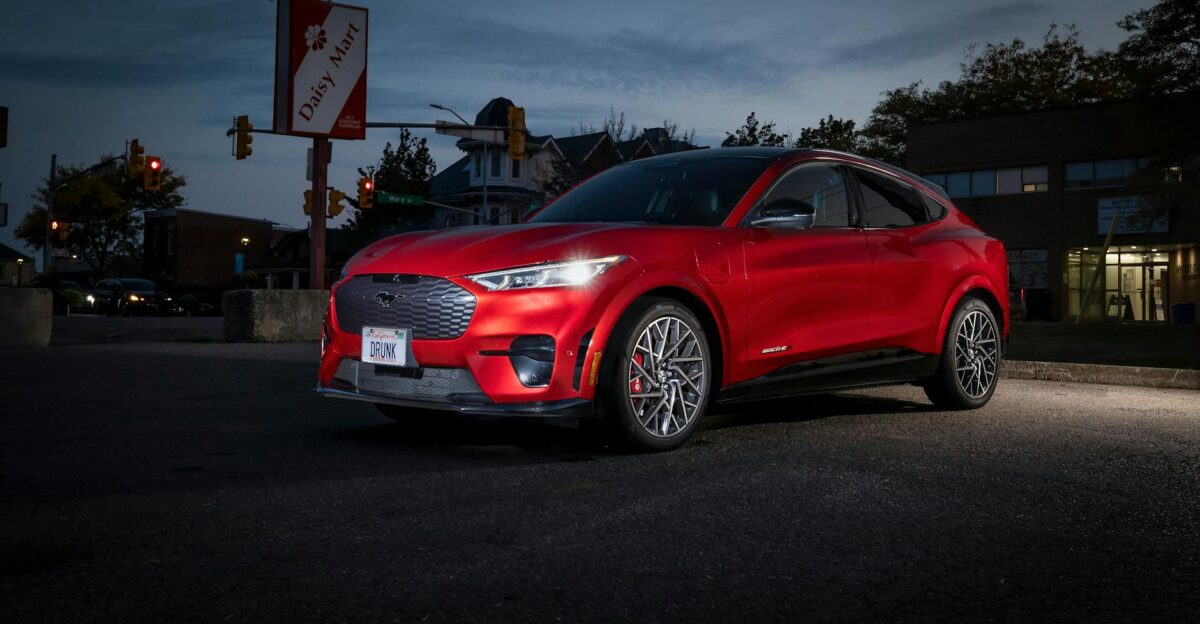
GM’s retrenchment came amid a broader reevaluation of EV strategies across Detroit. Ford announced a $19.5 billion write-down on its electric vehicle operations in December 2025, including the cancellation of a fully electric F-150 Lightning program. CEO Jim Farley said a rapid shift in market conditions over the prior months had prompted the decision.
Stellantis also adjusted its plans, delaying electric versions of the Alfa Romeo Giulia and Stelvio by a year while keeping gasoline variants, and ending several plug-in hybrid projects in North America, including the Wrangler 4xe. Companies cited a mix of softer demand, policy uncertainty, and the need to focus on profitable models.
In this environment, hybrids emerged as a favored compromise. GM, Ford, and Stellantis began steering more investment toward hybrid and extended-range vehicles, which can satisfy regulatory requirements more efficiently than pure gasoline models while avoiding the higher costs and infrastructure needs of full battery electrics. GM retained a diverse EV lineup but scaled back volume expectations, seeking to keep options open without sustaining heavy losses.
Global Signals, Used EVs, And The Cost Challenge
While the U.S. market cooled, other regions continued to adopt EVs at higher rates. China reached roughly 50% EV penetration in 2025, and Europe’s five largest markets averaged about 23%. In contrast, EVs accounted for 6.6% of U.S. retail sales in December 2025, down from 11.2% a year earlier, according to J.D. Power. Edmunds projects that EVs will represent about 6% of U.S. vehicle sales in 2026, down from 7.4% in 2025, attributing much of the decline to higher effective prices and the loss of incentives.
One bright spot has been the used EV segment. In 2025, about 243,000 EV leases expired—more than triple the number in 2024—sending a wave of lower-priced, warrantied electric vehicles into the secondary market. Those vehicles, with lower running costs and reduced upfront prices, could help expand EV ownership among buyers who cannot afford new models that often exceed $45,000.
Longer term, cost remains central. Analysts estimate that battery packs must reach around $100 per kilowatt-hour for electric vehicles to match gasoline models on price without subsidies. Average prices are around $110 per kilowatt-hour after falling about 8% in 2025. GM has set a goal of cutting combined cell and pack costs by $30 per kilowatt-hour by 2028 through the use of manganese-rich cathode chemistry. Even if those targets are met, profitability at scale will still depend on steadier demand and more predictable policy.
Looking Ahead As Detroit Resets
GM entered 2026 with its stock trading near $83.70, up 68% over 12 months, as investors appeared to reward a more cautious approach and clearer emphasis on near-term profit. The company’s $7.6 billion in charges, workforce reductions, and capacity cuts mark a decisive shift from rapid EV expansion to a slower, more incremental transition spanning decades rather than years.
As Detroit’s major automakers adjust, they are betting on a mix of hybrids, carefully calibrated EV volumes, and a growing used EV ecosystem to navigate changing regulations and consumer preferences. The next phase will test whether this revised strategy can deliver both financial stability and gradual emissions reductions in a market where technology, policy, and demand continue to evolve.
Sources
General Motors Takes $6 Billion Charge Related to Electric Vehicle Retreat. Automotive Manufacturing Solutions, January 8 2026
Ford Takes $19.5 Billion Hit in Detroit’s Biggest EV Bust. The Silicon Review, December 2025
U.S. Retail Auto Sales Rise 4% in 2025 Despite Q4 Slowdown. J.D. Power, January 5 2026
Electric Vehicle Tax Credits Are Gone in 2025: What You Need to Know. Edmunds, January 2025
Ford CEO says market changed, driving EV strategy decision. Reuters, December 2025