On September 30, 2025, a single deadline reshaped America’s electric vehicle landscape. The expiration of the federal EV tax credit—a $7,500 incentive for new battery-powered cars—instantly made models thousands of dollars more expensive, just as major U.S. manufacturers were ramping up production.
Within weeks, General Motors booked a $1.6 billion restructuring charge, announced 1,750 permanent job cuts, and ordered an 18-month pause at key battery facilities. The fallout rippled through assembly plants, suppliers, and local economies from Detroit to the Tennessee hills. Here’s what’s happening…
Policy Whiplash Hits EV Prices

Under the One Big Beautiful Bill Act, passed in July 2025, the federal EV tax credit ended on September 30. That change effectively raised the sticker price of many models by $7,500 overnight. For a $50,000 electric vehicle, the end of the credit translated into roughly a 15 percent jump in what buyers paid out of pocket, removing one of the strongest financial reasons to choose a plug-in over a comparable gasoline model.
In the weeks before the deadline, customers rushed to complete purchases. EVs climbed to a record share of new car sales in September 2025, with third-quarter sales reaching 438,000 units, or 10.5 percent market share—well above the 7 percent share seen in earlier quarters.
Once October arrived without federal support, orders dropped sharply, exposing how heavily demand rested on incentives. GM CEO Mary Barra said in Q3 earnings calls that regulatory changes and fleet incentives had complicated operations, signaling slower-than-expected adoption.
Detroit, Ohio, and Tennessee Reeling

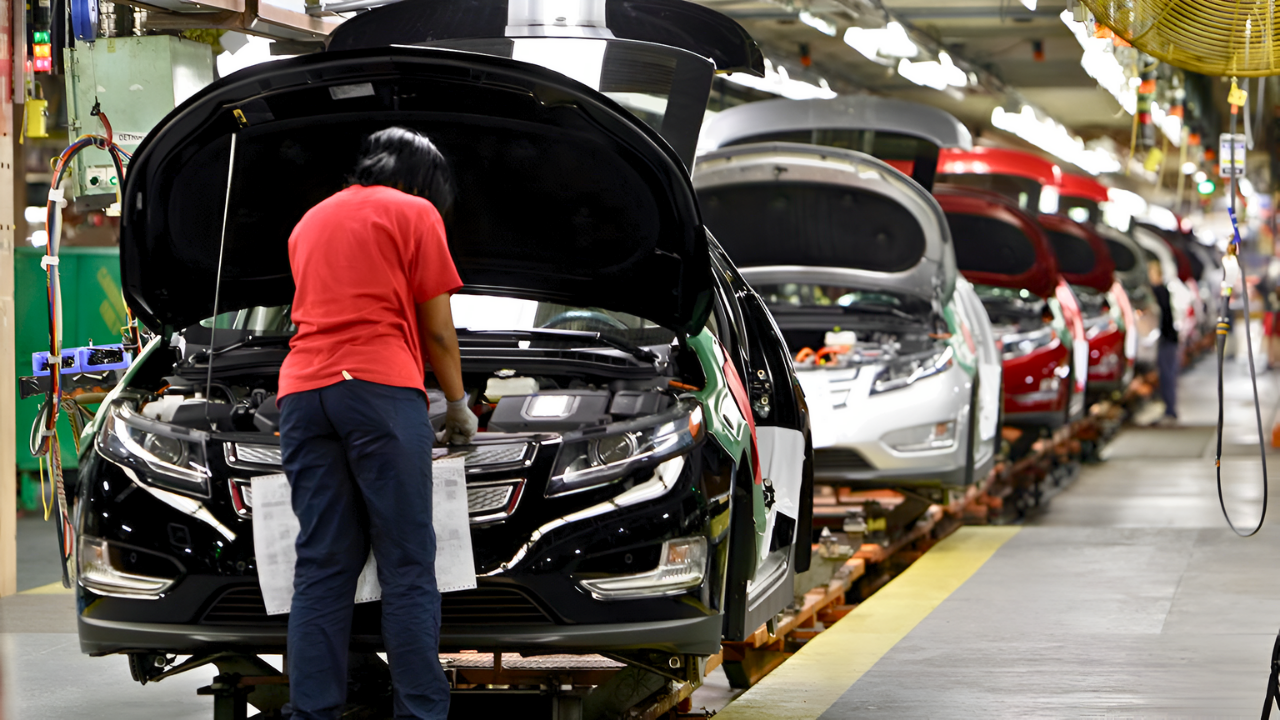
The most visible impact landed at GM’s Factory Zero in Detroit, where models like the Silverado EV, Sierra EV, Hummer EV, Lyriq, and Vistiq are built. In late October, GM announced 1,200 permanent job cuts there and moved the facility to a single shift. Production dropped to an estimated 25 to 30 percent of intended capacity, leaving a flagship plant operating far below design.
Down the supply chain, Ultium Cells—GM’s battery joint venture with LG Energy Solutions—cut 550 permanent jobs in Warren, Ohio, and furloughed another 850 starting January 2026. Spring Hill, Tennessee, also faced 700 furloughs. Many affected workers would rely on Supplemental Unemployment Benefits replacing around 60 percent of prior wages. Local businesses braced for reduced spending, leaving 1,550 workers uncertain about production resuming on schedule.
Suppliers and Competitors Adjust

The EV slowdown extended beyond GM. Dana Thermal Products closed its Auburn Hills, Michigan plant, eliminating 200 jobs. The factory had produced thermal management systems critical for EV battery safety. Ford paused F-150 Lightning production indefinitely, Stellantis delayed Alfa Romeo EV launches from 2026 to 2027, and Rivian cut 600 positions. Analysts noted this reflected a broader reassessment of U.S. EV adoption without sustained federal incentives.
Strategically, automakers focusing on hybrids, such as Toyota and Honda, fared better. Hybrids, with lower prices and familiar fueling patterns, retained consumer appeal. In contrast, manufacturers investing heavily in large battery trucks and SUVs faced thin margins and higher production costs once incentives disappeared.
Job Losses Strain Local Communities
Across Michigan, Ohio, and Tennessee, more than 3,300 workers faced job loss or extended furloughs. That included 1,200 permanent cuts at Factory Zero, 1,400 combined layoffs and furloughs in Warren and Spring Hill, 700 furloughs in Spring Hill, and 200 layoffs in Auburn Hills. For cities like Warren, Ohio, with around 40,000 residents, the layoffs represented 3 to 4 percent of the working-age population tied to EV manufacturing. Many displaced workers may turn to lower-wage service jobs, while furloughed employees confronted long-term uncertainty.
GM’s $1.6 billion restructuring charge captured sunk costs in plants, equipment, and supply agreements built for demand that did not materialize. Meanwhile, Chinese manufacturers such as BYD, NIO, and Li Auto expanded under domestic support, with BYD emerging as the world’s leading EV producer by volume in 2025. U.S. producers’ retrenchment contrasted sharply with global competitors, highlighting the stakes in a fast-evolving industry.
Looking Ahead After the Shock

The end of the federal EV tax credit triggered one of the largest waves of electricity-related auto job losses in U.S. history. GM slowed investments, idled battery capacity, and revised sales forecasts, while towns in Michigan, Ohio, and Tennessee faced economic strain. The policy shock revealed how early-stage clean transportation relies on predictable incentives to succeed.
Long-term, the industry may pivot toward hybrids and more flexible battery plants capable of scaling production. Communities’ recovery will depend on retraining initiatives, new industrial projects, and whether EV adoption rebounds. The choices made now will shape the future of U.S. vehicle manufacturing and the regional economies that embraced electrification early.
Sources:
GM Q3 2025 SEC Regulatory Filing (October 14, 2025)
Reuters Automotive Division (October 14 & 29, 2025)
CNBC Financial Coverage (October 14 & 29, 2025)
Associated Press (October 14, 2025)
Bloomberg Finance (October 29, 2025)
The New York Times Business Section (October 29, 2025)
Michigan Department of Labor & Economic Opportunity WARN Act Filings (October 8, 2025)
Tennessee Department of Labor & Workforce Development WARN Notices (October 29, 2025)
IRS One Big Beautiful Bill Act guidance (2025)