
Minneapolis-based General Mills (Fortune 500 rank #216, roughly $19.9 billion revenue) is grappling with new uncertainty in its Cincinnati operations.
The food giant reported profits down nearly half in late 2025, and it now signals major strategic shifts as commercial real estate turmoil brews.
In Greater Cincinnati, its Mason-area office at Deerfield Crossing is caught in a foreclosure saga. Rising anxiety over that instability is forcing the company – and the local economy – to take notice.
Rising Stakes

Nationwide, Fortune 500 firms are moving office locations at unprecedented rates. One study found over 590 corporate headquarters relocations since 2022 – a jump of about 29% over the prior year.
Remarkably, more than 30% of Fortune 500 companies have made a major office move in the past six years.
Many stayed in the same metro: 70 firms (2018–2023) relocated within their region.
As companies under economic pressure seek better landlord deals and amenities, Cincinnati’s once-stable office market looks increasingly vulnerable to the same exodus.
Background Context

This story traces back to Deerfield Crossing’s ownership. In 2015, an Apollo Global fund bought the Mason office park (320,000 SF) for about $42 million.
The complex – home to General Mills’ Cincinnati hub – was heavily leveraged.
By late 2023, an Apollo affiliate’s $31.9 million mortgage on Deerfield Crossing had come due, and the borrower defaulted in December 2023.
A foreclosure complaint followed, and by January 2024, the court had appointed a receiver to manage Deerfield Crossing.
These moves were meant to stabilize the complex amid rising loan defaults and tightening credit for Apollo’s commercial real estate portfolio.
Financial Strain

Commercial real estate is under pressure everywhere. With interest rates elevated, many property owners face looming loan maturities.
Apollo’s own finance arm reported that borrowers repaid $2.5 billion of loans in 2024 – a sign that companies were refinancing or selling assets rather than carrying on. In response, lenders and investors are tightening lending standards.
Apollo’s year-end results showed it was building large reserves: specific loan loss allowances alone hit $342.5 million by 2024.
Heavy debt burdens and rising defaults have forced Apollo to rethink its strategy on troubled assets.
The Revelation
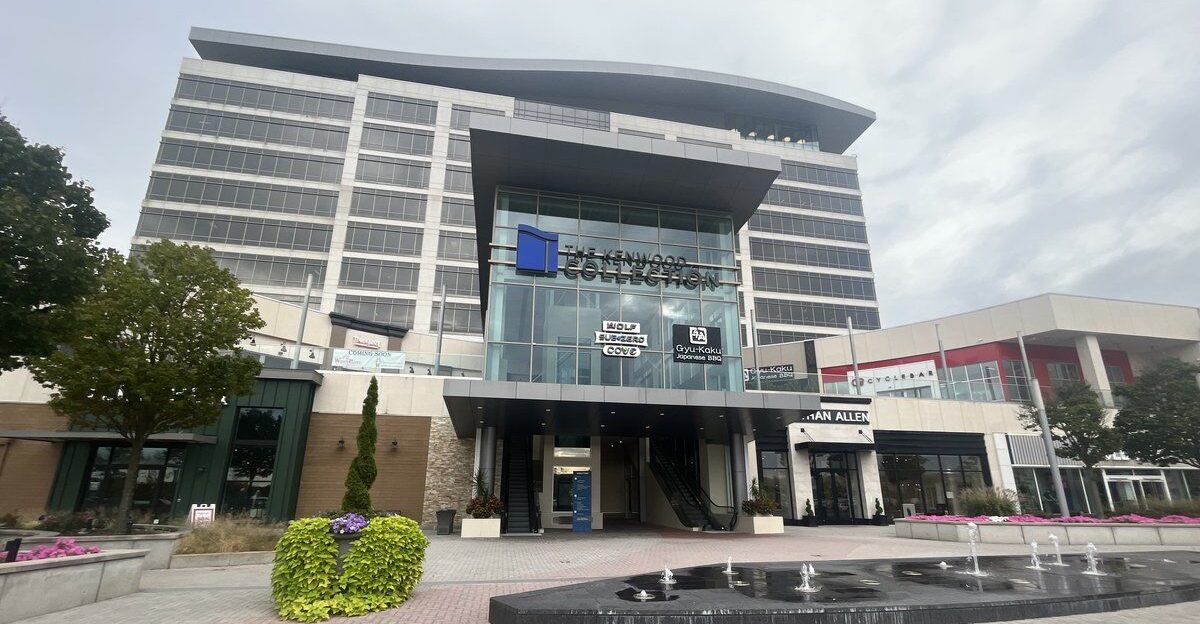
Amid this backdrop, General Mills made its move public. On August 4, 2025, the company announced it had leased about 13,000 SF on the eighth floor of Kenwood Collection, an upscale mixed-use tower.
It will relocate its Cincinnati office there on Jan. 1, 2026, exiting Deerfield Crossing. (Deerfield Crossing is now controlled by a court-appointed receiver after Apollo’s affiliate defaulted on the loan.)
This announcement confirmed what insiders had long suspected. One Deerfield Crossing tenant commented, “We’d heard rumors all year about the building’s finances.
When GM confirmed the move, none of us were really surprised – it felt like finally getting an answer,” reflecting the quiet expectation inside the complex.
Regional Impact

Interestingly, Cincinnati’s office market as a whole is holding up better than much of the nation. As of Q1 2025, Cincinnati’s overall vacancy was only 8.8% – well below the U.S. average of ~13.8%.
Downtown’s vacancy (10.7%) ranked among the third-tightest in the country.
Limited new construction and repurposing of old buildings have kept supply tight, funneling tenants into the city’s best spaces.
General Mills’ move to Kenwood should be seen in this context: it’s a flight to quality within the same metro. Rather than fleeing Cincinnati entirely, the company is trading a distressed suburban asset for a stable, amenity-rich office – mirroring a broader “flight to Class A” trend in the city’s market.
Human Element
On the ground, affected workers and neighbors voice mixed feelings. “There’s no tragedy here,” said one local executive (not involved with General Mills) who has dealt with foreclosed properties; for him, the move represents a logical step.
Inside General Mills, about 100 Cincinnati-area employees are now preparing to switch sites. Some express cautious optimism.
One GM engineer remarked, “Honestly, it feels like a fresh start. We’d been hearing about Deerfield’s issues for months; it’ll be nice to work in a building that’s actually maintained.” Others worry about the commute change or the end of longstanding office routines.
But most agree that moving into a modern Kenwood tower – with restaurants, shops and transit right downstairs – is a significant upgrade.
Competitive Response

Cincinnati’s other big companies have also been reshuffling. For example, Procter & Gamble is relocating around 1,500 employees out of older suburban offices, with roughly 300 moving downtown and 1,200 into Mason facilities.
Tech firm Paycor is consolidating by moving its headquarters into a new downtown tower. These shifts intensify competition for prime office space.
General Mills’ Kenwood choice puts it in the same league as other Fortune 500 tenants seeking stability.
By securing top-tier Class A space, the company ensures it won’t be squeezed out by rivals or the uncertainties of a sinking landlord.
Market Context
These moves fit into a national picture of corporate relocation. Research shows that over 30% of Fortune 500 firms have relocated in the past six years, often not far from home.
A CBRE analysis identified 70 Fortune 500 HQ moves within the same metro area between 2018 and 2023 (versus just 28 moves out-of-state).
Companies increasingly prefer mixed-use developments with amenities, walkability and transit access. The Kenwood Collection exemplifies this model. By leaving Deerfield Crossing for a retail-office complex, General Mills is following the broader trend of corporates swapping aging towers for modern, integrated work environments.
Hidden Consequence

Behind the scenes, Apollo’s woes are deepening. The firm’s year-end reports show $342.5 million in allowances set aside for loans now viewed as troubled – implying very high expected losses on just a handful of loans.
Its portfolio’s Real Estate Owned (REO) holdings swelled to $767 million by the end of 2024, reflecting numerous foreclosure takeovers. In short,
Apollo has become a fire-sale landlord in many markets. General Mills’ departure is one of the first high-profile defections, but observers fear many more are quietly planning to leave Apollo-affiliated buildings.
“If a Fortune 500 tenant feels insecure, it’ll walk before it makes headlines,” noted a New York-based real estate consultant. In that sense,
GM’s move may be viewed as a canary in the coal mine – an early signal of broader tenant flight from Apollo’s distressed portfolio.
Stakeholder Tension

Through 2024, Deerfield Crossing’s existing tenants endured growing discomfort. Under court receivership, routine maintenance slowed to a crawl.
Leases were harder to negotiate or renew. Several smaller firms quietly began searching for new space, tired of outages and unanswered repair requests. A source at one tenant recalled, “It felt like the landlord gave up.
The elevators and heat would go out, and nobody would come fix them.” With a receiver in place, remaining tenants knew the old Apollo manager had diminished power.
In that uncertain environment, General Mills simply followed suit: when the company needed to secure its long-term space, it opted to walk away rather than bet on Deerfield’s rehabilitation.
Ownership Shift

In January 2024, the court-appointed receiver officially took control of Deerfield Crossing.
Apollo’s management team was effectively sidelined, and the receiver’s job was to stabilize the property and market it for sale.
This change in ownership status arguably made it easier for companies to break leases. Under court oversight, the receiver could neither make major new investments nor demand strict terms, so tenants had more leverage.
For General Mills, this was the final push: with the asset in limbo, the company chose certainty in a lease with a new owner rather than piecemeal negotiations under the receiver.
Strategic Response

General Mills’ decision in August 2025 was calculated. The company negotiated its Kenwood lease while the fate of Deerfield was still unresolved.
By moving 13,000 SF into brand-new Class A space, GM prioritized continuity for its regional team. In practical terms, it traded potential cost savings (if Apollo had offered deep discounts) for the security of a stable landlord and a high-quality building.
As one industry observer put it, GM’s move reflects basic risk management: better to lock in a new location than to gamble on a defaulting owner.
This choice underscores how corporate leaders now weigh landlord stability equally – if not more – heavily than rent rates.
Expert Outlook

Analysts say this corporate reshuffling is far from over. Some forecasts suggest U.S. office building values could drop around 26% by 2025 as remote work lingers.
Yet markets like Cincinnati are likely to bifurcate: strong tenants flocking to top-tier buildings, while less desirable offices remain idle. Marcus & Millichap noted Cincinnati’s sub-9% vacancy in Class A/B space, with tenant demand focused on newer stock.
In this climate, General Mills’ move is seen as a savvy strategy.
By preemptively exiting a troubled lease, the company sets a precedent – signaling to peers and analysts that Fortune 500 firms will hedge against partner defaults and seek only the most robust real estate partners.
Future Questions

This episode raises key questions. Will other tenants under Apollo’s umbrella take note and negotiate outs?
If General Mills remains successful in Cincinnati, might other big firms follow its lead to stay in-town but flee shaky landlords?
Conversely, could Apollo resolve its credit issues and retain its remaining tenants? More broadly: will corporate lease negotiations now routinely include financial health checks on landlords?
The answers could reshape corporate real estate practices nationwide.
Policy Implications

The fallout has already caught policymakers’ eyes. Rapid relocations of major employers can strain local economies and budgets.
Some regions (and even states like Ohio) may debate incentives or protection measures. For example, lawmakers might condition subsidies on job retention, or require tenant notice periods during foreclosure.
Cincinnati’s economic development authorities have already touted GM’s decision to stay in the area as a win, one achieved through public-private coordination.
Observers wonder if states will respond to such corporate moves with new legislative guardrails or emergency incentives to keep jobs local.
Financial Ripple

Apollo’s troubles illustrate a broader ripple: the U.S. corporate sector (Fortune 500 firms with almost $20 trillion in revenue) is now intensely sensitive to real estate risk. Global investors watch U.S. office markets closely, as dozens of Fortune Global 500 and Forbes 2000 companies evaluate their property strategies post-pandemic.
A single tenant move like General Mills’ can have far-reaching effects on investor confidence – hinting that issues at one landlord might presage drops in property values worldwide.
What looked like a local office change could signal vulnerabilities in Apollo’s international assets and beyond.
Legal Dimensions

There are legal undercurrents as well. Foreclosure of a tenant’s building raises questions about lease obligations. In all likelihood, General Mills’ Cincinnati lease contained clauses allowing early exit under landlord default.
If not, the company’s lawyers would negotiate exit terms or compensation from the receiver. More broadly, corporate counsel are now insisting on landlord credit checks and stronger exit rights.
For every Fortune 500 firm, the Cincinnati saga underscores that lease agreements must factor in landlord financial health – a shift from earlier decades, when rent was often the singular focus.
Cultural Shift

All told, the episode reflects a changing mindset in Corporate America. In the volatile credit markets of the 2020s, firms have less appetite for risky landlord partnerships.
Companies are increasingly willing to pay up (in rent or incentives) for a rock-solid, stable landlord – even if that means higher costs.
The General Mills case shows a typical Fortune 500 strategy today: seek stability and continuity over chasing every cost cut.
Executives now often say that avoiding uncertainty is worth a premium. In effect, the Cincinnati move is a cultural signal that cost-minimization is taking a back seat to operational security.
Broader Reflection

General Mills’ quick exit from Deerfield Crossing may prove symbolic. It highlights how the largest companies are treating office leases defensively.
No longer is a cheap rent worth a deal with an unstable partner. Instead, preserving business continuity and employee morale comes first.
If this becomes the new norm, we may see a fundamental change in commercial real estate: properties held by financially distressed landlords could become investment pariahs, and emphasis will shift to the highest-quality assets.
The GM story foreshadows a market where stability trumps savings – a trend likely to reshape office investing nationwide.