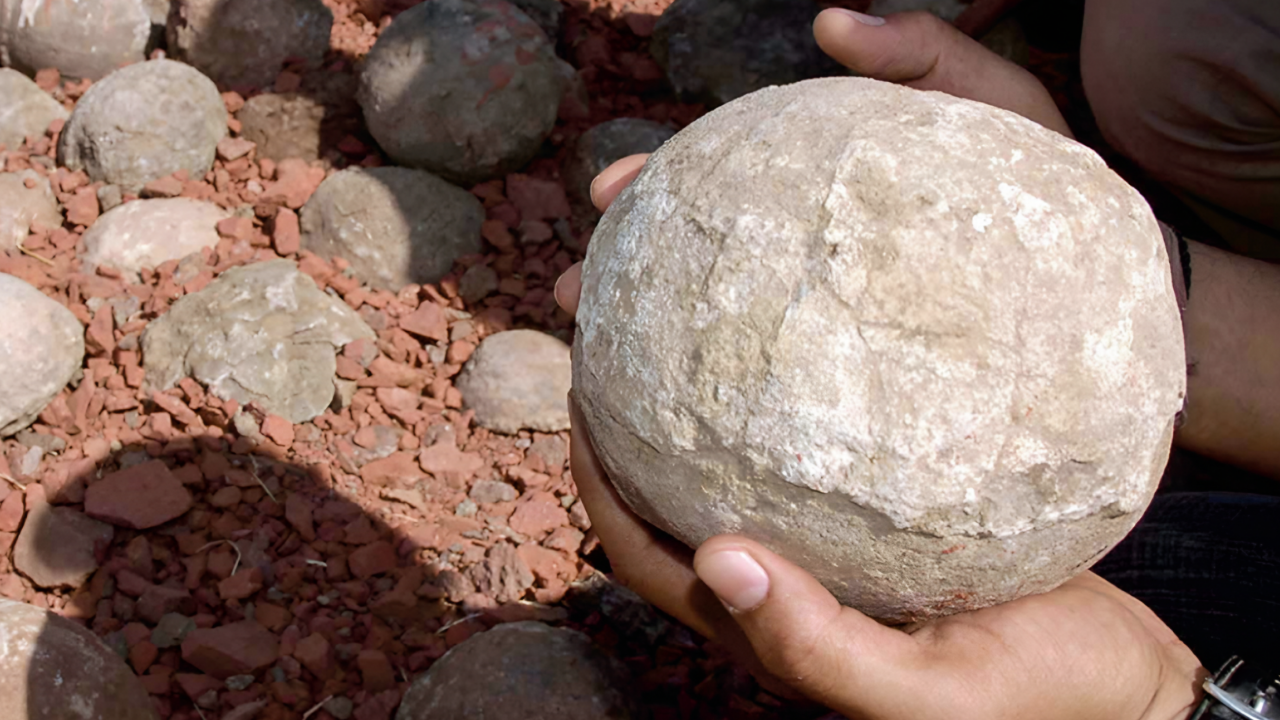
Along a roadside in Anhui province, eastern China, cannonball-sized fossils recently caught the attention of paleontologists passing through the Qianshan Basin. Believed at first to be typical dinosaur eggs, fractures in their shells exposed a sparkling surprise—interiors filled largely with calcite crystals. The find turned out to be more than a geological curiosity: when scientists examined the shells’ microstructures, they discovered evidence of a new kind of duck-billed dinosaur egg, refining the story of how ornithopods once reproduced.
Unearthed in a Race Against Time
Fossils rarely surface intact in the fast-developing landscapes of eastern China. Erosion and construction threaten to erase ancient traces almost as fast as they appear. Of the three eggs initially recovered from Qianshan, one vanished before study could begin. The two remaining offered just enough evidence for researchers to document their unique traits—and to identify a new oospecies, or species classified by eggs alone, now named Shixingoolithus qianshanensis.
Qianshan’s fossil-bearing strata, part of the Upper Cretaceous Chishan Formation, are rich with Late Cretaceous remains but are also fragile. Volcanic and tectonic activity that affected South China during the Cretaceous helped shape basins where sediments preserved snapshots of prehistoric life, from plants to dinosaurs, in this and comparable regions. The same long-term burial and percolation of mineral-rich groundwater that entombed extinct creatures also helped fossilize these calcified eggs, transforming fragile reproductive remnants into crystalline time capsules.
Rewriting the Ornithopod Record
In 2022, a research team led by Qing He of Anhui University and colleagues formally named the discovery Shixingoolithus qianshanensis in the Journal of Palaeogeography. Under a microscope, the eggs revealed an extremely thick shell, around 2.3 to 2.6 millimeters—typical of the Stalicoolithidae oofamily, known for their sturdy, nearly spherical eggs. This morphology pointed to ornithopods, the herbivorous, duck-billed dinosaurs that thrived across the Cretaceous world.
These eggs carried no embryos, yet their shells told a biological story. Over millions of years, mineral-rich groundwater infiltrated the hollow interiors, depositing calcite that preserved shell surfaces from decay. What was lost in organic remains was recovered in microstructural clarity. Researchers could examine radial columns and inner layers in unusual detail—a feat rarely possible in fossils less heavily mineralized.
Discovery, Debate, and Classification
The identification of Shixingoolithus qianshanensis stirred cautious excitement among paleontologists. Some welcomed the data as a much-needed expansion of the Asian fossil record; others questioned whether eggs alone could justify naming an oospecies, since directly linking eggshells to specific skeletons is often difficult. Advocates of the find argue that shell thickness, shape, and microstructure together form a useful signature—much as many bird eggs today are characteristic of particular groups.
Comparisons to other Chinese fossil sites highlight this significance. Henan’s Xixia Basin and Jiangxi’s Ganzhou district have produced hadrosauroid embryos, including well-known “baby” specimens described from southern China. Qianshan, lacking embryonic fossils but rich in chemically transformed eggs, offers a different kind of insight: it shows how mineral processes can preserve biological information long after soft tissues disappear.
Fieldwork continues despite setbacks. The disappearance of the third egg remains unresolved, a reminder of how vulnerable fossil recovery can be. Every specimen matters in reconstructing Cretaceous life, and even minor losses carry scientific weight.
Science in Partnership
The Anhui University team’s collaboration with the Nanjing Institute of Geology and Palaeontology and other Chinese institutions underscores growing regional leadership in vertebrate paleontology. Publication in the Journal of Palaeogeography gave the research international reach, while media coverage elevated public interest in China’s prehistoric heritage. Government-backed and regional initiatives across China are working to protect fossil-rich areas, and Qianshan is among the localities drawing increased scientific and conservation attention.
Plans for expanded surveys are already under way. Potential new egg sites lie exposed along infrastructure projects, forcing scientists to work quickly before excavation erases ancient layers. Teams increasingly employ advanced imaging methods, such as CT scanning, to detect embryonic material in similar eggs before cutting into them, reducing the risk of damaging specimens. If an intact embryo is ever found inside a Shixingoolithus egg, it could conclusively link this oospecies to its parent dinosaur and help resolve long-standing questions about ornithopod reproduction.
A Window Into a Lost World
Dated to the Late Cretaceous, the eggs of Shixingoolithus qianshanensis likely formed tens of millions of years before the end of the dinosaur era, around 70–85 million years ago. Their thick shells may have helped regulate temperature and moisture in a changing Cretaceous climate—adaptations that speak to the resilience of their makers. That resilience would ultimately meet its limit when the asteroid that struck the Yucatán Peninsula about 66 million years ago ended the Age of Dinosaurs.
What remains is not extinction’s tragedy, but a trace of survival’s ingenuity. Within their crystallized shells, the last echoes of an ancient lineage endure, offering clues to a vanished ecology and a vivid connection between Earth’s deep geological past and its fragile biological present.
Sources:
Earth com, December 19, 2025
Live Science, September 20, 2022
Journal of Palaeogeography, August 2022
PMC/NIH hadrosauroid embryo study, May 2022
NASA Science, January 2024
Natural History Museum London, November 2020