Across American classrooms, a single behavior dominates student focus: checking their phone. Teachers report spending up to 30 minutes per class period managing device distractions rather than instruction.
School leaders nationwide are grappling with an uncomfortable truth: smartphones have become the primary barrier to learning, surpassing even absenteeism in impact. The frustration has reached a breaking point, forcing unprecedented policy responses.
A Tipping Point Arrives

By early 2026, the pressure cooker exploded. Twenty-two states enacted cell phone restrictions in just twelve months in 2025 alone. This unprecedented legislative surge represents the fastest coordinated adoption of education policies since the national standards movement.
What started as isolated districts experimenting with phone bans has transformed into a genuine nationwide movement reshaping how millions of students experience school.
Where It Started
Florida pioneered the statewide “bell-to-bell” model in May 2023 with the passage of HB 379, which requires comprehensive phone restrictions during both instructional and non-instructional periods.
New York followed suit in September 2025, banning devices during the entire school day across all districts. These trailblazer states provided proof of concept demonstrating that broad-scale implementation was feasible, enforceable, and politically viable despite initial skepticism.
The Momentum Builds

Virginia’s Governor Glenn Youngkin issued Executive Order 33 in January 2025, allocating $500,000 for implementation support. Texas, Alabama, Louisiana, Georgia, and Ohio quickly followed with statewide mandates.
Districts reported dramatic improvements: reduced classroom disruptions, higher test scores in early adopter regions, and measurable improvements in student mental health. The success stories fueled legislative urgency across remaining holdout states.
The New Jersey Signal

On January 8, 2026, New Jersey Governor Phil Murphy signed Senate Bill 3695 into law, establishing a statewide mandate requiring all 600-plus school districts to adopt cell phone bans effective in the 2026-2027 school year.
This made New Jersey the 26th state to require mandatory restrictions on internet-enabled devices during regular school hours, on buses, and at school-sanctioned events. The legislation was passed with overwhelming support, with only three dissenting votes in December 2025.
The Scale of Impact

New Jersey’s 1.3 million public school students join more than twelve million peers in just California, Texas, and the Garden State alone. Nationwide, the 26 states with mandatory cell phone bans collectively serve approximately thirty million K-12 students, more than half the nation’s public school enrollment.
This represents the most significant coordinated educational technology restriction in U.S. history, affecting multiple generations simultaneously.
The Educator’s Relief

“We do so many jobs as educators in our building. Phone police should not be one of them, but that’s where we are,” said Steve Beatty, President of the New Jersey Education Association.
Teachers have spent years enforcing phone policies individually, creating classroom friction, and consuming instructional minutes. The statewide mandate shifts enforcement from individual teachers to institutional policy, a shift educators describe as transformative for classroom climate.
The Funding Machine

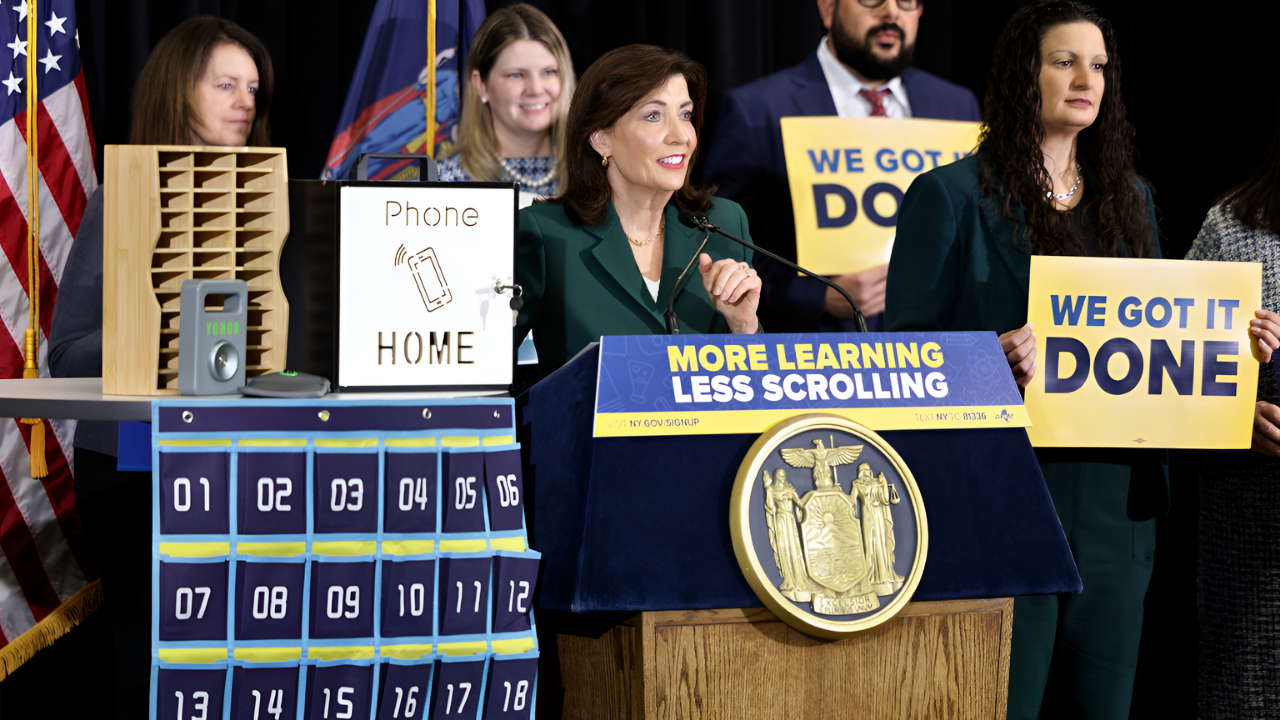
New Jersey allocated $980,000 in implementation grants to eighty-six school districts and charter schools to purchase phone storage systems, educate staff, and manage rollout logistics.
New York spent $29 million statewide, with $13.5 million directed to NYC schools alone for phone pouches, lockers, and staff training. Texas and California created similar funding mechanisms. This funding approach transformed cell phone management from an unfunded mandate to a resourced initiative.
The Implementation Arsenal

Districts are deploying multiple technologies to enforce bans, including Yondr phone pouches (which lock devices at the building entrance), secure charging lockers, classroom phone storage carts, and designated “phone parking” stations.
Emergency override protocols allow students to access devices during genuine crises. The approach strikes a balance between strict enforcement and practical flexibility; students retain phone access during school for genuine emergencies, while blocking recreational use.
The Unexpected Casualty

Emergency communication protocols face scrutiny under comprehensive bans. Schools must now develop systems that enable parents to reach students during genuine crises without undermining enforcement of bans.
Precisely how schools distinguish “emergency contact” from “recreational texting” remains administratively contentious. Some districts allow lockbox bypass during designated periods, while others maintain strict separation between school emergency channels and personal devices, creating new operational complexity.
The Privacy Pushback

Civil liberties organizations raise concerns about phone pouches and storage systems creating new surveillance infrastructure. Student privacy advocates question whether schools maintain appropriate boundaries on device inspection and digital access.
Some parents argue that phone bans infringe on their parental authority by limiting their ability to provide emergency contact information. These objections highlight inherent tensions between preventing distraction and preserving autonomy.
The Teacher Training Gap

Implementing a unified policy across more than 600 districts requires unprecedented professional development. New Jersey’s Department of Education created ninety-minute teacher training modules covering enforcement, student communication, and emergency protocols.
Yet, rollout timelines are tight: training must be completed by August 2026, with schools set to open in September 2026. Districts report uncertainty about the consistency of urban versus rural contexts, which present vastly different implementation challenges.
The District Variation Strategy

Rather than imposing identical methods, state guidelines allow districts discretion on implementation. Wealthy suburban districts purchased Yondr pouches, while urban districts allocated funding for lockers, and rural schools implemented simple classroom baskets.
This flexibility acknowledges that implementation contexts vary dramatically; the risk is that inconsistent application could create legal vulnerabilities if enforcement becomes perceived as discriminatory.
The Student Skepticism

Education researchers warn that enforcement alone won’t produce sustained behavior change. Students adapt quickly, finding workarounds or resistance strategies to overcome challenges.
Long-term success depends on an institutional culture shift, with teachers, parents, and students all accepting a phone-free school as the norm. Early data from New York (September 2025) indicate strong initial compliance; however, multi-year longitudinal studies are pending.
The Untested Question

Can universal phone bans survive legal challenge? First-Amendment scholars debate whether personal device restrictions on public school grounds withstand constitutional scrutiny. No appellate court has yet ruled on comprehensive state-mandated bans.
If litigation emerges, courts must balance student expression rights against school safety and academic mission. This legal uncertainty influences cautious implementation in some districts.
The Political Realignment

Cell phone bans unite unlikely political coalitions: conservative parents citing safety concerns join progressive educators citing mental health impacts. Both Democrats and Republicans sponsored state legislation.
This bipartisan consensus marks rare agreement on education policy, even as deeper ideological divides persist on curriculum and governance. The phone ban becomes the one issue both sides can champion simultaneously.
The Silicon Valley Response
Tech industry observers note the irony: companies built smartphones as educational tools; schools now exclude them from educational spaces. Some manufacturers advocate for age-appropriate device design rather than blanket bans.
Others lobby for “school mode” software enabling parental lockdown during school hours without physical confiscation. The tech policy debate intensifies even as implementation proceeds.
The Mental Health Bet

Advocates argue phone bans address the teen mental health crisis: reduced social media exposure reduces anxiety, depression, and self-harm. Research from schools that have implemented bans shows a decrease in cyberbullying and improved sleep patterns.
However, causation remains contested: do phones cause mental health decline, or do struggling teens use phones more heavily? The policy stakes rest on this unresolved debate.
The Gen Z Reckoning

Teenagers raised with constant smartphone connectivity face their first extended digital disconnection during school. For students born after 2008, this represents a paradigm shift in daily experience.
Some describe relief from social pressure; others report withdrawal symptoms and anxiety about missing peer communications. The generational experience of enforced phone-free school becomes a defining marker for Gen Z’s relationship with technology.
The Harbinger Effect
If twenty-six states successfully implement comprehensive phone bans without legal derailment or operational failure, remaining states will likely follow within twelve to twenty-four months.
The model becomes normalized. In five years, phone-free school may become a standard assumption rather than a novel experiment. However, the experiment also signals something deeper: society’s growing acknowledgment that unfettered access to technology carries genuine costs and that institutional boundaries can meaningfully shape outcomes.
Sources:
CivicIQ: 26 States Now Require School Cell Phone Bans: 2026 K-12 Policy Tracker Implementation Guide
New York Times: New York’s Ban on Cellphones in Schools Is Going ‘Better Than Expected’
Texas Education Agency: Enrollment In Texas Public Schools, 2024-25
California Department of Finance: Public K-12 Graded Enrollment
New Jersey Department of Education: Public Schools Fact Sheet 2024-2025
Campus Safety Magazine: Which States Have Banned Cell Phones in Schools?