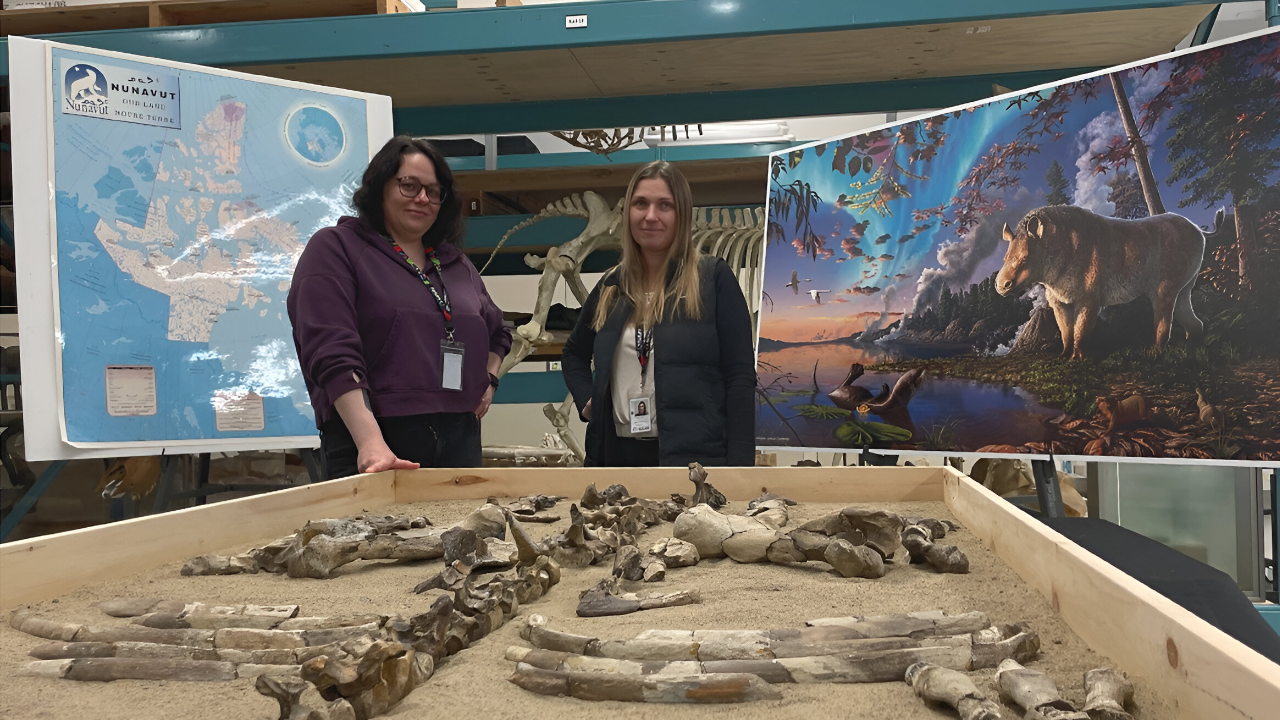
In a rocky impact crater high in Canada’s Arctic, scientists have uncovered a hornless rhinoceros that is rewriting the map of ancient Earth. The newly described species, Epiatheracerium itjilik, lived 23 million years ago on what is now Devon Island, Nunavut. Its remarkably complete skeleton, announced in 2025, shows that large mammals were still using a land route between Europe and North America tens of millions of years later than geologists had assumed.
Old Assumptions, New Challenge
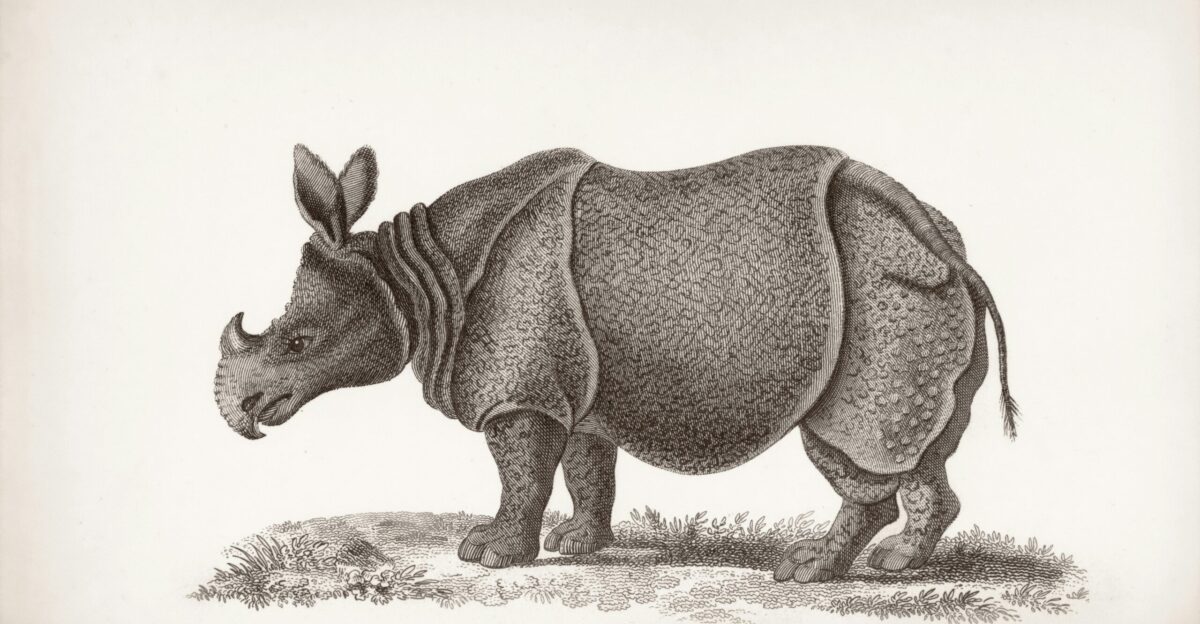
For decades, textbooks described the North Atlantic Land Bridge as a short-lived pathway. Geological studies indicated that this strip of emergent land between Greenland, northern Europe, and northeastern North America broke apart around 56 million years ago in the early Eocene, as the Atlantic Ocean widened.
Under that timeline, later mammals were thought to be effectively trapped on their respective continents. By the Oligocene and Miocene, large animals such as rhinoceroses were believed to have no viable route between Europe and North America. Similar species on opposite sides of the Atlantic were explained as parallel evolution, not recent exchange.
The Arctic rhino from Devon Island directly contradicts that view. Its ancestry, age, and location indicate that a functional land connection persisted far longer than the long-accepted closure date, forcing a re-evaluation of how and when mammals moved between continents.
A Rhino in a Temperate Arctic
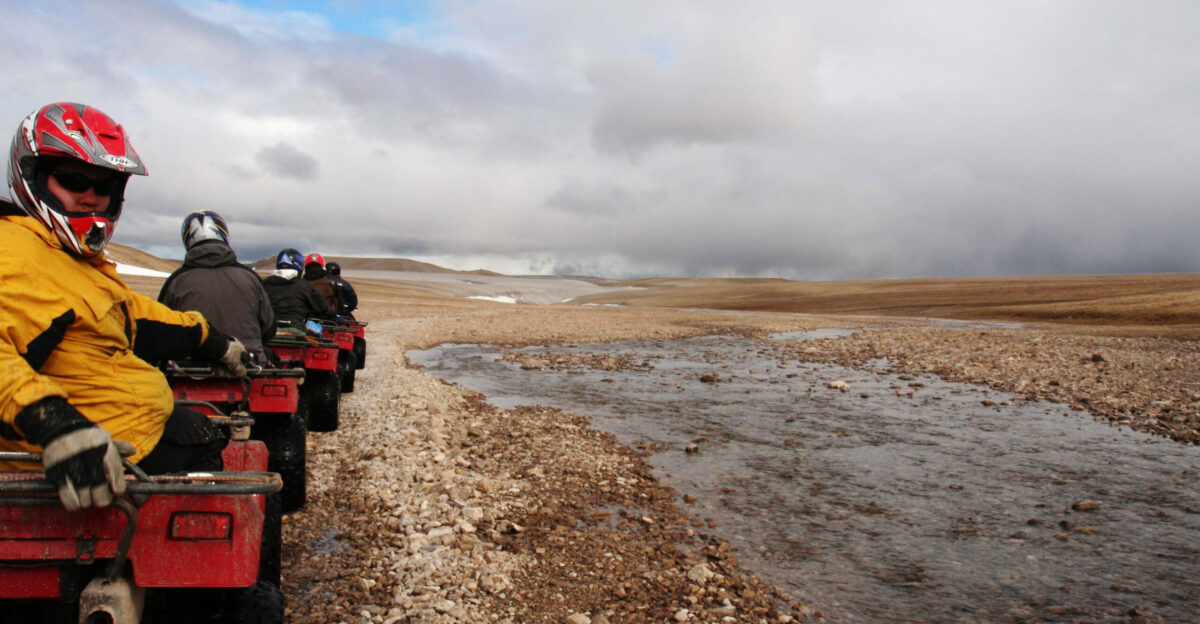
Epiatheracerium itjilik was a member of the hornless rhino group Aceratheriinae. It stood approximately 5 feet (1.5 meters) tall at the shoulder and lived during the Early Miocene, roughly 23 million years ago. Despite its high-latitude discovery site in the modern Arctic, it was not a tundra specialist. Evidence from fossil plants and pollen indicates that the region then was a temperate, mixed forest with mild winters, warm summers, and dense coniferous and deciduous trees.
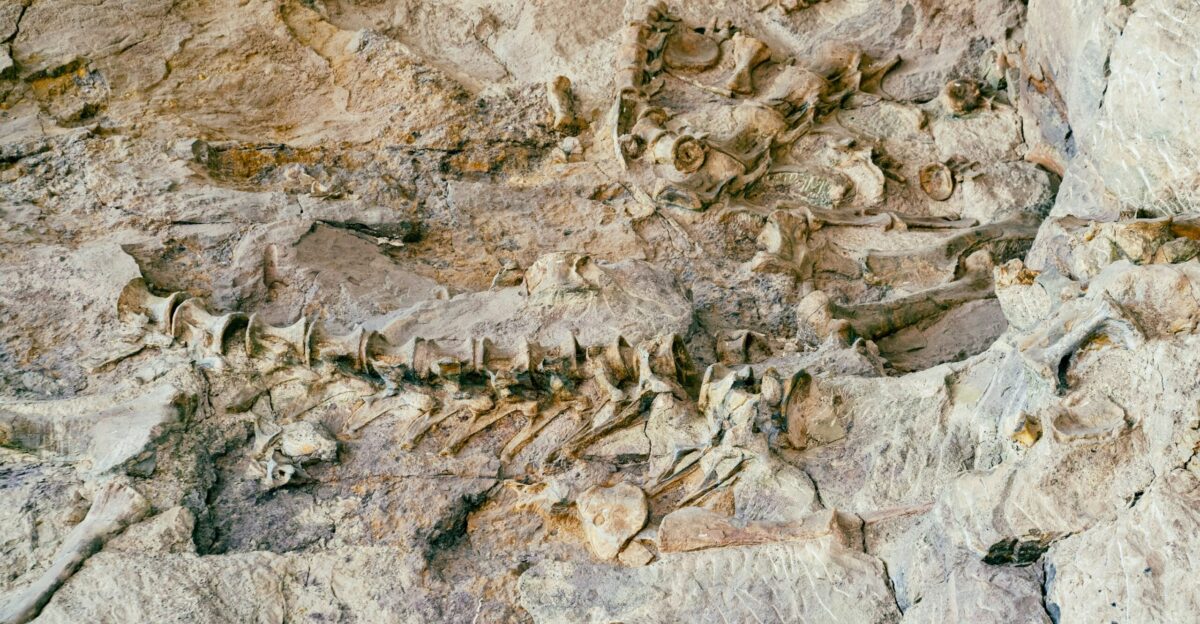
The first bones were found in 1986 by Mary Dawson of the Carnegie Museum of Natural History during work at Haughton Crater, an impact structure on Devon Island. Additional field seasons yielded more of the skeleton. Over time, researchers were able to assemble about 75 percent of the animal’s bones, an unusually complete specimen for an ancient rhino, which are typically represented by scattered teeth and partial jaws.
The Haughton Crater appears to have played a key role in that preservation. Its geology likely created a sheltered basin where carcasses could be buried quickly and remain protected from scavengers and disturbance. The bones of E. itjilik are three-dimensional, minimally altered, and in excellent condition, giving scientists an opportunity to document subtle anatomical traits that are usually lost.
Using those details, researchers could place the species precisely within the rhino family tree and compare it with relatives from Europe, Asia, and North America.
Reopening the North Atlantic Land Bridge
To test how this Arctic rhino fit into global rhino evolution, a team led by Danielle Fraser at the Canadian Museum of Nature conducted an extensive phylogenetic and biogeographic analysis. They examined 57 rhino species, living and extinct, combining fossil ages, anatomical features, and geographic data in a fossilized birth–death modeling framework.
Using the BioGeoBears software package, the team reconstructed how rhino lineages originated, dispersed, and split across continents. Their results indicate that E. itjilik descended from European ancestors and reached the Canadian High Arctic by crossing the North Atlantic Land Bridge around 23 million years ago.
That conclusion extends the bridge’s effective lifespan by at least 20 million years beyond the widely cited 56-million-year closure date. The work, published in Nature Ecology & Evolution, suggests that the intercontinental corridor remained intermittently passable to large mammals through the Early Miocene, even as seafloor spreading continued in the North Atlantic.
This longer timeline helps resolve longstanding puzzles, such as the close resemblance of some Miocene mammals found in both Europe and North America despite no previously accepted route for them to travel.
Impacts on Evolution, Climate, and Conservation
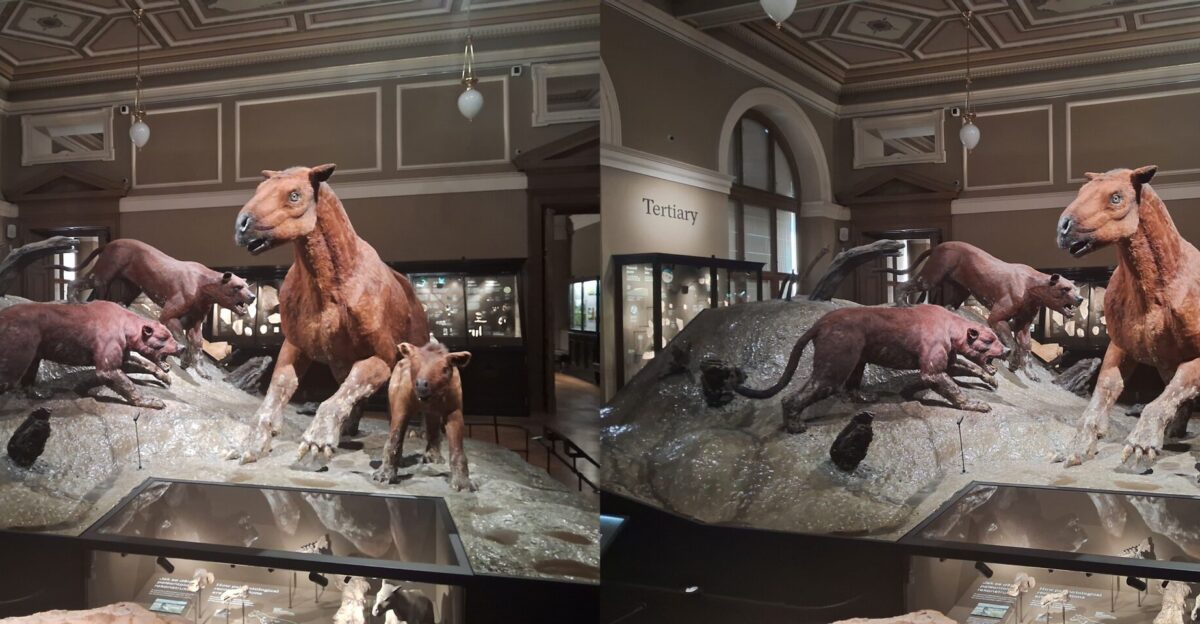
The revised Land Bridge history has wide implications for Miocene biogeography. The epoch from 23 to 5 million years ago saw major climate transitions, the spread of grasslands, and shifts in mammal body size and behavior. If rhinos were still crossing between continents during that period, other groups—such as deer, horses, and carnivores—may also have dispersed later than once believed.
Reconsidering which Miocene mammals were long-term residents and which were recent arrivals changes how scientists reconstruct predator–prey interactions, habitat development, and regional diversity. It also suggests that geological models of North Atlantic opening may need to be refined to account for a land connection that persisted, perhaps in a fragmented or seasonal form, well into the Miocene.
The Arctic setting of E. itjilik highlights how dramatically Earth’s climate has shifted. The warm, forested High Arctic of 23 million years ago supported primates, odd-toed ungulates, carnivores, and other mammals in rich riverine ecosystems. As global cooling intensified, ice sheets expanded and ocean circulation patterns changed, the Arctic became progressively colder, and many lineages, including Arctic rhinos, disappeared.
Viewed against the broader history of rhinoceroses, E. itjilik is one of many lost branches. Today only five rhino species survive in Africa and Asia, while at least 50 extinct species are known from the fossil record. The disappearance of Arctic rhinos during episodes of global cooling, habitat fragmentation, and changing predator communities underscores how sensitive large mammals can be to environmental upheaval.
The species’ name itself reflects both scientific classification and cultural context. Epiatheracerium places the animal within the Aceratheriinae, while the species epithet itjilik derives from Inuktitut, meaning “frosty” or “frost,” acknowledging the Indigenous peoples and languages of the region where the fossils were found.
Looking ahead, researchers plan to use isotopic analysis of the bones to reconstruct diet and seasonal movements and to explore whether any molecular data can be recovered to test genetic links to modern rhinos. Continued work at Haughton Crater may reveal additional individuals and shed light on population variation. Geologists are also likely to revisit models of North Atlantic development, searching for evidence of other potential crossing points.
For scientists studying today’s rapid warming, the story of Epiatheracerium itjilik offers both a window into a past warm Arctic and a warning. It shows that northern regions can support diverse large-mammal communities under mild climates, but it also illustrates how quickly such faunas can vanish when conditions change. As conservationists work to protect the few remaining rhino species, deep-time perspectives on climate, habitat, and migration are becoming an increasingly important part of understanding their long-term prospects.
Sources
Nature Ecology & Evolution, October 27, 2025
CBC News, October 28, 2025
Discover Magazine, October 27, 2025
NPR, December 4, 2025
Arctic Today, October 30, 2025
IFLScience, November 15, 2025