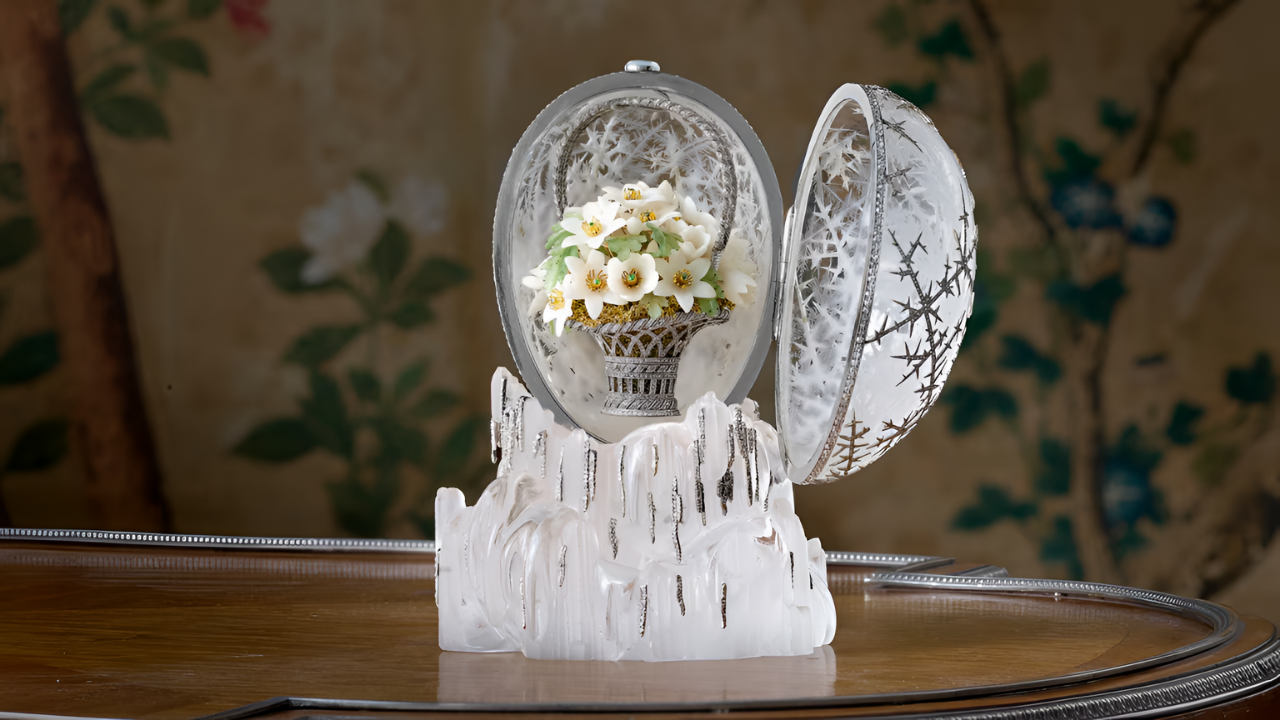
In a tense three-minute frenzy at Christie’s London on December 2, 2025, the Winter Egg—a rare Fabergé Imperial Easter Egg—sold for £22.9 million, including fees, equivalent to $30.2 million. This sale marked the highest price ever for such a treasure, underscoring its unmatched status among the seven privately held survivors from the original 50 created between 1885 and 1916.
Commissioned for Imperial Love
Tsar Nicholas II ordered the Winter Egg in 1913 as an Easter present for his mother, Dowager Empress Maria Feodorovna. Crafted from translucent rock crystal and adorned with 4,500 rose-cut diamonds, it cost 24,600 rubles—the third-highest sum Fabergé charged for any piece, as noted in the surviving invoice dated April 13, 1913. This gesture captured a son’s devotion amid the grandeur of the Romanov court.
The Woman Behind the Vision
Alma Pihl, born in Moscow in 1888, designed the egg as one of just two women in Fabergé’s St. Petersburg workshop. Granddaughter of master jeweler August Holmström and niece to Albert Holmström, who executed her work, Pihl drew inspiration from frost crystals on her window one winter evening. Her fractal ice patterns, first seen in snowflake brooches for oil magnate Emanuel Nobel, evolved into this imperial marvel, expanding Fabergé’s artistic boundaries.
The Ice Crystal Exterior
The egg’s surface shimmers with platinum-set diamonds forming snowflake motifs over rock crystal, allowing light to filter through like sunlight on frost. Fine engravings evoke delicate ice on the interior. Platinum rivulets at the base suggest melting snow, while a cabochon moonstone at the top bears the date 1913. Pihl scaled her jewelry motifs into a frozen orb, suspended in crystalline perfection.
The Hidden Surprise Within
Inside lies Fabergé’s trademark surprise: a platinum basket brimming with white quartz wood anemones. Each flower is carved from a single quartz piece, with gold wire stems, stamens, demantoid garnet centers, and nephrite leaves amid gold moss. Studded with 1,378 diamonds, it symbolizes spring’s renewal bursting from winter’s grasp—a poignant contrast of seasons.
Lost to Revolution, Rediscovered
The 1917 Bolshevik Revolution upended the Romanovs, transferring the egg to Moscow’s Kremlin Armory in September 1917. Soviet authorities, needing funds, labeled Fabergé works as “exploiter art” and sold them cheaply. London dealer Wartski bought it in the late 1920s or early 1930s for £450—about $30,000 today. It passed to Napier Sturt, 3rd Baron Alington, in 1934 for £1,500, then to Sir Bernard Eckstein, and auctioned in 1949 for £1,700.
Presumed lost or destroyed during purges, the egg resurfaced at Christie’s Geneva in 1994, fetching 7.3 million Swiss francs ($5.6 million) in a record sale. Christie’s New York resold it in 2002 for $9.6 million, another benchmark. It then vanished from view for 23 years, heightening anticipation among collectors and museums.
Alma Pihl’s Enduring Legacy
Pihl thrived in a male-dominated field, designing the Winter Egg in 1913 and the pricier Mosaic Egg (28,300 rubles) for Empress Alexandra in 1914. Only the Mosaic and Catherine the Great (26,800 rubles) eggs cost more, both now in museums. As the most expensive Imperial Egg to reach auction, the Winter Egg highlights Pihl’s innovation—her frost-inspired vision outlasting empires.
Three Minutes That Rewrote History
Bidding opened at £17 million and climbed rapidly, closing at a £19.5 million hammer price. An anonymous buyer claimed this irreplaceable artifact of Romanov history, crafted 112 years ago by a trailblazing woman. The Dowager Empress, exiled to Denmark and dying in 1928, never knew her gift had been sold for pennies amid the 1918 execution of Nicholas II and his family.
This transaction elevates the Winter Egg beyond any prior Fabergé sale, its scarcity driving value in a market starved for such rarities. For collectors, it embodies survival through revolution and war; for historians, a testament to artistry’s permanence. Future auctions may test these heights, but none will match its singular narrative.
Sources
“The Winter Egg sells for £23m” – Fabergé Official
“A Prized Fabergé Egg Is Sold at Auction for More Than $30 Million” – The New York Times
“Fabergé egg fetches record £22.9m at London auction” – BBC News
“The Winter Egg: an imperial Fabergé egg” – Christie’s Official Press Release
“An Iconic, Icy Imperial Fabergé Easter Egg Hits the Auction Block” – Court Jeweller
“Fabergé’s rare gem: Alma Pihl” – V&A Museum