
Seven distant stars have captured the attention of astronomers hunting for signs of advanced civilizations. In June 2024, Project Hephaistos revealed that seven M-dwarf stars were emitting unusual infrared radiation—signals that defy easy explanation using known astrophysical phenomena.
Using data from five million stars, researchers flagged these as potential Dyson sphere candidates, hypothetical megastructures designed to harness stellar energy. While preliminary and requiring further verification, the findings challenge traditional methods for detecting intelligent life.
Global Collaboration Behind the Search

Project Hephaistos, led by Matías Suazo at Uppsala University in Sweden, brought together seven co-authors from Sweden, India, the UK, and the United States. Funded by the Royal Swedish Academy of Sciences, the Magnus Bergvall Foundation, AI4Research, and India’s SPARC project, the initiative reflects a strong international commitment to searching for technosignatures.
The team combined expertise in astronomy, data science, and machine learning to sift through enormous datasets. The project’s name, inspired by the Greek god of fire and craftsmanship, reflects its focus on blending cosmic phenomena with advanced technological concepts. Unlike traditional SETI efforts relying on communication signals, Project Hephaistos searches for physical evidence of large-scale stellar engineering.
Detecting the Unusual: Methods and Findings
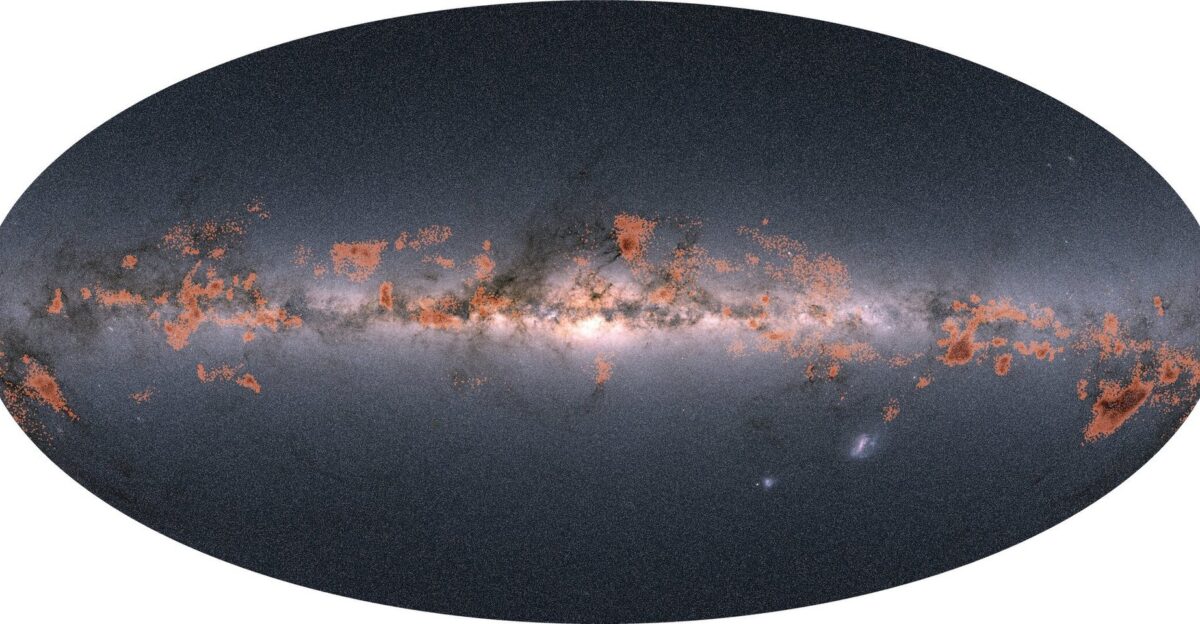
Researchers analyzed data from Gaia, 2MASS, and WISE missions, focusing on stars within 300 parsecs (978 light-years) of Earth. Their pipeline required mid-infrared detection in WISE W3 (12 μm) and W4 (22 μm) bands, followed by photometric fitting and convolutional neural network filters to remove nebular contamination. After detailed checks, 368 candidates were narrowed to seven M-dwarf stars.
M-dwarfs, making up 75–85% of the Milky Way, are prime targets due to their longevity and potential habitable zones. The rarity of debris disks around older M-dwarfs suggests natural explanations may be incomplete. Still, the team cautioned that infrared excesses do not confirm artificial structures. “The search was biased towards excesses that are consistent with Dyson spheres,” they noted, emphasizing the need for independent verification.
Verification and Scientific Caution

Follow-up studies at Jodrell Bank Observatory and the European VLBI Network used high-resolution radio observations to test the findings. Three of the seven candidates were affected by background contamination, including Hot DOG galaxies and active galactic nuclei (AGN). By January, candidate G was confirmed as a background AGN rather than a megastructure.
The remaining four stars remain unexplained, though statistical models suggest similar contamination could account for them. These studies highlight the essential role of verification in astronomy. Ruling out instrumental artifacts and background interference is critical before any anomaly can be considered a credible technosignature, underscoring both the promise and difficulty of detecting advanced civilizations.
Historical and Financial Context

The Dyson sphere concept dates to 1960, when physicist Freeman Dyson suggested that advanced civilizations might capture stellar energy, emitting waste heat detectable in infrared. Project Hephaistos is the first large-scale modern search for such technosignatures, utilizing ESA and NASA data and follow-up observations from European radio telescopes.
he project’s scale reflects both ambition and complexity, with combined public investments exceeding $1.4 billion. By surveying local Milky Way stars, researchers aim to identify subtle anomalies that could signal advanced engineering, marking a shift in how SETI approaches the cosmic search for intelligent life.
Implications for SETI and Future Research
The seven infrared-excess stars have energized the SETI community, emphasizing searches for physical evidence of engineering over communication signals. The findings encourage statistical rigor, methodological transparency, and advanced machine learning tools to separate true anomalies from background noise.
Project Hephaistos also raises questions central to the Fermi Paradox. The lack of confirmed Dyson spheres, despite extensive searches and follow-ups, illustrates the difficulty of detecting distant civilizations. Yet, every analysis, verification, and even natural explanation refines tools for future studies, advancing humanity’s quest to answer one of its most profound questions: are we alone in the galaxy?