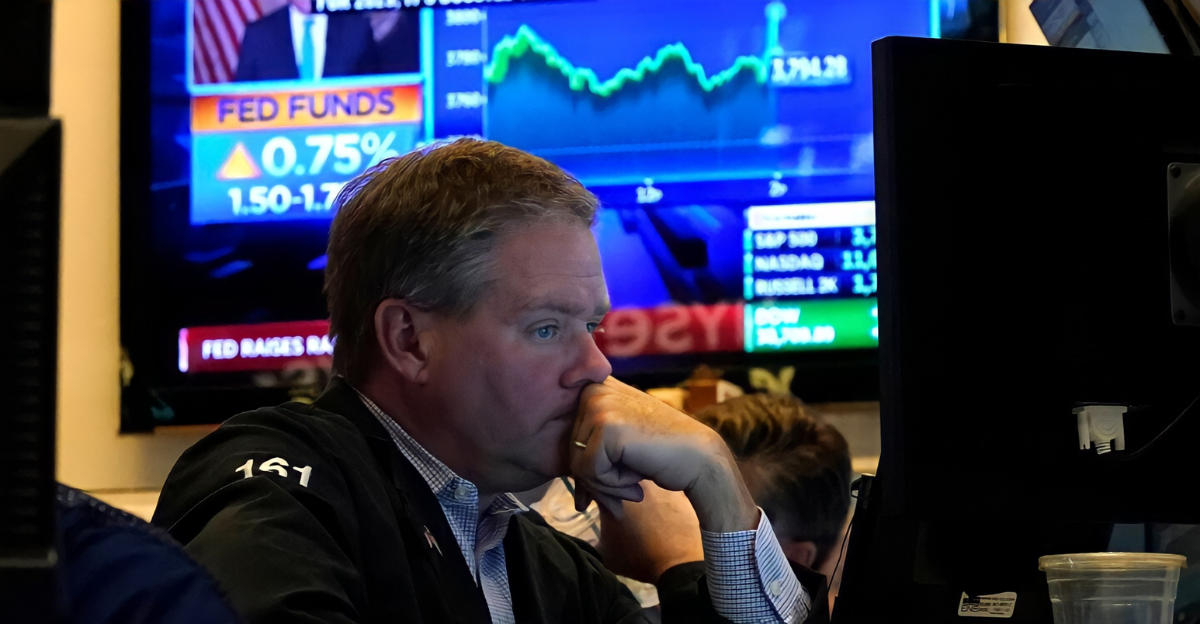
By mid-Sept 2025, the Fed ended a nine-month pause: August CPI hit 2.9%, the highest since January, even as U.S. unemployment rose to 4.3%, the most since 2021.
These data surprised markets and officials. Almost immediately, big banks cut their lending rates, reacting to the Fed’s move. Behind the scenes, Fed officials privately signaled debate: one dissenting governor wanted a half-point cut instead of 25bp. In short,
The economy’s sudden wobble broke the Fed’s silence and set the stage for policy drama ahead.
Pressure Cooker

The real economy was under strain. Job creation in August collapsed to just +22,000—an outsized slowdown after prior gains.
On top of that, a massive benchmark revision peeled away roughly 911,000 jobs from the first half of 2025, the biggest downward revision in decades.
“The economy is skating as close to the edge of recession as you can get,” warned economist Christopher Rupkey, noting that only a Fed rate cut could arrest the slide. With inflation still above target, markets quickly priced in aggressive Fed easing even as officials feared inflation would stay stubborn. This pot was boiling over.
Historical Context

Prior to this meeting, the Fed’s policy rate had been unmoved at 4.25–4.50% since late 2024. In fact, the central bank had held steady for nine straight months. That pause came after three quarter-point rate cuts in late 2024, which themselves followed a hiking spree that drove the Fed funds rate up toward 5½%.
The result was an unusually long steady spell in 2025 as officials sought clarity on how trade wars and tariffs might affect prices.
The Fed entered September sitting at historically high rates, facing pressure to pivot even as economic signals grew mixed.
Mounting Tensions
Fed Chair Powell was caught between forces. On one side, the Trump administration’s trade policy had driven U.S. tariffs to new heights, generating roughly $150 billion in tariff revenue in the first seven months of 2025.
Those taxes were adding to consumer prices, complicating the Fed’s fight against inflation. At the same time, President Trump publicly blasted Powell for keeping rates “too high,” even calling him a “numbskull” for slowing his rate-cut push.
The White House was pushing hard for relief from expensive borrowing, while economists warned that rushing cuts amid tariff-driven inflation risked a policy mistake. In short, the Fed was in a political crossfire between growth and price pressures.
The Cut Revealed
At 2:00 PM EDT on Sept. 17, 2025, the Fed announced a 25bp cut, lowering its federal funds target range to 4.00–4.25%. The decision carried an 11–1 vote: all participants except newcomer Stephen Miran supported it.
In the press conference, Powell called the move a “risk management cut,” aimed at insulating the economy from rising labor market and geopolitical risks.
This underscored the Fed’s cautious shift: not a dramatic easing, but a prudent adjustment. (Trump’s demands for a much larger cut went unmet.) Powell stressed that policymakers would continue to “keep our eye on inflation” even as they eased to protect jobs. The tone was clear: moderate easing, not an all-out pivot.
Immediate Ripple

Banks and financial firms wasted no time. Within hours of the Fed’s announcement, major lenders (JPMorgan, Bank of America, Wells Fargo, Citigroup) lowered their prime lending rate from 7.50% to 7.25%.
This meant millions of borrowers — from credit card and HELOC customers to small businesses — immediately saw slightly cheaper loan costs. Credit cards tied to prime fell in rate, mortgage refinancing costs dipped, and new loans became easier to price.
The Fed’s quarter-point cut had thus translated rapidly into a bit of relief for consumers and firms. As one analyst put it, this early “ripple” was meant to take the edge off high borrowing costs in this volatile economy.
Consumer Relief

Consumers began to feel modest relief. As Fed officials said, the cut was a “risk management” step to ease pressure on households. For example, the average credit-card APR (~20.12%) is drifting downward, which helps those carrying the typical $6,473 card balance.
Homeowners saw bigger swings: mortgage refinancing applications jumped about 60% as 30-year fixed mortgage rates fell to ~6.35% — their lowest in nearly a year. In short,
Borrowing costs for cars, homes, and credit cards moved closer to early-2024 levels. One first-time homebuyer told reporters the cut had actually unlocked the chance to refinance his loan and save hundreds a month. The Fed’s maneuver had already lightened pockets a little.
Banking Bonanza

Financial firms cheered the Fed’s decision. By lowering short-term funding costs, the cut promised better net interest margins for banks. Indeed, bank stocks jumped: regional lender indexes climbed immediately, and U.S. financial stocks broadly outperformed after the announcement.
Lower rates meant small-cap and debt-reliant companies also rejoiced, expecting to refinance existing bonds at cheaper yields.
A bond trader noted the easing would “be a boon for risk assets,” as firms lined up to issue new debt and raise capital. In the near-term, Wall Street gains reflected faith that this was the start of a benign easing cycle — even if it was only a quarter point for now.
Economic Crossroads

The Fed’s move came amid a fragile backdrop. U.S. GDP growth rebounded about 3.0% annualized in Q2 2025, partly driven by front-loaded imports ahead of tariffs. But that masked uneasy consumers: confidence wavered, and spending was on edge in some surveys.
The dollar had traded near four-year lows versus the euro as investors braced for Fed easing and President Trump again pressed for lower rates.
Abroad, worries about slowing global growth, China’s economy, and sustained trade tensions meant Fed watchers had no clean path. In other words, policymakers stood at a macroeconomic crossroads: they had to navigate a slow-growth, persistent-inflation environment with few easy options.
Dissent Unveiled

The Fed’s unity broke at this meeting. Governor Stephen Miran, Trump’s recently confirmed appointee (on leave from his White House CEA job), cast the sole dissenting vote. His preference was a half-point cut. Miran’s vote made history: a sitting White House official voting on Fed policy is unprecedented in modern times.
In statements afterward, critics roared that Fed governance was being politicized. Supporters defended Miran’s independence, but warned lines had been blurred.
Meanwhile, Fed officials emphasized their process: as Powell later said, no 50bp cut had “widespread support” and decisions were still data-based. The dissent flagged a clear split in how to weigh growth versus inflation, raising tough questions about Fed independence and political influence.
Independence Under Siege

The confirmation fight over Miran had already signaled trouble. Democrats on the Senate floor openly feared the Fed’s autonomy was at risk. Opponents disparaged Miran as a “puppet” of the White House and warned this was no ordinary Fed appointment.
The final confirmation vote was 48–47 along party lines, underscoring the politicization. Even at the Sept meeting, GOP lawmakers voiced support for Trump’s growth-first stance, while warnings echoed that Fed credibility was on the line.
Institutional “guardrails” became a hot topic: Senators like Elizabeth Warren demanded iron-clad Fed independence.
Powell’s Balancing Act

Into this maelstrom stepped Chair Powell. He had quietly aligned 11 of the 12 voters behind the quarter-point decision. “For now… it is business as usual at the Fed,” noted a German central banker after the meeting, crediting Powell’s leadership.
In public, Powell affirmed that policy would remain data-dependent. At his press conference, he assured markets that Fed officials would “keep their eye on inflation… [and] maximum employment,” showing he understood both sides of the mandate.
He also drew a firm line about Fed culture: “We do our work based on the incoming data,” he said, noting that the half-point cut had no strong backing.
Strategic Pivot

Immediately, the Fed’s new outlook shifted. In the updated “dot plot” of interest-rate forecasts, officials penciled in two additional cuts by year-end (up from one in June), bringing the funds rate down toward roughly 3.6%.
They also raised 2025 growth expectations (GDP now ~1.6% vs 1.4% previously), reflecting a brighter outlook for consumption. By contrast, inflation was forecast higher: Fed members now saw core inflation around 3.1% in 2025.
The summary thus revealed a dovish tilt in policy: the Fed aimed for a “steady pace” of easing, conditional on data. As one Fed insider put it, officials believed they could support jobs with moderate rate cuts while still keeping inflation from running away.
Market Skepticism
Traders and analysts greeted the Fed’s messages with caution. “For the average American, a small change in rates will have little to no effect on their day-to-day lives,” warned Bankrate’s Amy Hubble.
After the Fed’s quarter-point cut, most Americans saw just marginal relief — credit-card APRs and mortgage rates, while slightly lower, remained near multi-year highs. Some investors actually sold off stocks on the news, noting that the economy still had heavy structural challenges.
A financial adviser quipped that the cut “isn’t a victory parade” and would be a minor tweak at best.
Future Uncertainty

The scene ahead remained murky. By the Fed’s own projections, unemployment could rise to ~4.5% and inflation hover near 3.0% by year-end. Powell summarized the dilemma: “We have a situation where… there’s no risk-free path,” with rising joblessness risks on one side and persistent price pressures on the other.
Markets now priced in further easing (over 90% odds of another cut by October), even as inflation expectations began creeping up.
With President Trump pushing for even steeper cuts, trade-driven price shocks still feeding through the economy, and consumer price metrics above target, the Fed faces the classic policy tug-of-war. Its ability to balance these cross-currents — preserving jobs without unleashing runaway inflation — will be tested like never before.
Political Fallout
The Fed episode has major political echo effects. President Trump’s Fed agenda now hinges on the Miran case. He is openly defying courts by trying to oust Governor Lisa Cook, and claims he will fill her seat if he can.
Republicans in Congress have rallied behind his stance, endorsing Fed pressure to favor growth over inflation. Meanwhile, Democrats have signaled they will sue to block any ouster of Cook and have publicly scolded the White House for the move.
The Fed is now squarely in the middle of partisan fights. Powell sought to stay above it; as he told reporters, Fed officials will focus on data alone. But the political ramifications are immediate: every Fed meeting will now be litmus-tested by Capitol Hill. The once-sterile economic arena has become highly charged.
Global Implications

Central banks around the world have also been watching. As the Fed moves to ease, some peers may follow. Canada’s central bank, reeling from U.S. tariffs and a slowing economy, was already expected to cut rates again.
By contrast, Europe and Japan have mostly paused — though in Europe, markets are still debating if the ECB might do more next year. In any case, Fed futures now show roughly 70 bp of easing priced in by year-end.
The dollar briefly ticked higher after the Fed’s move, putting pressure on commodity producers and emerging markets. Nations heavily reliant on exports or dollar debt (like Brazil, South Africa, Turkey) suddenly face a tougher external environment as U.S. liquidity grows looser.
Inflation Dilemma

That brings us back to prices. Even after the cut, inflation is a stubborn foe. U.S. core CPI (excluding food & energy) ran 3.1% in Aug. — well above the Fed’s 2% goal. The Fed’s own median forecast still calls for inflation ending 2025 near 3.0%.
Tariff-driven goods inflation, plus rents and services pressures, threaten to ratchet prices higher if left unchecked. Many Fed officials are now openly saying that the risk of stagflation looms if they blunt inflation too much.
As one market strategist noted, Fed colleagues “deemed that the downside risk to employment has increased, and therefore… are weighing the labor market more than the higher inflation”. The danger is clear: if the Fed leans too far into cutting, it could allow inflation to spiral, but if it holds rates too long, jobs suffer.
Generational Shift

This Fed cycle has a generational cast. For many Millennials and Gen Zers — who grew up with near-zero rates and tight credit — it is their first real test of monetary policy under stress. They are watching closely. Surveys show younger Americans are more skeptical of institutions and more vocal about policy fairness.
The debate over Fed independence versus accountability resonates strongly with a generation demanding responsiveness. As one market observer warned, cutting rates too much in this environment risks “stagflationary pressures,” — a nightmarish outcome many fear today.
The Fed’s moves are seen as part of a broader question: how technocratic policies mesh with the public’s economic reality. Younger Americans, burdened by high costs and uncertain careers, expect the Fed to keep its promises.
Crossroads Moment

Ultimately, September’s cut was more than an incremental rate move; it has become a test of American institutions. Bundesbank Chief Joachim Nagel captured the stakes: if Fed independence were “permanently undermined” by politics, “the consequences would be serious”.
This week’s decision will therefore resonate long after rates are changed. Will the Fed remain an independent anchor for the economy, or will it bend to political will? The answer will define its credibility for years.
This rate cut is a crossroads: the future of U.S. monetary policy — and, by extension, faith in democratic governance — hangs in the balance.