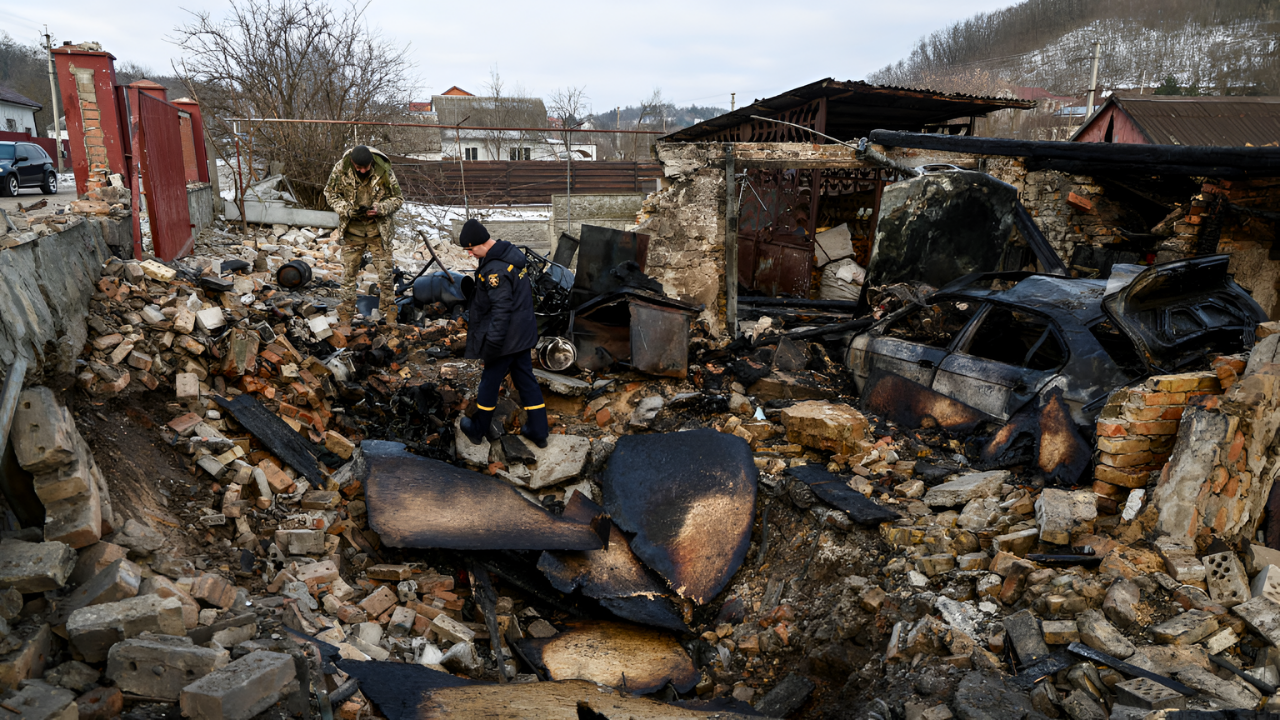
Russian missiles and drones pierced Ukraine’s night sky on December 29-30, 2025, unleashing one of the war’s largest aerial barrages with two Iskander-M missiles and 60 attack drones. Air defenses raced against the onslaught, revealing the mounting strain on Ukraine’s protective shield.
Escalating Aerial Onslaught
Russia intensified its drone campaign in December 2025, launching over 5,100 drones—the highest monthly total since the invasion began. The tactic aimed to saturate Ukraine’s defenses through multi-directional swarms from Russian territories and Crimea. Ukrainian intelligence indicates Russia produces about 404 Shahed-type drones daily, targeting 1,000 per day by mid-2026.
Shahed drones spearheaded the December 29-30 attack, joined by Gerbera variants. These unmanned aerial vehicles now fly at altitudes up to 3,000 meters, carrying fragmentation, incendiary, or thermobaric warheads that complicate interception.
Defensive Struggles
Ukraine’s air defenses blend Soviet-era systems with Western supplies, but missile shortages and coverage gaps leave vulnerabilities exposed. Swarms exploit these weaknesses, forcing crews to prioritize amid relentless pressure. Mobile anti-aircraft units and fighter jets provide partial countermeasures, yet the volume tests limits.
In the assault, Ukrainian forces downed 52 of 60 drones and one Iskander-M missile, achieving an 87% success rate—a notable win. Still, the rest struck five sites nationwide. Interception rates fluctuate: 70-90% against drones in ideal conditions, dropping to 40-50% in mass attacks; ballistic missiles vary from 0% to over 80%, influenced by salvo size, location, and Patriot availability.
Geographic Strain
Attacks spanned northern, southern, and eastern Ukraine, demanding broad coverage. Launches from diverse origins stretched response times, underscoring Russia’s intent to overload localized defenses.
Iskander Threat
The Iskander-M poses a steep challenge, with Russia firing nearly 1,000 since the war started and Ukraine intercepting just 24% overall. Rates shifted from 37% in summer 2025 to 6-17% by fall, due to software upgrades enabling evasive maneuvers and decoys. Some salvos see full intercepts; others none.
Ukrainian Innovation
Ukraine countered offensively, striking Russian air bases, fuel depots, and refineries with U.S. backing. Domestic production surged to over 1.5 million FPV drones in 2024, including kamikaze, reconnaissance, and long-range models, sustaining operations deep into enemy territory.
Amid shortages, artificial intelligence aids prediction of attack patterns via machine vision trained on conflict data, optimizing interceptor drones and response times.
Western Support Shortfalls
Patriot systems guard key cities like Kyiv, but only six batteries exist, with limited missiles and area coverage. Unprotected regions suffer lower intercepts as Russia targets them deliberately. By early 2026, overall missile interception fell to 36%—the lowest since October 2022—while drones held at 83%.
Human Toll
Even high intercepts yield devastation. Human Rights Watch recorded 30 civilian deaths and 483 injuries from Kherson drone strikes between May and December 2024. Hospitals, homes, and infrastructure bore the brunt, deepening the crisis.
Escalation Trajectory
Both sides escalated: Russia with thousands of monthly drones, Ukraine launching over 100 nightly. Analysts view it as a tactical duel of refinements. Sustainability questions persist as defenses hold but supplies dwindle, hinging on Western aid to match the tempo.
The barrage’s implications extend beyond immediate damage, signaling a war of attrition where production, innovation, and alliances determine endurance. Ukraine’s adaptations offer resilience, yet gaps in support and escalating volumes raise doubts about long-term viability without bolstered resources.
Sources:
Ukrainian Air Force Command, Ukrainian air defence downs Iskander ballistic missile and 52 drones, December 30, 2024
ABC News, Russia downs 4,300 Ukrainian drones in December setting new record, December 31, 2024
Le Monde, Ukraine’s air defense is struggling to keep up with intensifying Russian strikes, May 26, 2025
Human Rights Watch, Ukraine: Russia Using Drones to Attack Civilians, June 3, 2025
RUSI, Iskander: An Improved Russian Missile Tests Ukraine’s Air Defence, October 24, 2025
CSIS, Ukraine’s Future Vision and Current Capabilities for Waging AI-Enabled Autonomous Warfare, 2025