In February 2022, SpaceX launched a group of Starlink satellites into low Earth orbit. Soon after launch, many of them began falling back into the atmosphere rather than following their planned paths. A sudden increase in air density at high altitude caused stronger drag on the satellites.
They burned up within days and never reached working altitude. This happened during a geomagnetic disturbance linked to space weather. Energy from the Sun heated the upper atmosphere, causing it to expand. What looked like a routine storm turned into an early warning sign.
It showed that even “normal” solar activity during Solar Cycle 25 could damage modern systems. Engineers and scientists then took a closer look at how space weather interacts with satellites in low orbit. That work helped them better plan future launches.
A Major Storm and Broken GPS

Two years later, in May 2024, a powerful geomagnetic storm hit Earth. It reached the top G5 level and was the strongest storm since at least the “Halloween” storms of 2003. Some experts say it may have been the worst since 1989. The storm pushed colorful auroras much farther south than usual. People saw lights in the sky across parts of the continental United States and in regions where auroras are rare.
But the beauty in the sky came with serious problems on the ground. GPS signals became unreliable or failed in some areas. Farmers in the U.S. Midwest reported that their GPS‑guided tractors veered off course or stopped. Planting lines that are usually straight are turned crooked during a key planting window.
Later studies estimated that GPS errors and delays cost farmers hundreds of millions of dollars in lost efficiency and lower yields. The storm proved that space weather can damage food production and business, not just satellites and power lines. It also showed how much modern agriculture depends on precise location data.
How the Sun Affects Earth
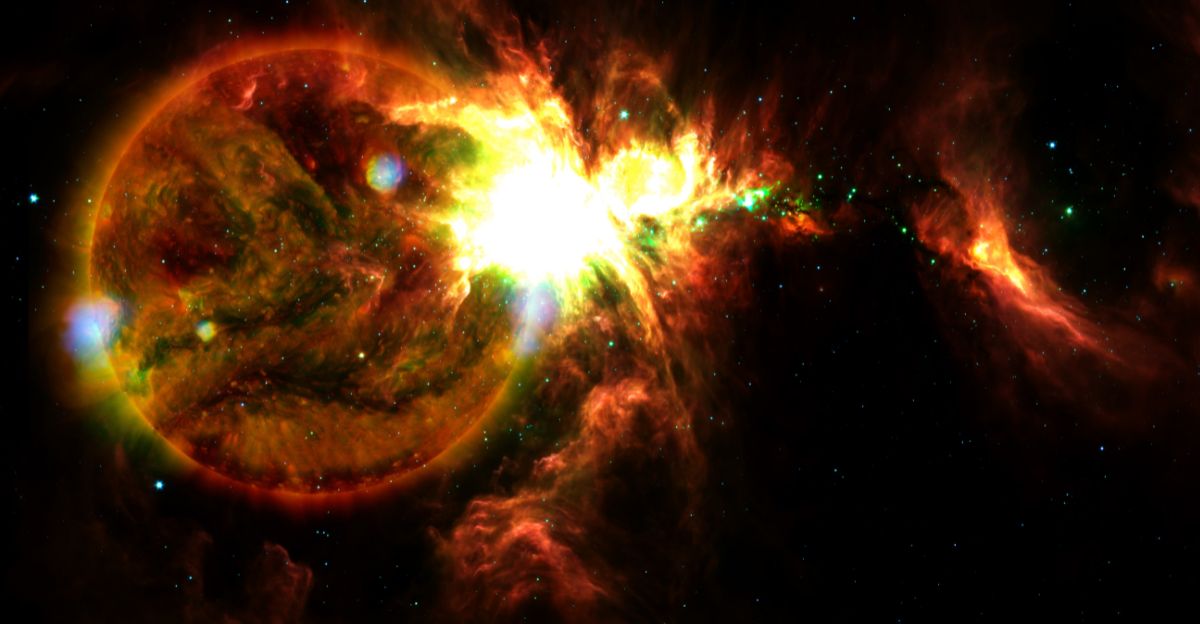
Solar storms start on the Sun, about 93 million miles from Earth. They come from solar flares and coronal mass ejections, which are huge blasts of energy and plasma. When one of these eruptions heads toward Earth, it can reach the planet in a few days. The arriving cloud then shakes Earth’s magnetic field. That extra energy flows into the upper atmosphere, heating it and causing it to swell.
Satellites in low Earth orbit then experience greater drag and can lose altitude more quickly. At the same time, charged particles change conditions in the ionosphere. Radio waves and GPS signals must pass through this region. When it becomes disturbed, signals can bend, scatter, or fade. That can reduce accuracy or even block navigation systems. The May 2024 storm aligned with a major science effort to observe the Sun.
Astronomers using ESA’s Solar Orbiter and NASA’s Solar Dynamics Observatory tracked an active region called NOAA 13664 for 94 days. It produced many flares, including strong M‑ and X‑class events, and helped drive the May storm. Agencies like NOAA and NASA are now building better missions and models. Their goal is to improve space weather forecasts, warn operators earlier, and protect satellites, power grids, aviation, and GPS users as Solar Cycle 25 moves toward its peak.
Sources:
- Y Baruah et al., The Loss of Starlink Satellites in February 2022, 2024-03-31
- Space.com, May 2024 solar storm cost $500 million in damages to farmers, new study reveals, 2025-06-22
- NDTV, Solar Orbiter Watches Sun’s Most Hyperactive Region For Record 94 Days – Milestone In Solar Physics, 2026-01-10
- NOAA Repository, Space Weather Environment During the SpaceX Starlink Satellite Loss in February 2022, 2022-02-02
- JASS, Observational Overview of the May 2024 G5-Level Geomagnetic Storm, 2024-08-14
- NASA Science, Historic Geomagnetic Storm Dazzles, 2025-10-23