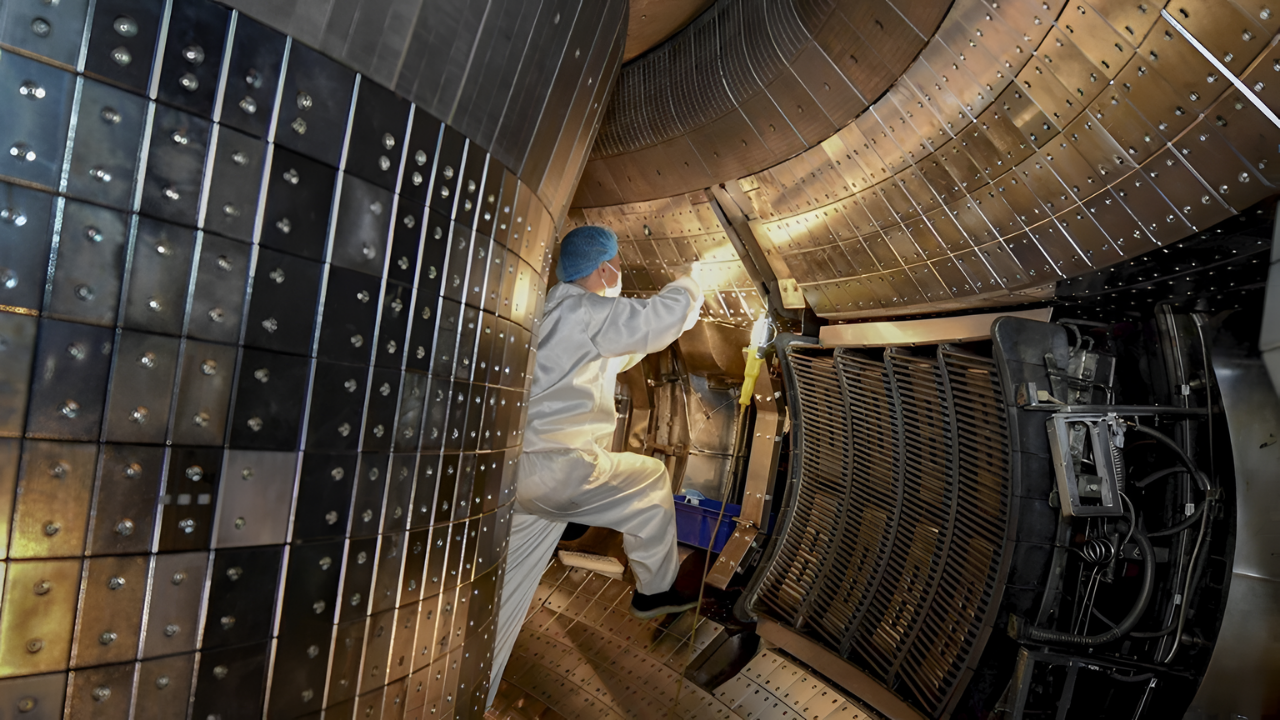
Fusion researchers in China have found a new way to run their “artificial sun” reactor at much higher fuel density than experts once thought possible, without losing control of the plasma. This result could help future fusion power plants make more energy in a smaller space, bringing clean, carbon‑free electricity a step closer.
What Fusion Power Is
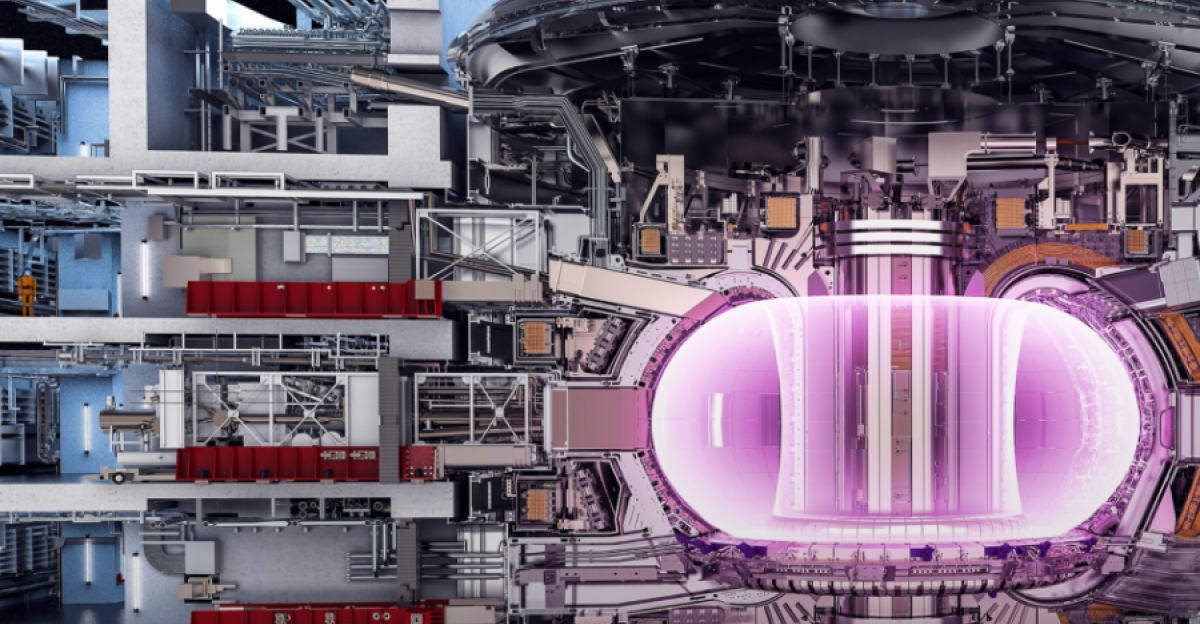
Fusion is the process that powers the Sun, where very light atoms are pressed together until they join and release energy. A fusion reactor tries to copy this by heating gas until it turns into plasma, a very hot, electrically charged state of matter.
In a device called a tokamak, strong magnetic fields hold the plasma in a ring so it does not touch the walls, because any contact would cool it down and stop the reaction. The goal is to keep this plasma hot, dense, and stable long enough that it produces more energy than the machine uses.
Beating the Greenwald Limit
For decades, engineers believed there was a practical upper limit to how dense plasma in a tokamak could be before it became unstable and damaged the machine. This rule of thumb is called the Greenwald limit, based on a formula first worked out in 1988 from many earlier experiments.
The Greenwald limit says that if you pack too many particles into the plasma, the risk of sudden disruptions rises sharply. Until now, most reactors stayed at or below this limit in normal operation, or only crossed it briefly and under special conditions.

China’s EAST tokamak in Hefei has now operated steadily at plasma densities between about 1.3 and 1.65 times this limit, a huge jump over the earlier range of around 0.8 to 1.0 on the same machine. Scientists describe this as entering a “density‑free regime,” where raising the density no longer automatically makes the plasma more unstable.
How EAST Did It
EAST’s success rests on a control method called Plasma‑Wall Self‑Organization, or PWSO, which focuses on the thin region where the hot plasma and the solid metal walls interact. Normally, particles hitting the wall knock off impurities that drift back into the plasma, cool it, and make it harder to control.
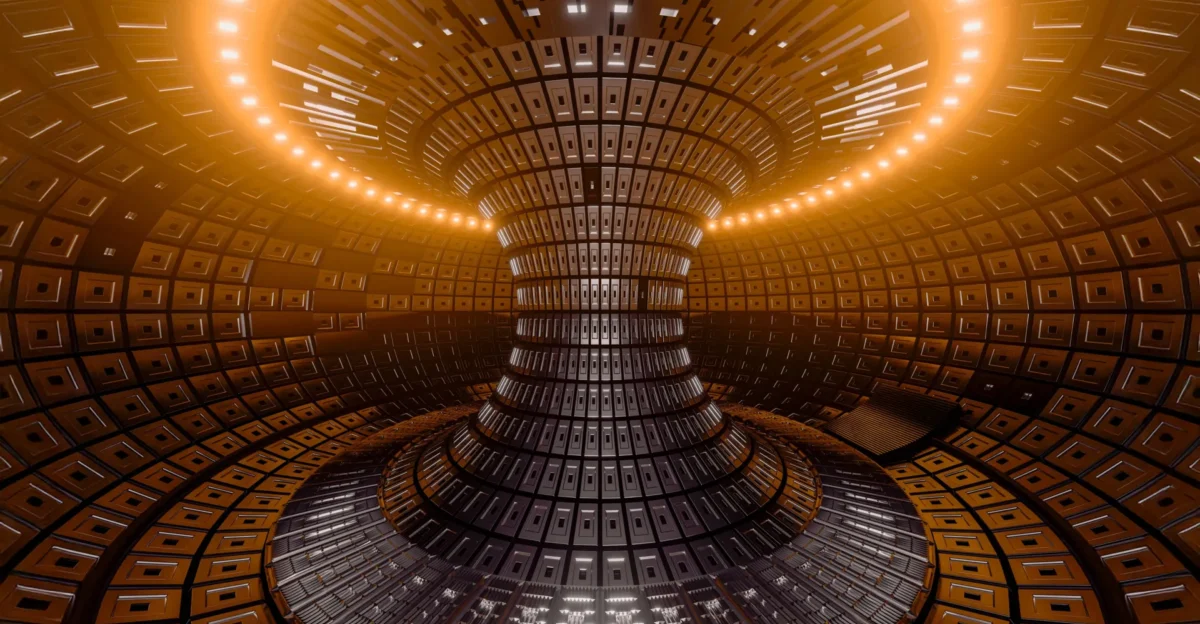
The PWSO strategy carefully shapes these interactions from the very start of each experiment. The team adjusts the gas pressure before the plasma is formed and uses targeted microwave heating, called electron cyclotron resonance heating (ECRH), during startup.
These steps help the plasma and walls “settle” into a cleaner, more orderly pattern with fewer impurities and less energy lost as radiation. When conditions are tuned just right, the plasma can be pushed to much higher densities while staying in this stable, density‑free regime that PWSO theory predicted.
Why It Matters for Future Energy
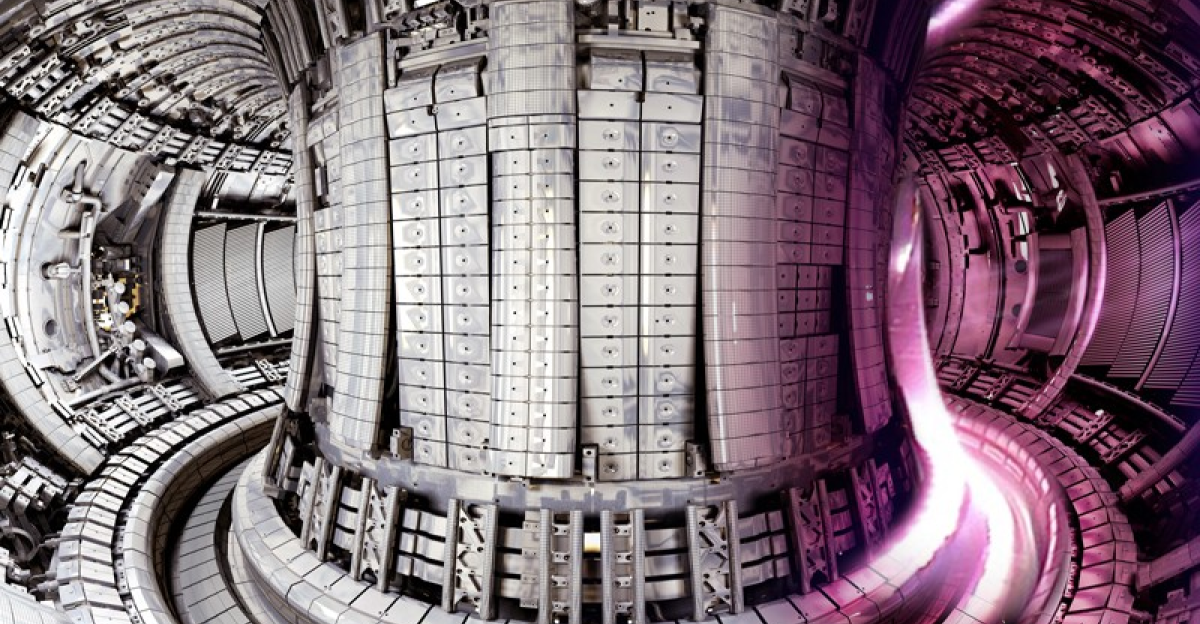
Running at higher density is important because it means more fuel in the same volume and more fusion reactions per second, as long as stability is maintained. That brings reactors closer to “burning plasma,” where the fusion process largely sustains itself and could someday produce net power for the grid.
The new results were published in the journal Science Advances under the title “Accessing the density‑free regime with ECRH‑assisted ohmic start‑up on EAST,” and show strong agreement between experiments and the PWSO model. The authors argue that the same approach could be used in larger future reactors, including ITER in France, which was designed using more conservative density limits.
If these methods can be scaled and kept running for much longer times, a commercial fusion plant—producing gigawatts of electricity without emitting carbon dioxide during operation—could arrive sooner than many expected. EAST is still an experimental device, and challenges like handling intense neutron damage and managing fuel cycles remain, but this result changes what many scientists thought was possible inside a tokamak.
Sources:
Science Advances, Accessing the density-free regime with ECRH-assisted ohmic start-up on EAST, 31 December 2025
Nature, Chinese nuclear fusion reactor pushes plasma past crucial limit: what happens next, 9 January 2026
Popular Mechanics, China’s Fusion Reactor Reached an “Unbreakable” Limit—and Broke Right Through It, 11 January 2026
Phys.org, Tokamak experiments exceed plasma density limit, offering new insights into fusion ignition, 31 December 2025
World Nuclear News, Chinese tokamak achieves progress in high-density operation, 8 January 2026