
Researchers conducting routine beach surveys along the Texas coast made an extraordinary discovery in early January 2026: the seafloor had surrendered thousands of skeletal remains, littering miles of pristine sand.
What typically represents a prized single find had suddenly become commonplace, raising urgent questions about Gulf of Mexico ecosystem health. The event caught marine scientists off guard, suggesting forces beneath the surface had shifted dramatically.
The Rarity Factor
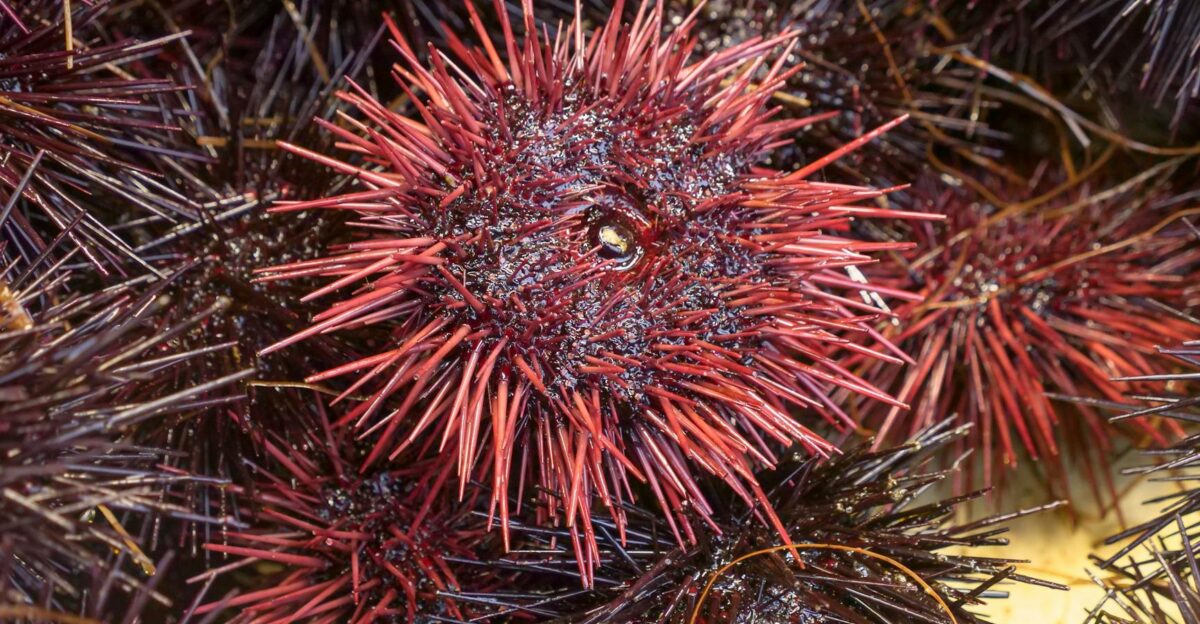
Heart urchins, small, burrowing cousins of sand dollars and sea stars, inhabit the seafloor of the Gulf of Mexico but are rarely observed by beachgoers. Jace Tunnell, Community Engagement Editor at the Harte Research Institute for Gulf of Mexico Studies, conducted weekly beach surveys for years, treating each discovery as a lucky find.
The creature’s cryptic lifestyle, buried two centimeters beneath sand, ordinarily shields it from human notice. Yet something dramatic had changed that calculus.
Gulf of Mexico Baseline
Heart urchins (Meoma ventricosa), also known as “sea potatoes,” are a stable ecological presence in the Gulf of Mexico. Scientists recognize them as sediment engineers that rework seafloor sediment and affect nutrient cycling.
Mass mortality events among echinoids (sea urchins, starfish, and relatives) are well documented, though typically localized or associated with specific pathogens or oxygen depletion.
Storm Stress Building

The Texas coast entered early January 2026 with atmospheric pressure dropping sharply as a polar cold front approached from the north. National Weather Service forecasts warned of temperature drops of up to 20 degrees, gusty winds up to 35 mph, and elevated wave heights across the northwestern Gulf of Mexico.
Marine conditions deteriorated between January 6 and 10, creating rough seas ideal for dislodging organisms from their shallow-water habitats.
The Stranding Revealed

On January 9, 2026, Jace Tunnell posted to the Harte Research Institute’s Facebook page: “The biggest news this week has to be the mass die off of these sea potatoes.
Literally thousands and thousands washing up along at least 60 miles of Texas beach that I surveyed this week.” The discovery spanned the central Texas coastline, with skeletal remains concentrated on multiple beaches following the cold front’s passage.
Geographic Scope Confirmed

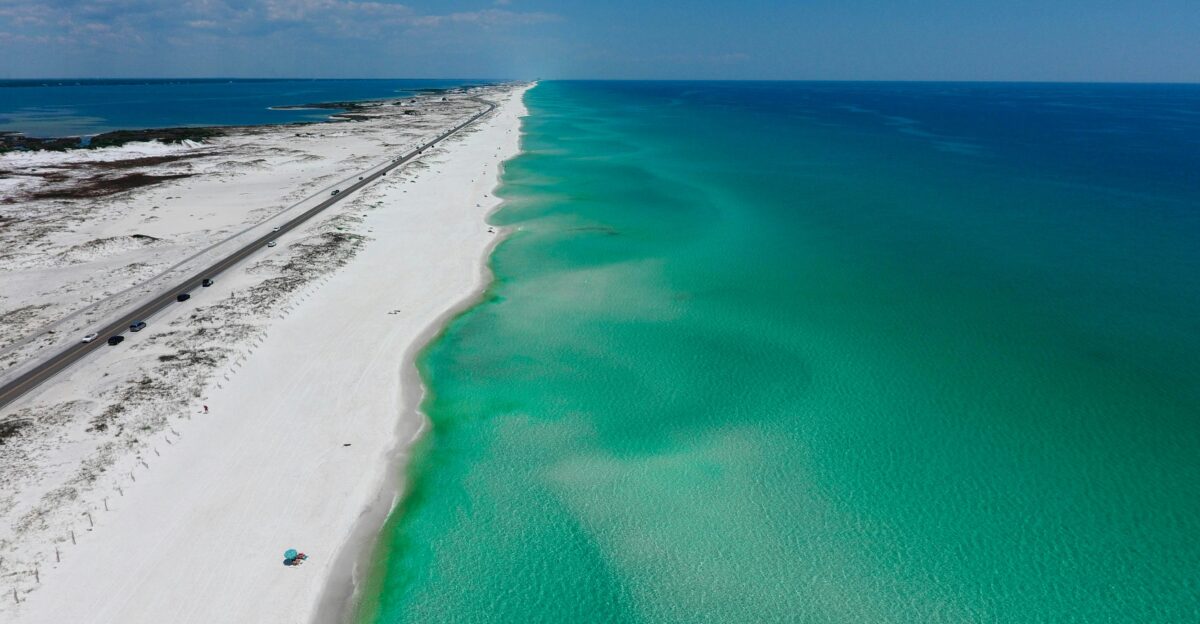
Systematic beach surveys documented at least 60 continuous miles of Texas shoreline blanketed with heart urchin remains. The affected area encompassed central Texas beaches, likely stretching across Nueces and San Patricio counties near Corpus Christi.
Visual evidence, including video footage and photographs shared by the Harte Research Institute, showed dense concentrations of white skeletal tests covering sand surfaces in multiple locations.
Researcher’s Astonishment
Tunnell’s reaction crystallized the event’s singularity. “I always felt like if you found one, you were lucky. Now I’ve got a whole gallon of them!” The researcher, with years of professional beach experience, had accumulated more specimens in a single week than in his entire prior career.
This shift from extreme rarity to abundance transformed a routine survey into an ecological anomaly requiring explanation.
Cold Front Mechanism

Jace Tunnell identified the likely culprit: “I suspect that a cold front or something similar moved in, creating large waves that led to this massive die-off.” The mechanism is explicit: violent wave action dislodged burrowed urchins from their sandy shelters.
Heart urchins, specialized for life at depths of 2 to 3 centimeters below the surface, lack defenses against forceful surface disturbance or rapid temperature fluctuations.
Population Composition Puzzle
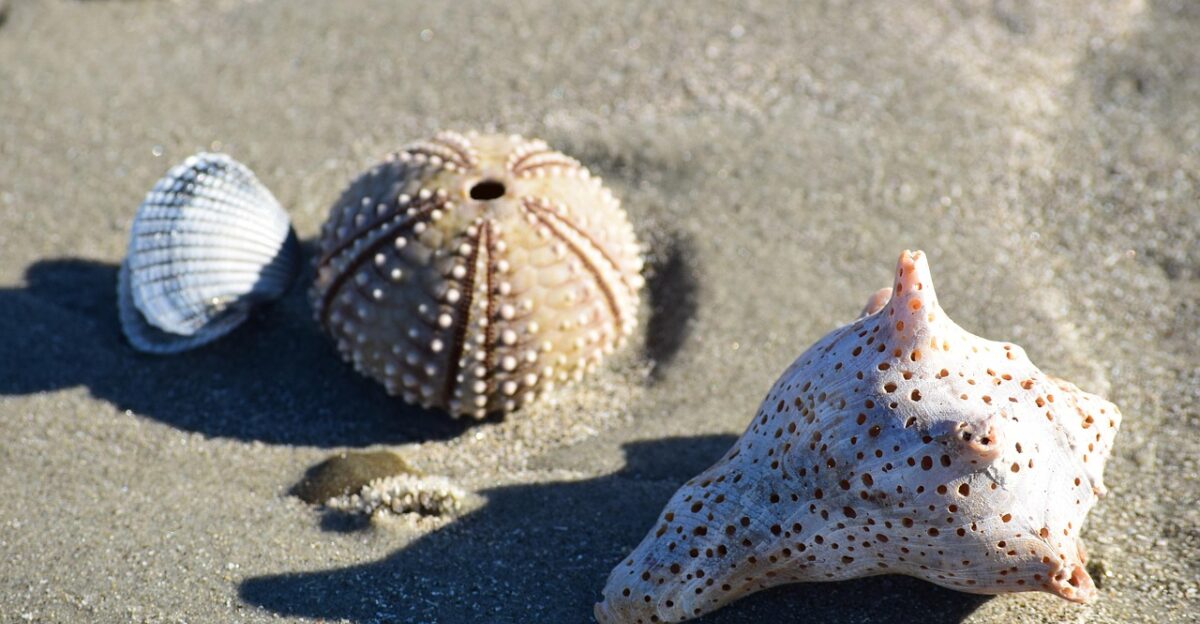
An unexpected detail emerged: most recovered skeletons measured approximately one inch in length, juvenile specimens. Larger, older individuals, which can reach three inches, were conspicuously absent from the collected samples.
This age-skewed mortality profile suggested the event targeted a specific population cohort, likely the current generation of young heart urchins that had burrowed into Texas seafloors only years earlier.
Generational Wipeout Implications

The absence of older, larger heart urchins raised a troubling secondary question: where was the adult population? If juveniles were wiped out while adults survived, it suggests either reproductive failure in prior years or differential survival strategies.
If, instead, the entire cohort perished, Texas waters could have lost a whole generation of sea potatoes, with cascading ecological impacts extending beyond the immediate beach stranding.
The Monitoring Gap

The Harte Research Institute’s systematic weekly surveys, led by Tunnell, had previously recorded heart urchin sightings as rare “lucky finds.” Yet no comprehensive historical baseline existed for Texas heart urchin populations; their abundance, distribution, or mortality patterns remained largely undocumented.
The mass stranding exposed a monitoring blind spot: scientists lacked baseline data to contextualize the event’s true ecological magnitude.
Institutional Response

The Harte Research Institute mobilized rapidly, documenting the event through video, photography, and social media communication. Multiple posts across Facebook and Instagram captured skeletal evidence, shared location data, and appealed to citizen scientists for additional observations.
This public-facing approach converted an isolated researcher discovery into a crowdsourced monitoring event, enlisting beachgoers as informal data collectors.
Scientific Uncertainty

No immediate explanation emerged for why this event occurred at this moment. Cold fronts and wave disturbances are routine along the Texas coast; complete mass mortality of an entire generation is not.
Scientists could confirm the temporal relationship between the cold front and the stranding, but not definitively establish causation or explain why this particular event proved so lethal.
Comparative Context

Comparable mass mortality events among echinoids are documented globally, notably the 2022 Caribbean Diadema antillarum (long-spined sea urchin) die-off and the 2021 north Pacific sea star pandemic.
However, heart urchin mass strandings in the Gulf of Mexico remain poorly documented in available scientific literature, making direct comparisons difficult and underscoring Texas’s knowledge gap.
What Comes Next?

Will another cold front trigger additional die-offs? Will researchers detect recovery, or will juvenile cohorts struggle to rebuild? The Harte Institute is committed to continued beach monitoring, tracking whether stranding remains a one-time event or signals a recurring vulnerability.
The answers will require sustained observation and patience.
Ecosystem Engineering Loss
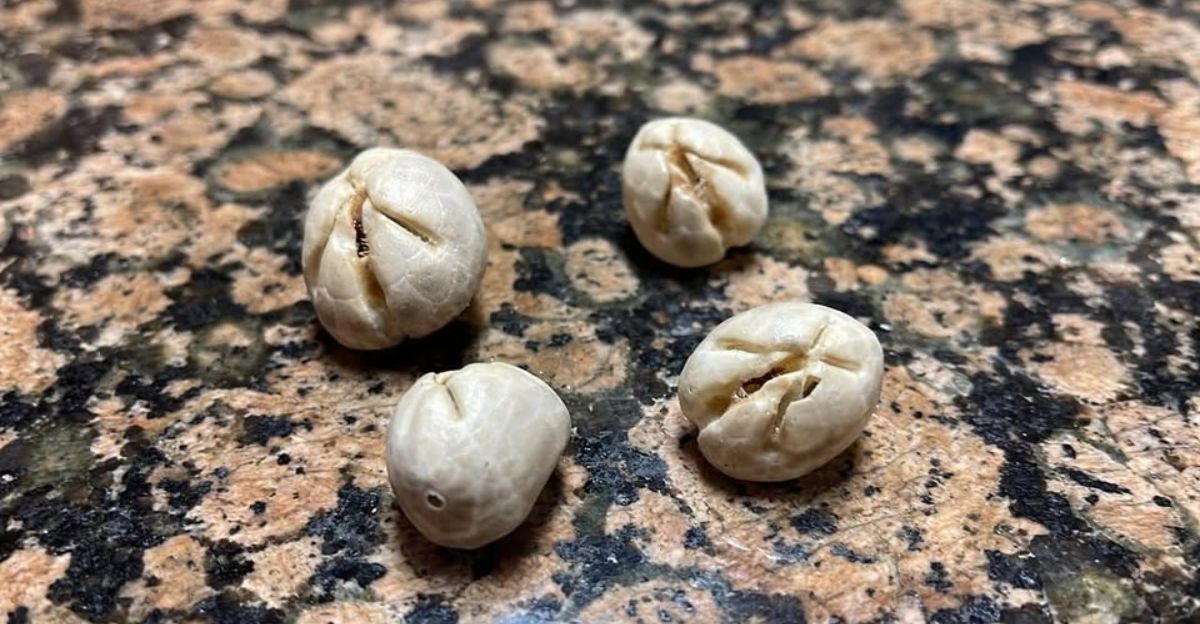
Beyond skeletons on beaches lies an ecological function interrupted. Heart urchins’ burrowing activity reworks hundreds of kilograms of sediment per square meter annually, a process that aerates the seafloor, distributes nutrients, and affects infaunal (burrowing) animal communities.
Loss of an entire juvenile generation could reduce this sediment-engineering capacity, with cascading effects on benthic ecosystem structure and productivity.
Regional Climate Signals

The January 2026 cold front occurred amid broader climate volatility. Rising ocean temperatures in the Gulf of Mexico, paired with increasingly intense weather systems, create ecological stress.
Heart urchins evolved thermal tolerance within historical Gulf ranges; rapid temperature swings and unprecedented wave energy may exceed their physiological limits, making this stranding a potential harbinger of climate-driven ecosystem instability.
Resource Management Questions

The event raised implicit policy questions: Should Texas wildlife agencies establish baseline populations for understudied species? Do monitoring gaps leave ecosystems unprotected? The Harte Institute’s week-to-week surveys, while valuable, are dependent on volunteers.
Scaling systematic monitoring requires institutional investment and coordination, which are currently absent for Gulf of Mexico macrofauna.
The Rarity Paradox
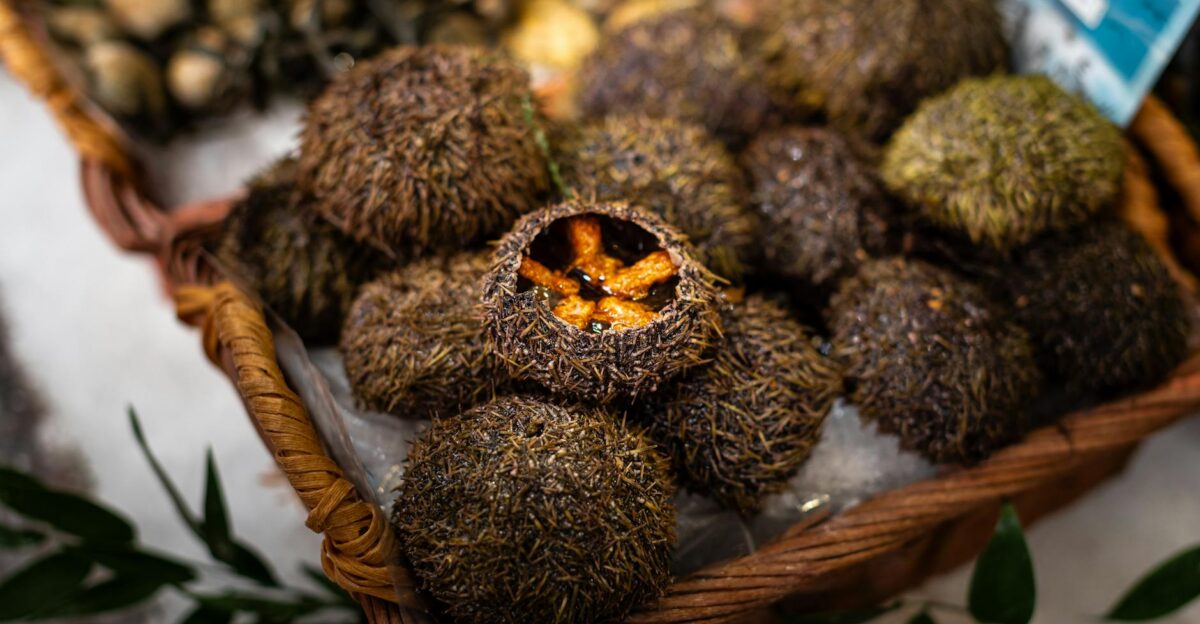
Heart urchins were “lucky finds” precisely because they were invisible, their rarity a sign of successful cryptic adaptation. The mass stranding inverted that calculus, transforming scarcity into visibility through death.
This paradox highlights how human ecological knowledge often arrives through catastrophe. We see what we lose; baseline absence is invisible until absence becomes undeniable.
Wider Wake-Up Call
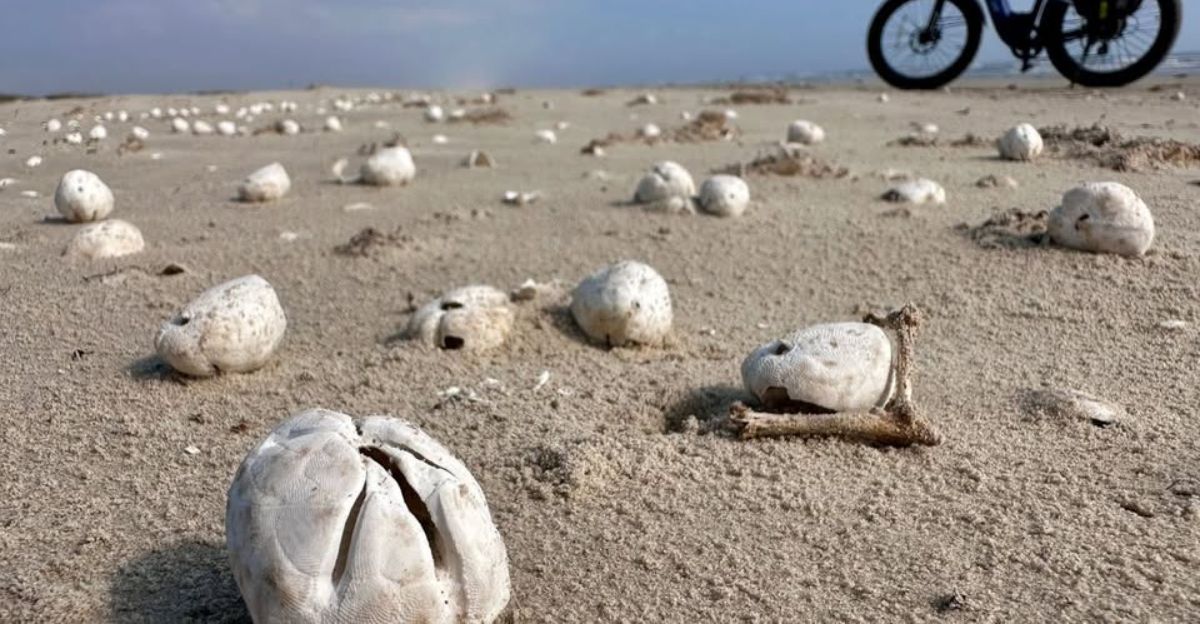
The Texas heart urchin stranding represents a local event with planetary implications. Thousands of miles away, sea urchins die from pathogens, starvation, and thermal stress.
Globally, echinoid populations fluctuate in response to warming oceans, oxygen depletion, and human-driven coastal change. This Texas beach is one data point in a larger story of marine ecosystem brittleness and humanity’s limited ability to predict, prevent, or respond.
Sources:
Harte Research Institute, Sea Potato Mass Stranding Alert
Yahoo News, Mass die-off: Thousands of rare sea creatures wash up on Texas coast
NOAA National Weather Service, Offshore Waters Forecast
Frontiers in Marine Science, Unravelling echinoid mass mortalities: a global overview of sea urchin, brittle star, and sea cucumber disease and mortality
Texas Parks and Wildlife Department, Marine Resources Division
AIMSPRESS, Effects of sediment disturbance by the heart urchin Meoma ventricosa: Implications for benthic ecosystem functioning