Automated equipment sat idle inside Kroger’s vast automated warehouse in Pleasant Prairie, Wisconsin, when the grocery giant shut down three of its high-profile Customer Fulfillment Centers in late 2025. Built with British technology firm Ocado and touted as a template for the future of online grocery, the sites had been operating for barely a year and a half. Their closure, and a massive financial write-down that followed, became the clearest signal yet that a much-hyped wave of artificial intelligence and robotics across retail and foodservice had badly overshot reality.
A sweeping study from MIT’s 2025 Project NANDA quantified the scale of the misstep: 95% of enterprise AI and automation pilots failed to deliver measurable returns on investment, with billions poured into such efforts. The core issue, researchers found, was not raw computing power but the inability of sophisticated systems to adapt to messy, variable workplaces shaped by human behavior, local conditions, and constant exceptions. Only about 5% of pilots showed success.
Kroger’s Warehouse Bet Unravels
Kroger’s partnership with Ocado was among the most ambitious automation projects in U.S. retail. The companies built a network of large, centralized Customer Fulfillment Centers designed to process online grocery orders through fleets of robots, conveyor systems, and advanced routing software. By November 2025, however, three of eight U.S. megasites—Frederick, Maryland; Pleasant Prairie, Wisconsin; and Groveland, Florida—were closed, even though they had opened only between 2021 and 2023.
Five CFCs remain in operation in Monroe (Ohio), Dallas, Atlanta, Denver, and Detroit. But the retrenchment came with a steep cost. Kroger recorded a $2.6 billion impairment tied to the facilities, paid Ocado $350 million in one-time cash compensation (including $250 million previously announced), and left much of the specialized warehouse automation at the shuttered sites idle. The centers had generated insufficient order volume to sustain operations, leading to their earlier-than-expected collapse.
The fallout extended to Ocado. The company lost an estimated $50 million in expected annual revenue related to the closures and faced sharp questions about its strategy of large-scale, centralized grocery automation. A planned U.S. expansion once described in terms of 20 sites effectively stalled, and investors and retailers began to reconsider whether mega-warehouses could compete with smaller, more flexible fulfillment models. By late 2025, Ocado was repositioning itself toward modular, micro-fulfillment-style systems, signaling that the era of the massive fully automated grocery hub had run aground.
Fast-Food Experiments Backfire
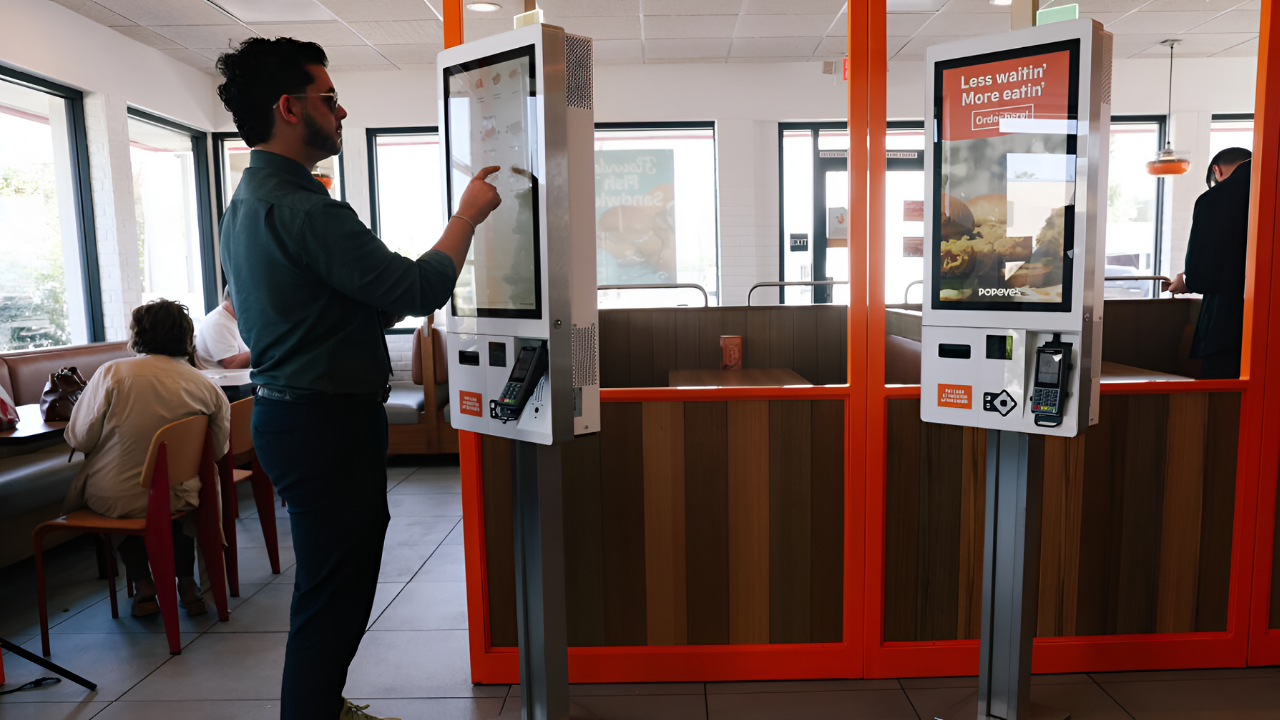
The automation pullback was not limited to grocery. Major restaurant chains, eager to reduce labor costs and speed service, launched a series of AI-driven pilots that quickly ran into public view—and public scrutiny.
Starbucks introduced a system known as Green Dot, described as a digital assistant to help baristas with order accuracy and reduce training time. While the technology succeeded on those narrow metrics, it could not counter broader challenges, including weakening North American sales and resistance from customers unhappy with changes to in-store experience. By 2025, Starbucks had initiated roughly 2,000 layoffs, including about 900 corporate positions announced in September 2025 and earlier reductions in early 2025, closed around 500 stores, and paused large-scale automation initiatives. In some trial locations, AI-shaped workflows were reported to disrupt baristas’ routines, contributing to longer lines and higher complaint levels. Even after committing $1 billion to restructuring, the company began highlighting more “human-centric” service and reinvested about $500 million in initiatives focused on baristas.
At drive-through chains, voice AI and robotics trials generated viral moments that undercut the idea of a frictionless, fully automated lane. McDonald’s customers shared incidents of bizarre orders, including incorrect toppings, duplicated tickets running into the hundreds of dollars, and excessive condiments. Taco Bell pilots produced even more extreme examples, such as a system misinterpreting a request and generating an 18,000-drink order for cups of water. Both companies ultimately wound down their most visible automation programs after franchise operators and consumers complained that the systems were error-prone, slowed service, and damaged brand perception.
For many customers, tolerance for occasional human mistakes did not extend to what they saw as machine-generated chaos. In some cases, AI-based ordering tools added new fees justified as technology surcharges and lengthened waits while staff intervened to correct system errors. Social platforms amplified memorable failures, accelerating skepticism just as companies had been promoting automation as a defining part of their future operations.
From Job Cuts to Rehiring
The retreat from full automation reshaped labor strategies across the sector. After trimming staff in anticipation of more machine-led operations, businesses found themselves short-handed when the new systems failed to perform as expected.
Kroger, having invested in robotic fulfillment, needed to recruit more manual order pickers to maintain service. Starbucks shifted resources back toward front-line roles, backing its barista-first programs with hundreds of millions of dollars. McDonald’s, which had experimented with reduced staffing at some locations as part of its automation trials, reverted to higher levels of customer-facing employees. Earlier forecasts that millions of jobs could vanish by the late 2020s proved overly aggressive as companies rebuilt parts of the workforce they had expected to downsize.
Financial markets responded to each automation reversal with renewed caution. Analysts estimated that if 95% of AI pilots failed to generate value, then the vast majority of investments represented lost or misdirected capital. Companies tied to the most prominent projects—including Kroger, Starbucks, Ocado, and others—faced significant market capitalization impacts over each cycle of enthusiasm and pullback. Commentators drew parallels to earlier speculative bubbles, noting that optimistic demonstrations and consultant-driven projections had outrun the day-to-day economics of complex service businesses.
Toward Hybrid Models and Tighter Oversight
As failures mounted, consulting firms including Accenture, McKinsey, and Gartner reported that up to 30% of generative AI pilots in the sector were abandoned before progressing beyond proof-of-concept. The pattern pointed to a common constraint: systems that worked in controlled conditions struggled to keep pace with shifting menus, fluctuating inventories, supply chain disruptions, and improvisational customer behavior. Human judgment remained central in these environments, and only after substantial spending did many organizations adjust their expectations.
Policy responses began to take shape. Lawmakers, concerned by high-profile layoffs tied to automation plans and by publicized missteps in deployment, called for stricter scrutiny of large technology projects and their claimed benefits. Corporate boards increasingly insisted on transparent return-on-investment checkpoints before approving major automation budgets. Executive pay came under greater examination, particularly at companies where the gap between top leadership compensation and typical front-line wages was stark.
At the same time, a different set of AI tools gained traction. Systems designed to support workers—such as knowledge assistants, human-in-the-loop platforms, and decision-support engines—saw rising adoption. Starbucks’ own Green Dot Assist, when applied narrowly as a training and accuracy tool, reportedly cut training time from about 30 to 12 hours and achieved order accuracy above 99%. In contrast, firms focused on fully autonomous robotics, including large warehouse-automation providers, faced slowing demand.
Globally, the U.S. experience prompted retailers in Europe and Asia to reassess large-scale automation plans. Many shifted toward hybrid approaches: smaller, store-adjacent fulfillment operations, robots that assist rather than replace staff, and careful integration of AI into existing workflows. Within the industry, the emphasis moved from sweeping replacement of labor toward targeted use of technology where it clearly complements human capabilities. Executives and investors now talk less about an inevitable march toward all-robot operations and more about measured, evidence-based deployment.
For workers and managers, the emerging lesson is that roles are changing rather than disappearing. Skills in customer interaction, digital fluency, and troubleshooting are increasingly valued in environments where people and machines work side by side. For boards and shareholders, the last two years have reinforced the importance of disciplined experimentation, smaller pilots, and rigorous performance thresholds before scaling. As companies regroup, the next phase of automation in retail and foodservice is likely to grow more slowly and selectively, shaped as much by front-line experience and public expectations as by advances in software and robotics.
Sources:
MIT Project NANDA Report. “95% of Enterprise AI and Automation Pilots in Retail and Foodservice Failed to Produce Measurable ROI.” Published August 2025.
Kroger Co. “Kroger Announces Closure of Three Customer Fulfillment Centers and $350 Million Payment to Ocado.” Press release. November 2025.
Bloomberg. “Ocado Gets $350 Million Payment From Kroger for Warehouse Closures.” Published December 5, 2025.
Starbucks Corp. “Starbucks Announces 900 Corporate Layoffs and 500+ Store Closures as Part of Restructuring Plan.” Press release. September 25, 2025.
CBS News. “McDonald’s Ends AI Drive-Thru Orders — For Now.” Published June 16, 2024.
BBC News. “Taco Bell Rethinks AI Drive-Through After Man Orders 18,000 Water Cups.” Published August 29, 2025.