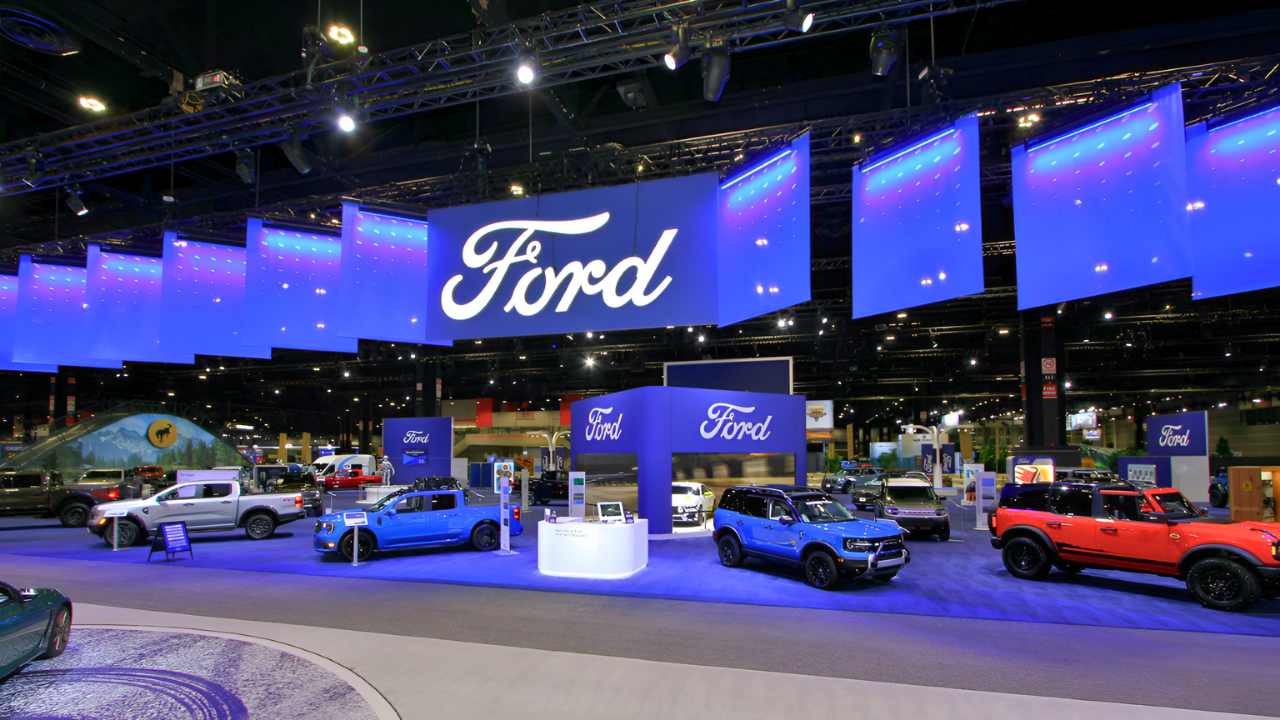
Ford’s $19.5 billion write-down marks one of the most dramatic reversals yet in the auto industry’s push toward fully electric vehicles. After years of betting heavily on battery-only models, the company is reshaping its strategy around hybrids, extended-range electrics and lower-cost gasoline vehicles aimed squarely at U.S. truck and utility buyers.
Strategic Reversal After EV Losses
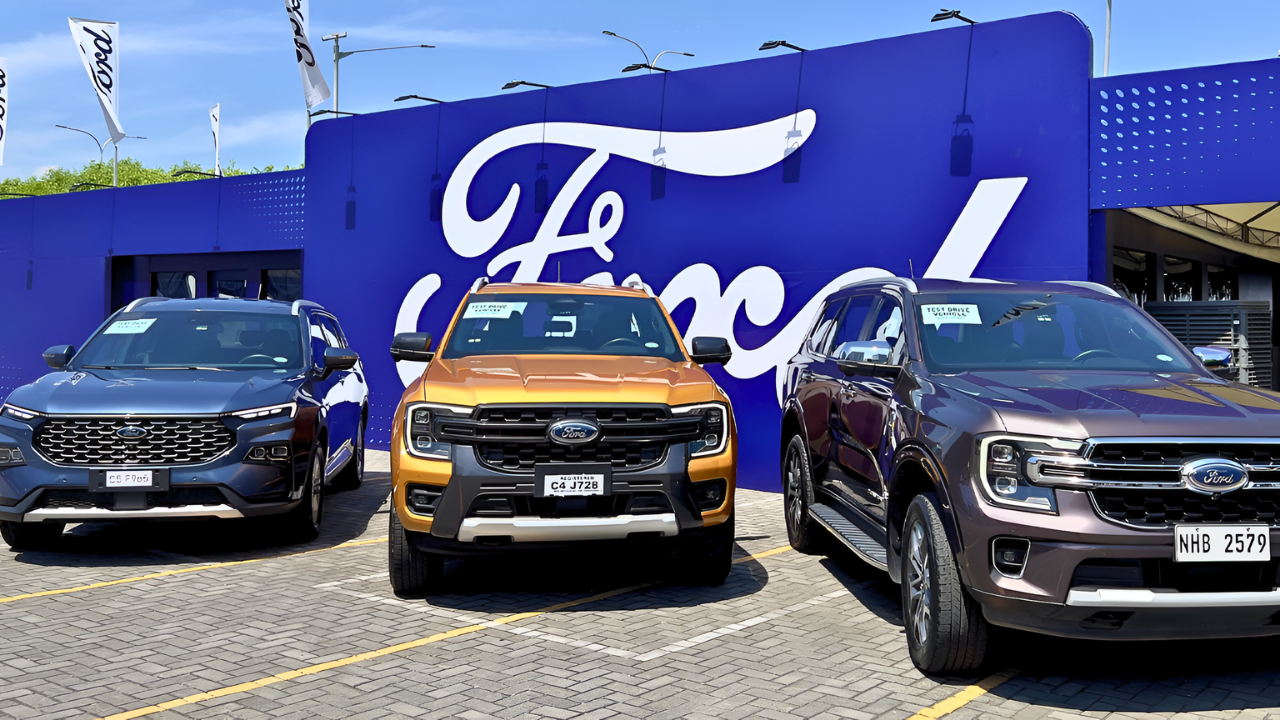
Ford’s dedicated EV division, Model e, racked up losses of $4.7 billion in 2024 and is projected to lose $5.5 billion in 2025, even as overall demand for plug-in models plateaued in the United States. High sticker prices, slower-than-expected charging buildout and the loss of the $7,500 federal EV tax credit all eroded the business case for battery-only trucks pitched at more than $50,000. Many buyers instead opted for gasoline pickups priced closer to $25,000, exposing a gap between corporate plans and the needs of core truck customers.
The company’s response is sweeping. The F-150 Lightning will no longer be offered as a pure EV in its next generation, and Ford is rebalancing its lineup around five new “affordable” vehicles due by 2030, along with a much larger role for hybrids. CEO Jim Farley has framed the move as a correction based on decades of experience with U.S. truck owners, saying rivals misread those customers’ priorities around towing, range and cost.
Inside the $19.5 Billion Charge
The $19.5 billion hit consists of roughly $5.5 billion in immediate cash costs and about $14 billion in non-cash write-downs tied to battery plants, product programs and other EV-related investments that no longer match Ford’s revised plan. Much of this accounting impact lands in the fourth quarter of 2025, even as the company still expects to post about $7 billion in profit before interest and taxes for the year.
For investors, the charge underlines how quickly assumptions about technology, regulation and demand can shift. Factories and platforms designed for rapid EV growth now require retooling or redeployment. Ford argues that absorbing the loss now gives it the flexibility to adjust to consumer preferences and policy changes later in the decade instead of being locked into unprofitable volumes.
Five Vehicles, One Pivotal Decade
Ford has committed to five lower-cost models by 2030, four of them to be built in the United States. Only four of those have been described publicly, underscoring the company’s desire to keep one slot open as market conditions evolve.
First is a midsize electric pickup scheduled for 2027 at Louisville Assembly in Kentucky, targeting a starting price around $30,000. Sized roughly like a compact SUV, it will use Ford’s universal EV platform, aim for about 300 miles of range and deliver acceleration on par with a Mustang EcoBoost. The goal is to offer an electric truck that undercuts high-end competitors, including Tesla’s Cybertruck, while appealing to buyers put off by full-size prices.
Second, Ford’s new Blue Oval City complex in Stanton, Tennessee, will pivot from its original focus on EVs to building affordable gasoline-powered full-size trucks from 2029. These models are meant for customers who want traditional capability without the cost of a premium F-150 or the unconventional styling of some rival electric pickups. The site represents a $3.5 billion investment and thousands of jobs, making its success central to both Ford’s finances and the local economy.
Third, a new commercial van will be produced in Ohio from 2029 with gasoline and hybrid versions instead of the previously planned all-electric design. Aimed at delivery fleets, trades and small businesses, the van emphasizes operating cost and dependability. Hybrids are meant to offer fuel savings without dependence on public charging, a key concern for operators on tight schedules.
Fourth, the F-150 Lightning will be reborn as an extended-range electric vehicle that combines electric drive with a gasoline generator. Ford says the setup is intended to deliver more than 700 miles of total range, enabling electric operation for daily use and gasoline backup for long trips or remote work sites. Pricing and launch timing have not been disclosed, but the configuration is designed to preserve the Lightning name while addressing range and charging anxiety.
The fifth vehicle has been confirmed but not described. Company executives present that omission as deliberate, leaving room to adapt to shifts in consumer demand, battery technology and regulation. It could take the form of a compact utility, a sedan, another truck variant or an entirely new format.
Batteries, Partners and Electrification Targets
Ford is also redirecting part of its battery investment into stationary energy storage. About $2 billion will go into systems built at plants in Kentucky and Michigan, with a target of 20 gigawatt-hours of annual capacity by 2027. Those batteries will serve data centers, utilities and homes rather than vehicles, where Ford believes margins and demand are more predictable than in the current EV market.
As part of this shift, the company dissolved its BlueOval SK joint venture with battery supplier SK On in December 2025. SK On will keep the Tennessee battery facility, while Ford retains control of the Kentucky operation. The split reflects diverging bets: SK On remains focused on vehicle batteries, while Ford is leaning more heavily into stationary storage alongside its revised approach to electrified vehicles.
Even with these changes, Ford is sticking to a headline target that 50 percent of its global sales will be “electrified” by 2030, up from 17 percent today. That figure includes hybrids as well as EVs, and the company now expects battery-only models to comprise just 15 to 20 percent of volume by then. The rest of its electrified tally will rely on hybrids and extended-range designs, aligning Ford more closely with strategies long favored by automakers such as Toyota.
Consequences for Owners, Workers and the Industry
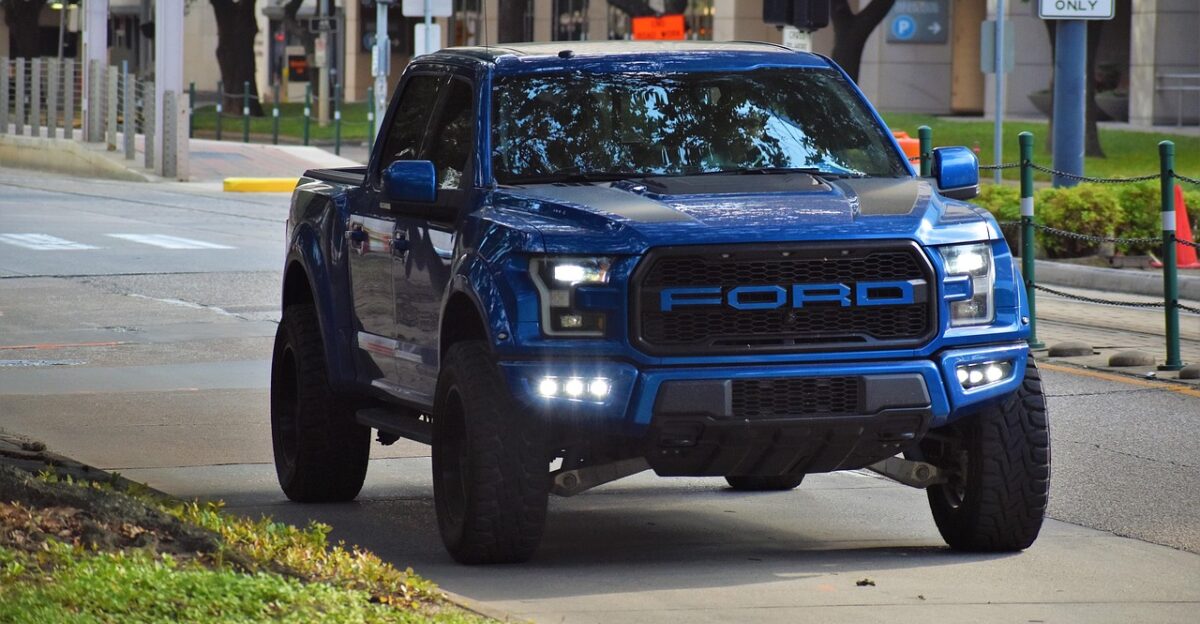
Current F-150 Lightning owners are among the most directly affected by Ford’s turn away from pure electric trucks. With the company discontinuing that configuration in the next generation, resale values could come under pressure as more of the existing vehicles return to the market. Ford plans to offer warranty extensions and trade-in options, but the abrupt shift has raised questions about product stability for buyers who paid premium prices on the promise of a long-lived EV platform.
On the factory floor, the reorientation is already changing employment patterns. Facilities in Tennessee, Kentucky, Ohio and Michigan are being retooled, and headcount at Blue Oval City has fallen from roughly 3,300 workers to about 2,300. Retraining and relocations are under way, accompanied by tense discussions with unions as job descriptions and long-term outlooks change. These adjustments ripple through surrounding communities that depend on auto manufacturing, underscoring that Ford’s $19.5 billion decision is as much about regional livelihoods as it is about balance sheets.
Ford’s embrace of hybrids reflects broader trends. Gas-electric models avoid range concerns, require no public charging infrastructure and typically deliver significant fuel savings for a smaller price premium than full EVs. They have gained particular traction in rural areas, on longer commutes and in harsh climates. Industry analysts now project that pure EVs may reach only around 15 to 20 percent of U.S. sales by the mid-2030s, with hybrids carrying much of the remaining electrification push.
Competitive pressure is another driver. Ford’s leadership has expressed concern about the potential entry of Chinese manufacturers such as BYD and Nio into the U.S. truck and utility market, given their cost advantage and experience with battery technology. Pricing the midsize electric pickup at about $30,000 is partly a defensive move to establish a foothold before lower-cost imports can arrive in scale.
Other Detroit automakers are making similar recalibrations. General Motors has reported multibillion-dollar EV-related losses, and Stellantis has moderated its own timelines and targets. Together, these moves point to a new phase in automotive electrification in which hybrids, extended-range vehicles and targeted, lower-cost EVs replace the earlier vision of rapid, universal adoption of battery-only models.
For consumers, the outcome is likely to be a wider array of drivetrains and price points rather than a single mandated technology path. For workers and regions tied to auto plants, the stakes center on how quickly manufacturers can convert existing facilities and skills to new products. For Ford itself, the next five years will test whether its costly pivot can reconcile investor expectations, regulatory demands and the day-to-day priorities of truck and utility buyers who ultimately decide what succeeds in the showroom.
Sources:
Ford Q4 2025 Earnings Report. Ford Motor Company, December 2025
Corporate Average Fuel Economy Standards Update. U.S. Environmental Protection Agency, December 2025
Jim Farley remarks at White House meeting. White House Press, December 2025
EV Sales Data November 2025. Automotive News, December 2025
BlueOval SK Joint Venture Announcement. Ford Motor Company, November 2025