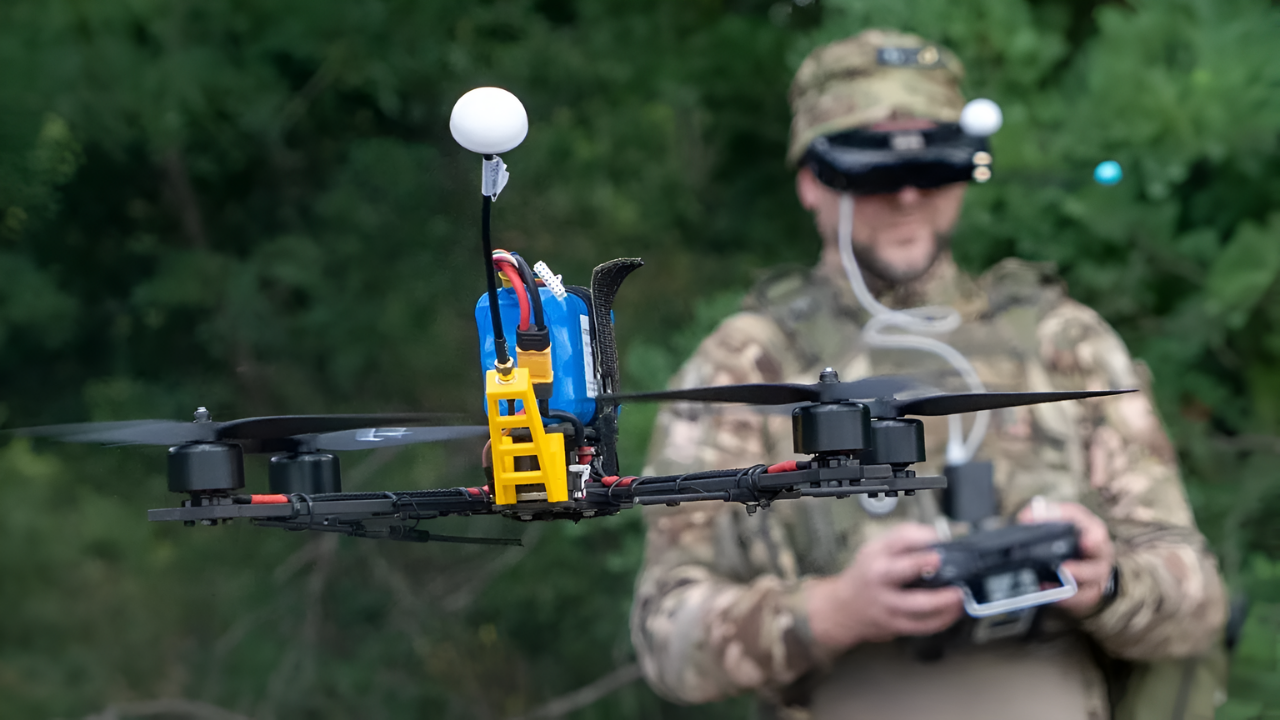
Cheap, homebuilt drones are reshaping the battlefield in Ukraine, turning rare Russian flamethrower systems worth millions into highly vulnerable targets. In one November 2025 operation near the city of Lyman, a Ukrainian first-person-view (FPV) drone costing only a few hundred dollars destroyed a TOS-1A “Solntsepyok” thermobaric launcher, highlighting how low-cost technology can neutralize some of Russia’s most feared weapons.
Russia’s Thermobaric Arsenal: A Rare and Devastating Threat
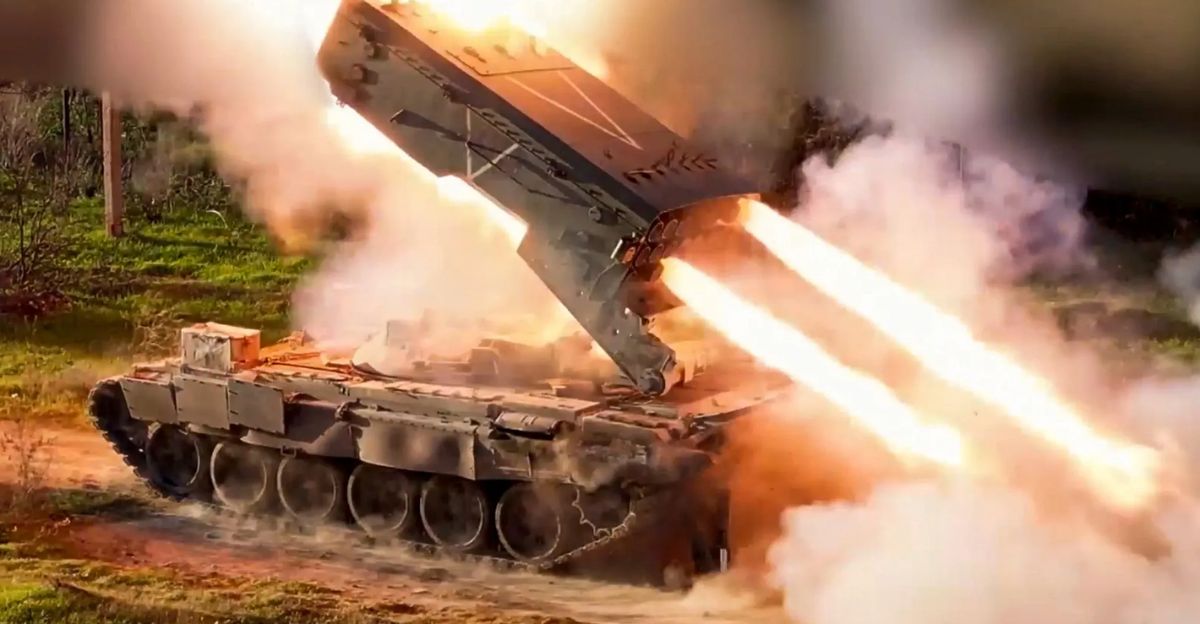
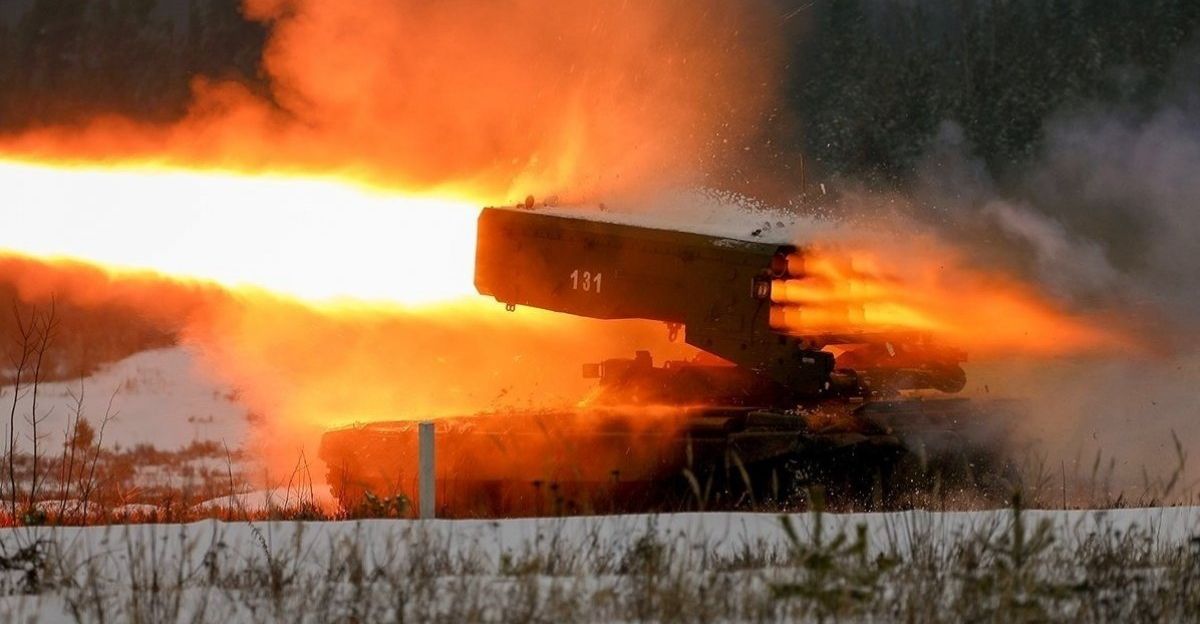
Russia’s heavy thermobaric flamethrower systems were designed to crush fortified positions and break defensive lines. The TOS-1A, mounted on a T-72 tank chassis, fires 24 unguided 220mm rockets that create intense overpressure and firestorms over a wide area, collapsing bunkers and trench networks. Ukrainian troops regard these launchers as among Russia’s most intimidating assets, not only for their destructive power but also for the psychological shock they create when they appear on the front. Only a limited number exist in each Russian army corps, making every loss a serious blow to Moscow’s offensive capabilities and to the industrial base struggling to replace them.
On the Lyman front in Donetsk Oblast, these systems have played a central role in Russia’s efforts to grind down Ukrainian defenses. The sector had become a testing ground for new tactics by late 2025, with Russian forces using thermobaric launchers to clear defensive lines and Ukrainian units responding with rapidly evolving drone operations. Casualties and equipment losses on both sides remained heavy, and small tactical gains often depended on whether high-value targets could be located and hit at the right moment. In this environment, the appearance of a single exposed TOS-1A, fully loaded and within drone reach, offered Ukraine a rare opportunity to disrupt the local balance of firepower.
The $300 Strike That Changed Everything
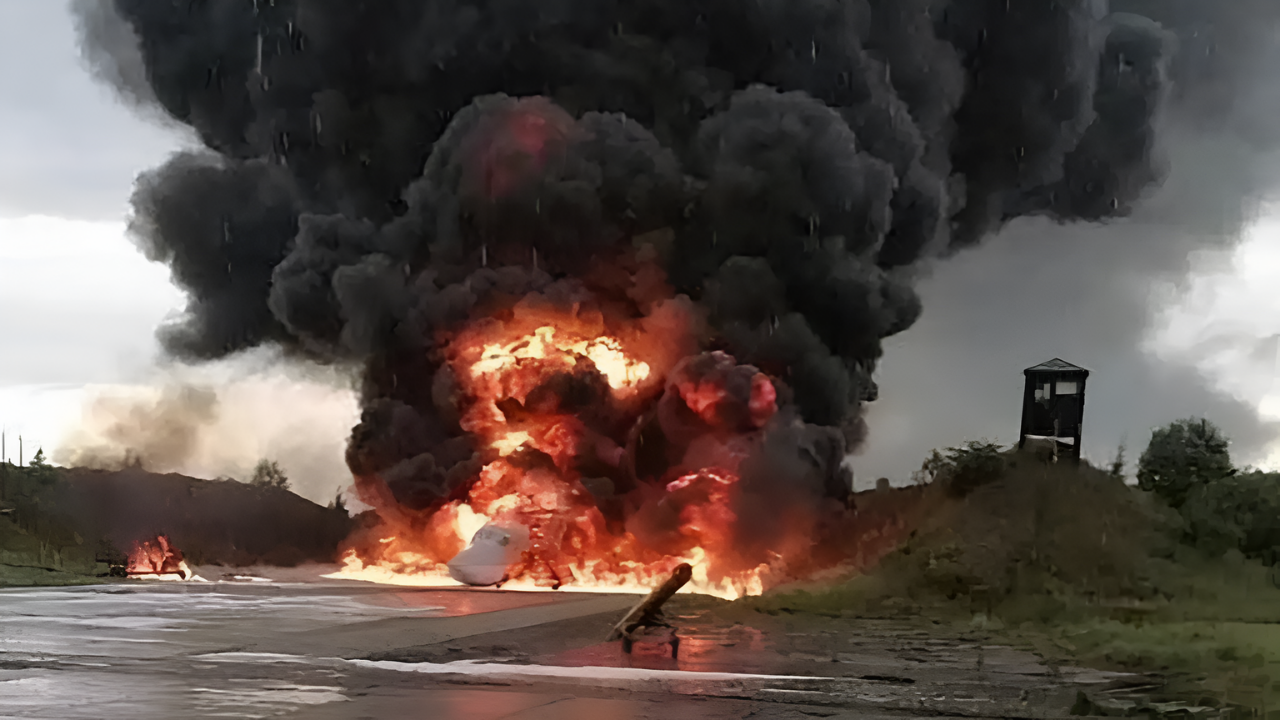
The strike that followed in late November 2025 encapsulated this shift. Operators from Ukraine’s Third Army Corps, working with the 63rd Separate Mechanised Brigade, launched an FPV drone assembled largely from commercial components such as racing frames, off-the-shelf cameras, and standard batteries. Guiding the aircraft through Russian air defenses, the team directed it into the launcher’s ammunition load. The resulting detonation triggered a chain reaction in the 220mm thermobaric rockets, producing catastrophic secondary explosions that destroyed the Solntsepyok and rendered it unusable. Analysts valued the system at between $6.5 million and $15 million, depending on configuration and wartime replacement costs, underscoring the extraordinary disparity between the price of the weapon and the cost of the drone that eliminated it.
For Ukrainian units around Lyman, the impact extended beyond a single destroyed vehicle. In the days after the strike, Russian pressure in that sector reportedly eased, giving Ukrainian commanders a short but critical window to rotate troops, strengthen fortifications, and evacuate casualties. Removing one thermobaric launcher from the line reduced the threat over a stretch of roughly 10–15 kilometers, where defenders had previously faced the constant risk of large-area saturation attacks. The operation reinforced a growing belief within Ukraine’s armed forces that small drone teams, operating with modest resources, could reliably threaten and sometimes destroy some of Russia’s most prized artillery and rocket systems.
Ukraine’s Wartime Drone Revolution
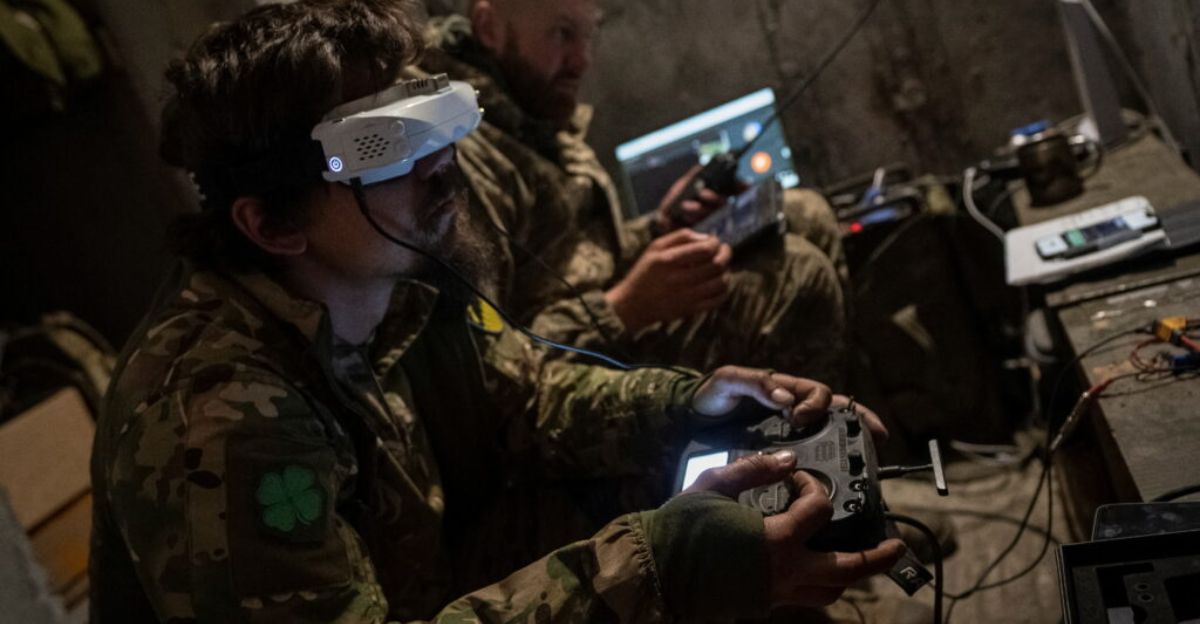
That success rests on a drone industry Ukraine has built under wartime conditions. Before the full-scale invasion in 2022, the country had only a modest base for unmanned aircraft. By mid-2025, however, Ukrainian workshops, volunteer initiatives, and government-backed manufacturers were turning out an estimated 200,000 drones per year, many of them FPV models tailored for precision strike roles. These platforms typically cost a few hundred dollars each, drawing on a mix of domestic production and imported commercial parts for frames, electronics, and cameras. Continuous field feedback has shortened development cycles, allowing engineers to experiment rapidly with payloads, guidance methods, and even basic swarm concepts. This nimble approach has given Ukraine an advantage less in high-end technology than in speed, adaptability, and sheer volume.
Russia’s Costly Defense Dilemma
Russia has tried to close this gap. By late 2025, its forces had surrounded high-value launchers like the TOS-1A with layered defenses that combined short-range guns, jamming equipment, and reconnaissance drones tasked with spotting incoming threats. Russian officers sought to harden firing positions, disperse assets, and adjust operating patterns to reduce exposure. At the same time, Russian industry increased production of its own FPV platforms, though sanctions and electronics shortages constrained output. Protecting each rare flamethrower system, however, demanded extra air-defense resources, careful siting, and additional crew training, driving up the overall cost of keeping these weapons in the field.
The November 2025 destruction of a TOS-1A also exposed a deeper supply problem for Moscow. The Solntsepyok is produced in limited numbers by a small group of specialized factories, which face bottlenecks in components such as microchips and precision mechanical parts. Even at maximum wartime capacity, annual production is believed to be only a few dozen units, far below the level needed to quickly replace combat losses. That means each launcher lost to a drone strike represents not just a tactical setback but a long-term reduction in Russia’s thermobaric arsenal, with replacement timelines stretching into years rather than months.
The Future of Asymmetric Warfare
For Ukrainian planners, these dynamics have encouraged a strategic recalibration. Rather than attempting to match Russia in tanks or heavy artillery, sectors of Ukraine’s defense establishment have shifted investment and production priorities toward more FPV and reconnaissance drones. This pivot emphasizes operations where cheap, expendable aircraft are directed against hardware that is scarce, expensive, and slow to replace, such as flamethrower systems, air-defense radars, and electronic warfare vehicles. Western financial assistance and access to global supply chains for dual-use electronics have reinforced this approach, making it easier for Ukraine to sustain high drone output even as the war drags on.
The Lyman strike is one episode in a broader contest over whether mass-produced, low-cost drones can steadily erode a better-armed opponent’s inventory of heavy weapons. Russia is betting that improved countermeasures, more cautious deployment, and its own drone programs will blunt this threat over time. Ukraine is wagering that innovation, industrial flexibility, and continued external support will keep the cost curve in its favor. How this contest evolves in the coming years will help determine not only the course of the war but also how militaries around the world plan for conflicts in which a few thousand dollars’ worth of components can threaten hardware once thought too valuable and protected to lose.
Sources
Newsweek – Ukraine Video Shows Destruction of Russia’s $15M Thermobaric Flamethrower
United24Media – Ukrainian FPV Team Vaporizes Russia’s TOS-1A Thermobaric Solntsepyok on Lyman Front
Critical Threats – Russian Offensive Campaign Assessment, November 29, 2025
Jamestown Foundation – Ukraine Leads World in Drone Innovation and Production
Army Recognition – Russia Dispatches New TOS-1A Solntsepek Flamethrowers with Upgraded Anti-Drone Protections
Ukrainska Pravda – Ukrainian Drones Destroy Russian Solntsepyok Flamethrower System