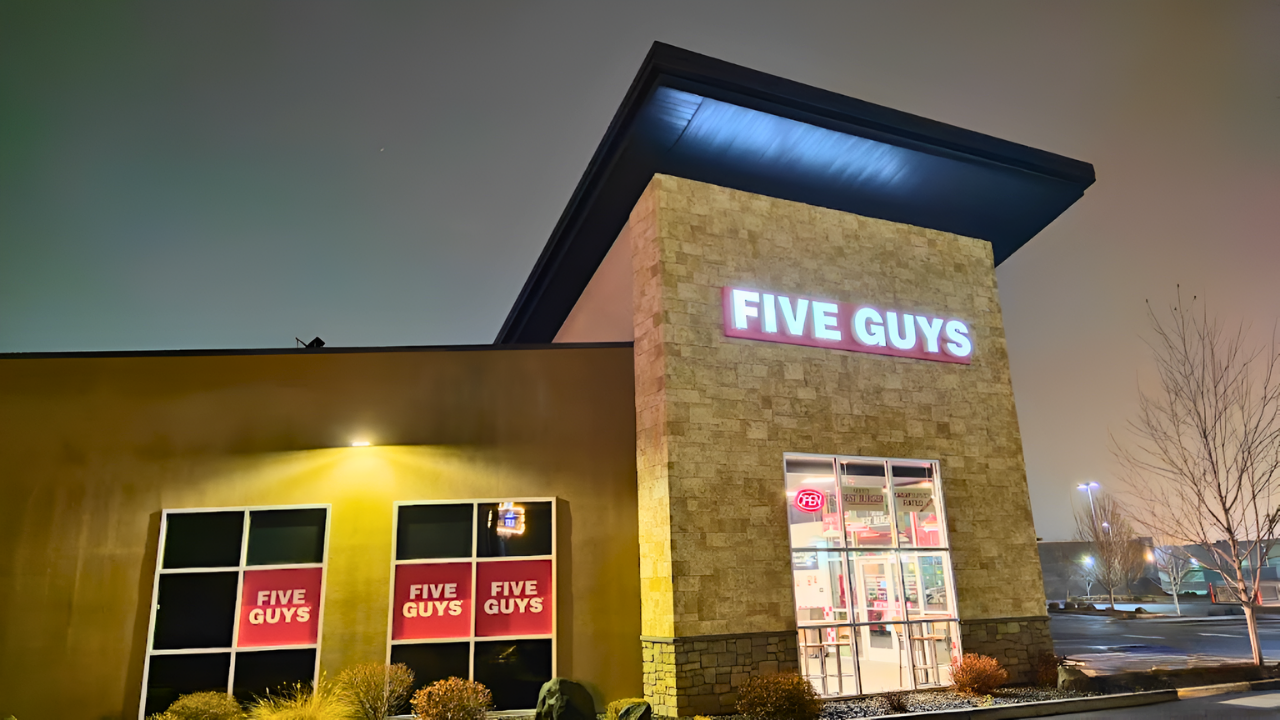
A darkened Five Guys in Folsom, California, tells a story playing out across America’s restaurant landscape. Lights off, chairs stacked, and a closure notice taped to the glass—the location that had operated for eight years suddenly shuttered, leaving 16 workers without jobs. This wasn’t an isolated incident. Five Guys locations closed across multiple states within six months, part of a larger contraction hitting premium burger chains nationwide.
The Perfect Storm of Rising Costs
Franchisees operating Five Guys and similar fast-casual concepts face a convergence of pressures that traditional quick-service competitors have managed better. Food-away-from-home inflation reached 3.9% in August 2025, significantly outpacing grocery inflation at 2.7%. This gap matters enormously when a Five Guys meal averages $15–$20 per person while McDonald’s delivers full meals under $8.
The economics have shifted decisively. U.S. cattle inventory sits at its smallest level since 1951, driving beef costs upward. Five Guys’ commitment to fresh-never-frozen beef amplified this exposure compared to competitors using frozen patties or blended proteins. Simultaneously, minimum wage increases in over 20 states pushed base pay toward $15–$17 hourly in 2025. Premium custom-prepared meals require higher staffing ratios than quick-service chains, leaving operators unable to automate or streamline cheaply.
Consumer Behavior Abandons Premium Pricing
Diners once accepted the price premium for fresh beef and customizable toppings. That calculus has reversed. When groceries cost less than dining out, the middle market collapses. Restaurant inflation at 3.9% versus grocery inflation at 2.7% has widened the value perception gap dramatically. As households tighten budgets, fast-casual transitions from a default dining choice to a luxury.
The franchise model, designed to distribute risk, instead concentrates pressure at the store level. Franchisees carry royalties near 6% of gross sales plus initial build-out costs exceeding $300,000–$640,000. When labor, utilities, and ingredients spike, franchisors still collect royalties even if stores break even or lose money. Montana Burgers Inc., operating nine stores across Montana, Idaho, and Washington, couldn’t sustain its Yakima location after eight years despite a broader operational footprint.
A Sector-Wide Contraction Emerges
Five Guys’ closures are merely the opening chapter. Wendy’s plans to close approximately 300 stores by year-end—the largest contraction in its modern history—threatening 4,500–7,500 jobs. CKE Restaurants is cutting aggressively: a 36-year Carl’s Jr in Redding, California, shut down; Loveland, Colorado, lost its 40-year location; and six Hardee’s units vanished across Minnesota. These shutdowns mirror Five Guys’ strain, signaling a market consolidating under inflation, labor pressure, and consumer downgrading rather than expanding.
The job losses mount quickly. Five Guys’ five closures alone represent an estimated 75–125 jobs lost, assuming 15–25 employees per location. Wendy’s planned closures could eliminate 3,000 to 5,250 additional positions. When combined with non-retail layoffs from other food-service operators, thousands of workers are being displaced as consumer spending patterns shift faster than operators can adjust.
Ripple Effects Extend Beyond Storefronts
Each closure leaves behind a space built specifically for restaurant service—hood vents, grease traps, walk-ins—not easily repurposed. California alone accounts for three of the Five Guys shutdowns, oversaturating the commercial real estate market with turnkey restaurant vacancies. Landlords now face longer empty periods, lower lease rates, and growing tenant improvement demands.
Food distributors, packaging firms, and uniform suppliers lose business immediately. Five Guys’ closures alone represent $7.5–$12.5 million in lost annual sales, translating into $2.6–$4.4 million stripped from supplier revenue streams. Scaling up to Wendy’s 300 closures means hundreds of millions removed from the ecosystem. Distributors respond by tightening credit terms, which pressures already-struggling restaurants into default faster—a feedback loop where closures reduce supplier volume and supplier strain accelerates further closures.
The Permanent Shift in American Dining
Restaurant dining is no longer seen as an accessible indulgence—it’s becoming an occasional treat. With better home appliances, meal kits, and social-driven cooking trends, Americans can replicate restaurant-quality meals cheaply. Fast-casual sits in a shrinking middle: too expensive for everyday spending, not premium enough for luxury dining. Once consumer behavior shifts this fundamentally, it rarely reverses.
The Five Guys collapse represents more than burger sales. It signals a sectorwide reset of cost structure, pricing power, real estate viability, and consumer demand. Wendy’s hundreds of shutdowns, Hardee’s and Carl’s Jr retrenchment, supplier contraction, and franchise-model strain form a single narrative about the future of eating in America—and who survives the next twelve months.
Sources:
USDA Economic Research Service Food Price Outlook (September 2025); USDA ERS Livestock, Dairy, and Poultry Outlook (August 2025)
Bureau of Labor Statistics Consumer Price Index News Release (August 2025); BLS CPI Summary Report (September 2025)
The Wendy’s Company Q3 2025 Investor Earnings Call Transcript; Wendy’s Investor Relations Quarterly Results
Yahoo Finance/TheStreet “Popular Burger Chain Abruptly Shuts Down Locations” (November 26, 2025); National Five Guys Closure Reporting Archive