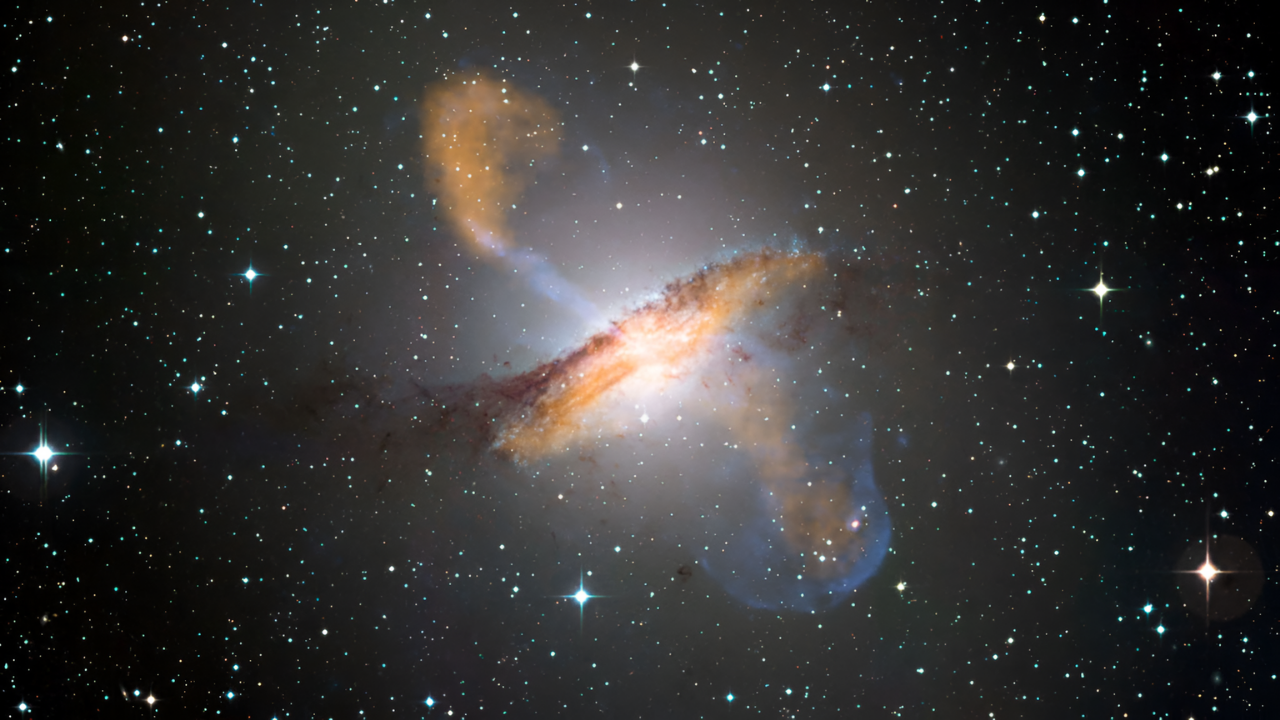
Astronomers have identified one of the largest rotating structures ever observed, a colossal cosmic filament stretching 50 million light-years and spinning at an astonishing pace. Packed with nearly 300 galaxies, along with gas and dark matter, the structure lies 140 million light-years from Earth and dwarfs the Milky Way by a factor of 500.
Its sheer scale and motion challenge long-held assumptions about how galaxies evolve within the cosmic web. The discovery suggests that vast structures may shape galaxy rotation more deeply than previously believed. Here’s what’s happening as scientists look into this deeper.
A Cosmic Giant Comes Into View
The newly identified filament is not just massive in size but extraordinary in behavior. Spanning 50 million light-years in length and measuring about 117,000 light-years across, it forms a colossal thread within the cosmic web. Nearly 300 galaxies are embedded within it, along with vast quantities of gas and dark matter. Located roughly 140 million light-years from Earth, the structure is about 500 times larger than the Milky Way.
What sets it apart is its coherent rotation, with the entire filament spinning as a single structure. This challenges existing cosmological models, which have typically assumed that such enormous filaments remain largely static. Instead, the finding points to dynamic motion on scales rarely observed before.
How MeerKAT Revealed the Motion

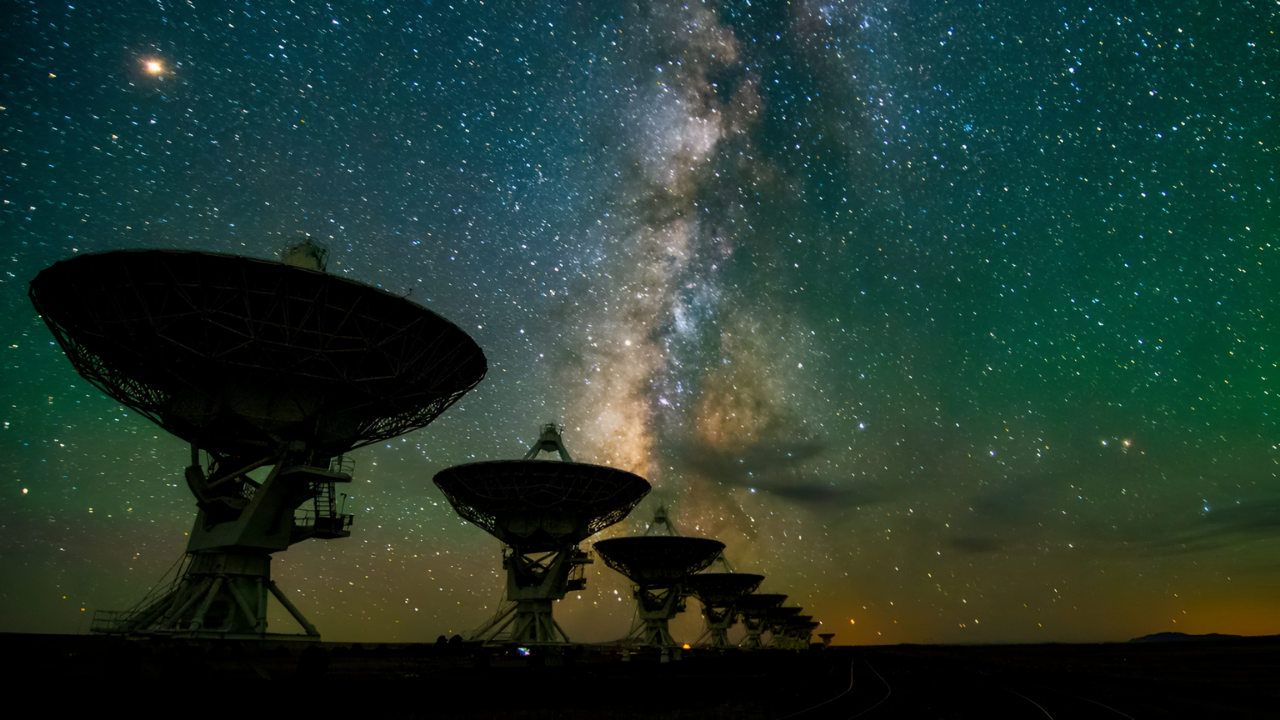
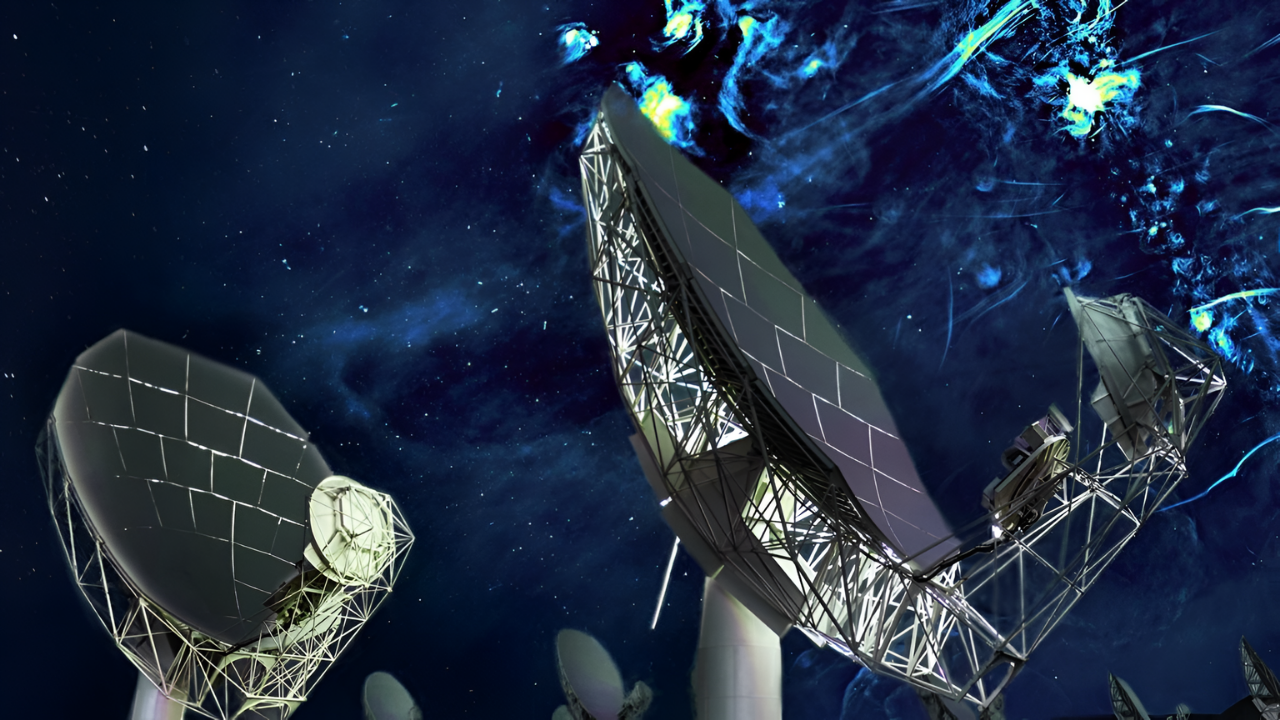
The filament’s rotation was uncovered using South Africa’s MeerKAT radio telescope, an array of 64 interconnected satellite dishes designed to detect faint radio signals from deep space. By observing hydrogen gas clouds threaded through the filament, astronomers detected a clear pattern of motion.
Galaxies at opposite ends of the structure were moving in opposite directions, a signature that confirms large-scale rotation rather than random movement. Traditional optical telescopes could not have revealed this behavior. MeerKAT’s sensitivity to radio emissions allowed scientists to map the gas in detail and trace its motion across millions of light-years. This marks a major advance in radio astronomy and opens a new window into the hidden dynamics of the universe.
Immense Scale, Measured Speed
Beyond its size, the filament’s speed adds to its significance. The structure rotates at about 110 kilometers per second, equivalent to roughly 246,000 miles per hour. At that rate, a full rotation takes billions of years to complete. Light itself requires 50 million years to travel from one end of the filament to the other, underscoring the immense distances involved.
These precise measurements help scientists understand how mass is distributed throughout the structure and how gravity operates on such enormous scales. By analyzing the filament’s motion, researchers gain insight into the forces shaping the large-scale universe and the role rotation may play in cosmic evolution.
Rethinking Where Galaxy Spin Begins
One of the most important implications of the discovery involves the origin of galaxy spin. Astronomers have long debated how galaxies acquire their angular momentum. This rotating filament offers a compelling clue. As galaxies form within the filament, they appear to inherit rotational energy from the larger structure.
The process resembles teacups spinning on a rotating platform, where each cup spins on its own axis while also moving with the platform beneath it. This dynamic suggests that galaxies do not evolve in isolation. Instead, their motion and structure may be strongly influenced by the vast cosmic frameworks in which they are embedded.
The filament also highlights the universe’s underlying scaffolding, formed by both ordinary matter and dark matter. Ordinary matter, including stars, gas, and galaxies, accounts for about 5% of the universe. Dark matter makes up roughly 27%, while dark energy comprises about 68%. Although dark matter cannot be seen directly, its gravitational pull shapes visible matter into filaments like this one.
Observing the filament’s rotation allows scientists to infer how dark matter is distributed and how it interacts with ordinary matter. In doing so, the discovery offers a rare glimpse into the invisible architecture that governs the universe on its largest scales.
What This Discovery Means Going Forward
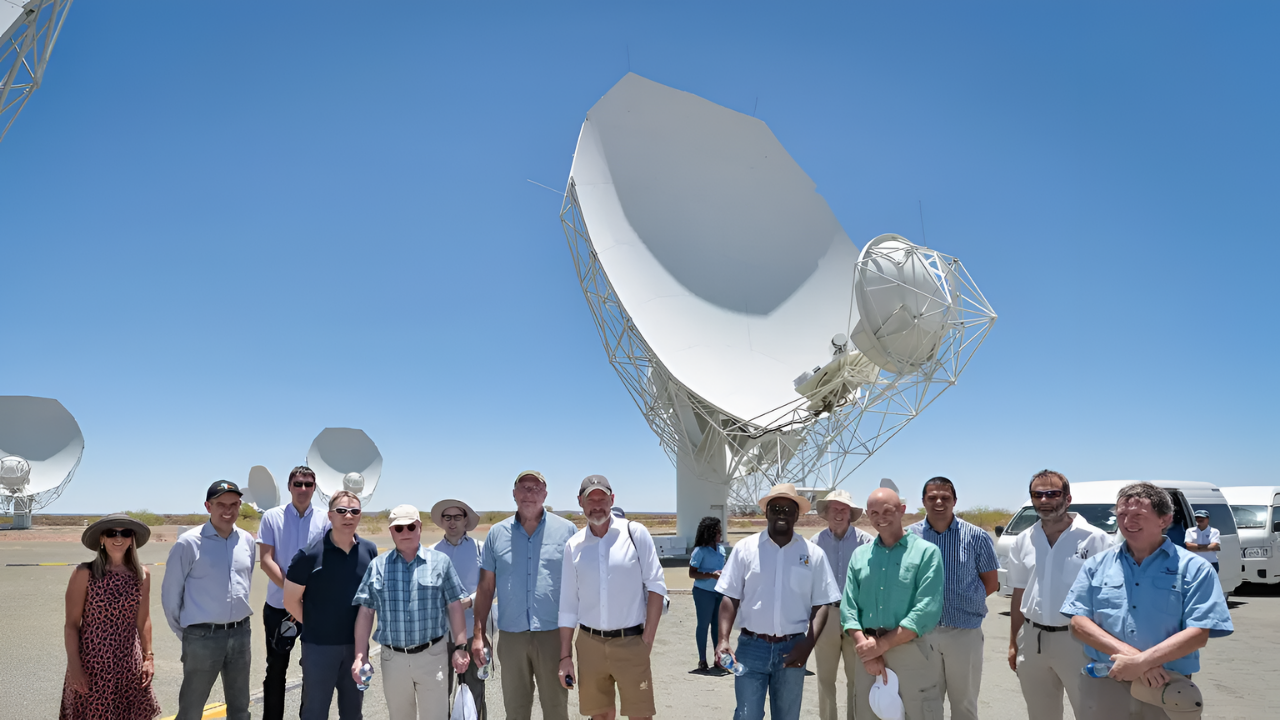
The research was co-led by Dr. Madalina Tudorache of the University of Cambridge Institute of Astronomy and the University of Oxford, alongside Dr. Lyla Jung of the University of Oxford Department of Physics. Published in December 2025 in the Monthly Notices of the Royal Astronomical Society, the study involved international teams from institutions across the United Kingdom and South Africa.
The findings are already reshaping discussions about cosmic evolution. Future studies will explore how filaments interact, how dark matter behaves within them, and how upcoming instruments can expand these observations. The Square Kilometre Array, under construction in South Africa and Australia and scheduled for science operations in 2032, promises even deeper insight with sensitivity far beyond current radio telescopes.
Sources:
University of Cambridge Press Release – Astronomers spot one of the largest spinning structures ever found in the universe – December 3, 2025
Monthly Notices of the Royal Astronomical Society – A 15 Mpc rotating galaxy filament at redshift z = 0.032 – December 2025
Reuters – Huge rotating structure of galaxies and dark matter is detected – December 8, 2025
Space.com – A 50 Million Light Year Structure Caught Spinning – December 4, 2025
University of Oxford Department of Physics – Research Communications and Dr. Lyla Jung Statements – December 2025
South African Radio Astronomy Observatory – MeerKAT Specifications and Capabilities – 2025