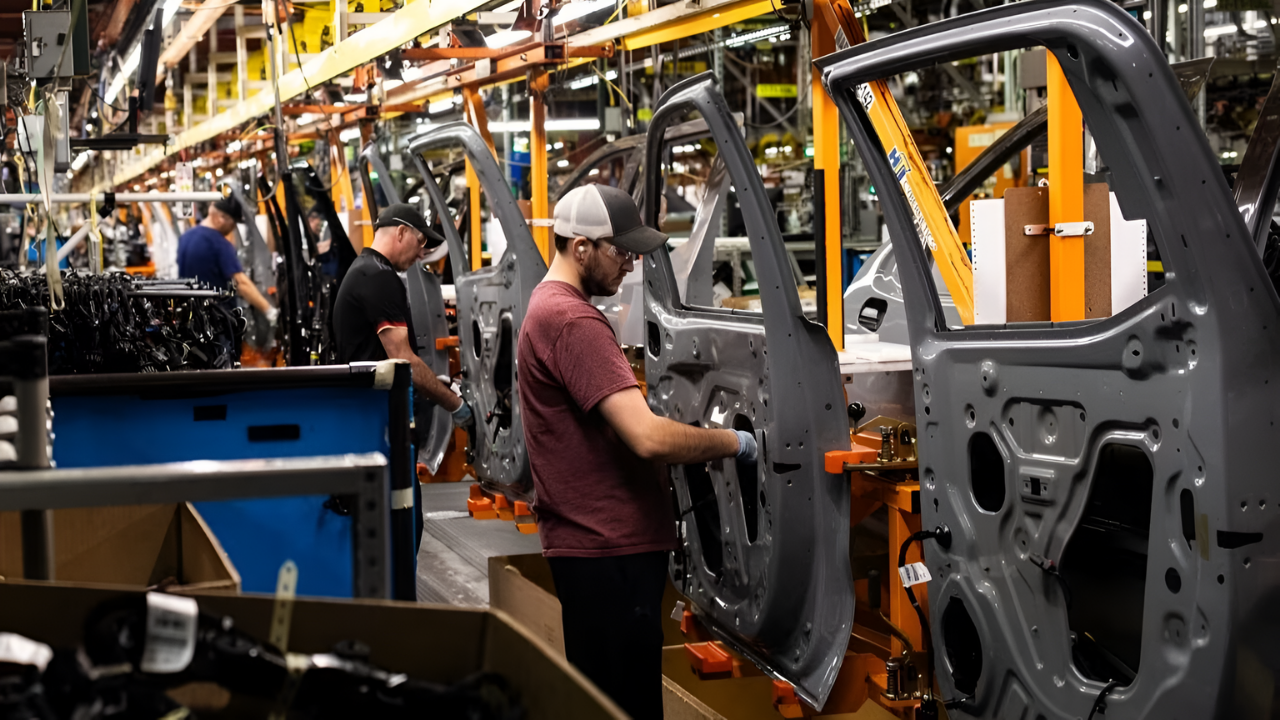
U.S. factories are sliding further into a slump as an expansive tariff regime reshapes supply chains, investment decisions, and consumer prices. By November 2025, manufacturing activity had contracted for nine consecutive months, with the Purchasing Managers’ Index at 48.2, below the 50 mark that separates growth from decline. Manufacturing still accounts for just over a tenth of the U.S. economy and employs nearly 13 million people, but the sector’s downturn is now broad, persistent, and closely tied to trade policy changes introduced since early 2025.
Tariffs and the Auto Shock

The manufacturing slide intensified after 25% tariffs were placed on more than $460 billion in vehicle and auto-parts imports, as well as new duties on heavy trucks. These measures came on top of a wider spring 2025 tariff package that imposed 20% duties on all Chinese imports and 25% tariffs on steel, aluminum, vehicles, and non-USMCA goods from Canada and Mexico.
The resulting jump in the average effective tariff rate has been steep compared with pre-2025 levels. Manufacturers report that tariffs are no longer a temporary disruption but a structural feature of the business environment. Companies are revamping sourcing strategies, revising pricing models, and delaying or redirecting long-term investments as they try to navigate higher and less predictable trade costs.
Auto manufacturing sits at the center of this shock. North American vehicle production relies heavily on cross-border parts flows, particularly between the United States, Mexico, and Canada. As these tightly integrated supply chains are taxed at multiple points, higher costs cascade through assembly lines and into final sticker prices. Consumers are seeing vehicles and replacement parts become more expensive, while automakers face thinner margins and more complicated logistics.
Jobs, Offshoring, and Global Retaliation

Inside U.S. factories, employment conditions have steadily worsened. Manufacturing payrolls have shrunk for ten straight months, and most firms now say they are holding headcounts flat or cutting staff rather than expanding. Transportation equipment producers have led the pullback, with workforce reductions and weaker financial guidance. In supplier hubs across the Midwest and Southeast, hiring freezes are expected to continue through 2026, indicating that companies see the tariff shock as long-lasting.
Instead of absorbing higher costs at home, many manufacturers are expanding production abroad. Plants that might once have supplied U.S. customers are being built or enlarged in Mexico, Vietnam, and other lower-tariff locations. This shift represents a break from decades of deepening North American integration and runs counter to the original goal of revitalizing domestic output.
Trading partners are also adjusting. Canada and Mexico now face higher effective tariffs on certain non-USMCA goods, while European imports confront broad-based duties. In response, governments and firms abroad are redirecting their own sourcing away from the U.S. market and investing in new capacity in Asia and Europe. Global automakers are strengthening non-U.S. operations, further limiting export opportunities for U.S.-based manufacturers.
Communities Under Strain and Legal Uncertainty

The impact is most visible in regions that depend heavily on factory work. Communities in Michigan, Ohio, Indiana, the industrial Midwest, and parts of the Pacific Northwest are confronting job losses or wage stagnation in fabricated metals, machinery, and transportation equipment. Surveys show that the anticipated post-tariff surge in domestic manufacturing has not materialized. Instead, uncertain demand and volatile input costs are overshadowing any protective benefit, leaving workers more concerned about shrinking order books than about foreign competition.
At the national level, the legal foundation of the tariff strategy is coming under scrutiny. In November 2025, Supreme Court justices questioned whether existing emergency economic statutes grant the executive branch such wide latitude to impose broad tariffs without fresh congressional approval. As inflation pressures build and political divisions deepen, this judicial review has added another layer of uncertainty for businesses trying to plan investments and hiring.
Costs, Inflation, and Shifting Business Strategies

Across the industrial landscape, input costs remain elevated. The prices-paid index for manufacturers is firmly in inflationary territory, with fabricated metals bearing some of the heaviest tariff burdens. Apparel, leather, machinery, construction, and utilities are also significantly exposed. Nearly a quarter of firms in highly affected industries now expect to scale back hiring as rising materials costs squeeze profit margins and deter expansion.
Retailers initially tried to get ahead of the tariffs by stockpiling goods, leading to a temporary surge in inventories. As those lower-cost items are sold off, replacement stock arrives at higher prices just as consumer demand softens. Companies are experimenting with new pricing strategies, accepting thinner margins on some lines and passing increases through on others. Short-term discounts on pre-tariff inventory mask underlying inflation, but as those supplies are depleted, shoppers are likely to confront more durable price rises.
The ripple effects stretch well beyond manufacturing and retail. Restaurants and food service businesses are grappling with higher costs for imported kitchen equipment, packaging, and ingredients. Tariffs on non-USMCA goods from Mexico, a key supplier of fresh produce and seafood, are particularly disruptive. Operators must choose between higher menu prices and further margin compression, on top of existing labor and energy pressures.
Secondary sectors such as leather, textiles, and machinery are also under strain. Heavy duties on imported inputs raise costs for apparel producers, machine makers, and electrical equipment manufacturers. Fabricated metal products, hit especially hard, transmit higher costs into construction, automotive, and other capital-intensive industries, amplifying the tariff shock across the broader economy.
Looking Forward: Policy Choices and Structural Change
The consequences are global. As U.S. purchasing power weakens and manufacturers cut output, export-driven emerging economies face falling orders. Retaliatory tariffs abroad weigh on U.S. exports, while companies everywhere reconfigure supply chains to reduce vulnerability to abrupt policy shifts. Healthcare systems are feeling the pinch through higher prices for imported medical devices and pharmaceutical components, potentially affecting access to advanced equipment over time.
The original goal of strengthening “Made in America” production stands in tension with current outcomes. Offshoring is accelerating, and some environmental groups warn that moving production to countries with looser standards could increase worldwide emissions. Labor organizations, meanwhile, are confronting the reality that job protection promises have given way to hiring freezes and relocations.
A few areas, including parts of agriculture, chemicals, food production, and segments of the energy and electronics industries, have benefited from exemptions or domestic resource advantages. Yet these gains are not large enough to reverse the wider contraction in core manufacturing fields such as transportation equipment and metals.
Financial markets are adjusting by favoring sectors and regions less exposed to U.S. trade policy shifts. Tariff uncertainty is now a major obstacle to long-term capital planning, with investors wary of both further escalation and abrupt reversals.
As policymakers weigh next steps, the tariff framework stands at a decisive point. Keeping current duties in place points toward continued manufacturing weakness, higher consumer prices, and ongoing offshoring through at least 2026. Rolling back tariffs could ease some pressures but would not quickly rebuild the complex supply networks that have been disrupted. With factories shedding tens of thousands of jobs, consumers paying more for many goods, and trading partners reorienting away from the United States, the choices made in the coming years will help determine whether this shock becomes a lasting feature of the global economic landscape or the starting point for a different approach to industrial and trade policy.
Sources
Federal Reserve Bank of Richmond Economic Brief, March 2025
Institute for Supply Management Manufacturing Report, November 2025
White House Fact Sheet, April 2025
Equitable Growth analysis, 2025
CEPR analysis, April 2025
First Quarter 2025 CFO Survey
J.P. Morgan Global Research, October 2025